Kim So-Young, Vice Chairman of the Financial Services Commission, Holds Meeting to Review Financial Market Issues and Communication
The financial authorities addressed concerns regarding the so-called 'April crisis theory,' which suggested that a concentration of maturities in real estate project financing (PF) loans could trigger a crisis, stating, "The concentration of PF loan maturities is not factual, and since loan maturities are evenly distributed, the possibility of a sudden shock is low."
On the 18th, Kim So-young, Vice Chairman of the Financial Services Commission, held a financial market issue review and communication meeting with the government, related agencies, and market experts at the Korea Institute of Finance in Jung-gu, Seoul. She stated, "As difficulties in PF projects continue, the government will support the normalization and enhancement of project viability with a consistent policy goal of smooth landing and orderly resolution, working in unison with related ministries."
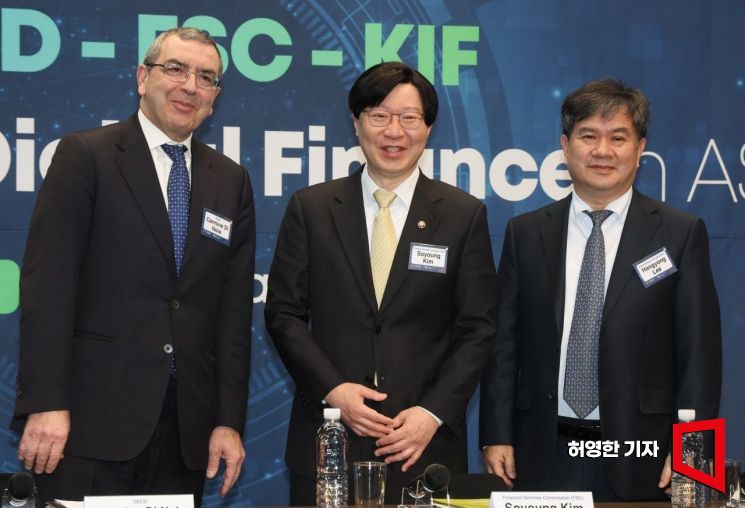 The Han-OECD Digital Finance Roundtable event was held on the 18th at the Korea Federation of Banks in Seoul. Kim So-young, Vice Chairman of the Financial Services Commission (center), Carmine Di Noia, Director of the OECD Directorate for Financial and Enterprise Affairs (left), and Lee Hang-yong, President of the Korea Institute of Finance, are posing for a photo. Photo by Heo Young-han younghan@
At the meeting, participants diagnosed that the recent increase in delinquency rates is a phenomenon accompanying the gradual end of emergency measures introduced in response to the COVID-19 crisis, along with interest rate hikes, asset price adjustments, and a slowdown in loan growth as the economy returns to a normal trajectory.
Although delinquency rates are on the rise, they remain within a manageable range compared to historical averages. Given that the financial sector has secured sufficient loss absorption capacity, the recent increase in delinquency rates is unlikely to directly impact the soundness of financial institutions or the stability of the financial system.
Vice Chairman Kim said, "Future delinquency rate trends will be determined by the timing of monetary policy shifts, the level of macroeconomic recovery including the real estate market, and efforts by the financial sector to resolve non-performing loans." She added, "The government will strive to ensure stable management of delinquency rates by promoting real estate market stabilization and working with the financial sector to activate debt restructuring and non-performing loan resolution."
The meeting also reviewed the 2023 business performance and soundness status of the small and medium-sized financial sector and discussed future response directions. Participants noted that small and medium-sized financial institutions have consistently generated substantial profits over the past few years. Although 2023 business performance is expected to be somewhat weaker compared to previous years, this is mainly attributed to increased provisions to enhance loss absorption capacity.
Regarding delinquency rates, similar to other financial sectors, there is an overall upward trend; however, it is expected to remain manageable through active efforts by the government and industry. Real estate PF loans are anticipated to be orderly normalized through various methods such as project-specific 'PF lender consortium agreements,' Korea Asset Management Corporation's (KAMCO) 'Real Estate PF Project Normalization Support Fund,' sector-specific PF funds, and sales via auctions and public sales.
Key indicators of loss absorption capacity in the small and medium-sized financial sector, such as capital ratios and liquidity reflecting deposit payment ability, were generally assessed as sound. Capital ratios are expected to slightly improve or maintain current levels compared to the previous year due to prolonged profitability. Even in the savings bank sector, which has recently experienced poor performance, all individual savings banks maintain capital ratios exceeding regulatory requirements by about 3 percentage points (p).
Liquidity trends in savings banks and mutual finance sectors are stable, and direct liquidity support through loans and repurchase agreement (RP) transactions by the Bank of Korea is also available to these institutions, indicating sufficient liquidity safety nets.
Vice Chairman Kim stated, "If the government and industry work together, the risks going forward can be adequately managed under the future smooth landing policy for real estate PF." She urged the industry to "strengthen soundness management through enhanced loss absorption capacity, active asset sales, and debt restructuring."
Additionally, regarding the 2023 financial statements disclosure by individual financial institutions scheduled for the end of this month, she requested, "The Financial Supervisory Service and the industry should strengthen efforts to provide accurate and sufficient explanations to the market to prevent unnecessary anxiety."
© The Asia Business Daily(www.asiae.co.kr). All rights reserved.

















