As the Bank of Japan (BOJ), Japan's central bank, is expected to end its negative interest rate policy soon, there is an analysis that the rise in Japan's benchmark interest rate could slow down the stock market's upward momentum. This is because a stronger yen could weaken the earnings of Japanese export companies. However, if the BOJ does not accelerate the pace of tightening, there is also a possibility that the Japanese stock market may not experience a significant correction as expected.
On the 18th, Goldman Sachs stated in an investment memo, "Since Japanese companies are implementing significant wage increases, the BOJ will no longer need additional data to decide on monetary policy," and added, "It is expected to raise interest rates at the Monetary Policy Meeting on the 19th, marking the first rate hike in 17 years since 2007." Since 2016, the BOJ has maintained an ultra-loose negative interest rate policy with short-term rates fixed at -0.1%.
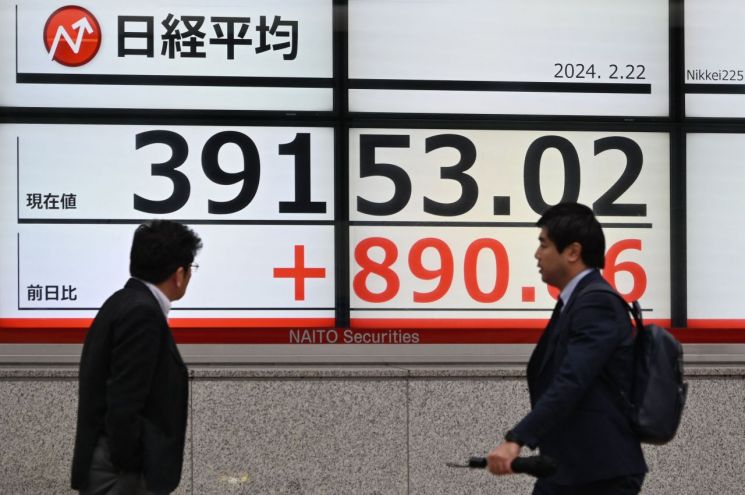
This year, Japan's representative stock index, the Nikkei 225, rose 19%, attracting strong global investor interest to the extent that it surpassed the highest level set during the bubble economy 34 years ago. However, with the end of the BOJ's ultra-loose monetary policy and the yen strengthening, there are expectations that the Japanese stock market could face a correction. The France-based asset management firm Amundi forecasted that the yen-dollar exchange rate, which is around 150 yen, could fall to 135 yen this year.
Rayder Murillo, Executive Director at Wolfpack Wealth Management, said, "A stronger yen could negatively impact the earnings of growth companies," because the prices of goods sold overseas by Japanese companies become more expensive.
He advised, "Investors should invest in stocks of companies that can benefit from a stronger yen," typically those that mainly import or focus on the domestic market.
However, there is also a counterargument that the yen-dollar exchange rate may not undergo significant adjustment since the expected rate hike in Japan is likely to be small. Morgan Stanley has predicted that Japan's short-term policy rate will remain around 0.25% until July. Given the still large interest rate gap with major countries like the U.S., the impact of exchange rates on the Japanese stock market is expected to be limited.
Ayako Sera, an analyst at Sumitomo Mitsui Trust Bank, pointed out, "There will be market shocks, but this does not mean entering a downward trend," adding, "If the yen-dollar exchange rate falls to 120 yen, it would affect stock prices, but that is unlikely to happen."
According to a Bloomberg survey conducted from the 11th to the 15th among 273 readers regarding the impact of Japanese interest rates, 45% of respondents answered that Japanese stocks are structurally undervalued.
If there are concerns about fluctuations in the yen-dollar exchange rate, there are also exchange-traded funds (ETFs) that can hedge against this risk. Examples include the "WisdomTree Japan Hedged Equity Fund (ticker: DXJ)" listed on the New York Stock Exchange and the "iShares MSCI Japan Euro Hedged UCITS ETF (IJPE)" listed on the London Stock Exchange.
© The Asia Business Daily(www.asiae.co.kr). All rights reserved.

















