Russia has once again chosen President Vladimir Putin. With his fifth term confirmed in this year's presidential election, President Putin has extended his regime until 2030, ascending as the 'Tsar of the 21st century.' This is effectively a path to lifelong rule.
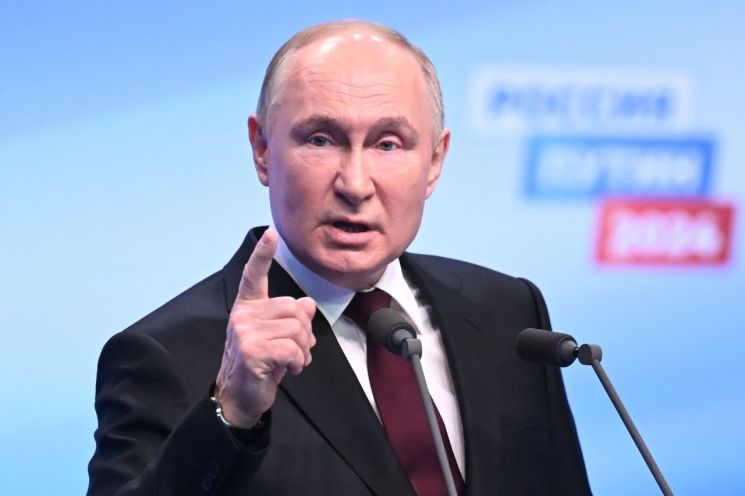
On the 17th (local time), exit polls from the Russian presidential election showed President Putin receiving 87% of the vote. The Russian Central Election Commission also announced that with 60% of the votes counted, President Putin's vote share was in the 87% range. This is the highest vote share in history.
Despite the prolonged war, large-scale economic sanctions from the West, and criticism of authoritarianism, the primary reason Russian citizens chose President Putin again is cited as his 'irreplaceable leadership.' According to a survey by the Russian private polling agency Levada Center, President Putin's approval rating remained above 80% throughout last year, a figure much higher than before the Ukraine war.
After the Ukraine war, the West, including the United States and Europe, attempted to shake President Putin's ruling foundation through large-scale economic sanctions, but the scenario the West expected did not materialize. The New York Times (NYT) reported, "Many Russian voters say they have enough reasons to support President Putin," adding that they believe he led Russia, which had fallen into hardship after the collapse of communism in the 1990s, into a period of economic prosperity. Irina told the NYT, "I am proud of my country and my president," and said, "He has elevated us globally."
The Soviet Union collapsed in 1991, unable to resolve economic difficulties despite Mikhail Gorbachev's reform and openness policies. Boris Yeltsin, Russia's first president, is evaluated as having diminished Russia's stature through declarations like the moratorium (payment deferral). In contrast, many Russians believe that President Putin, first elected in 2000, achieved relative economic prosperity by promoting a 'strong Russia.' This reflects the judgment that President Putin's achievements in economic stability outweigh his faults.
On this day, Russians interviewed by major foreign media including the NYT in front of polling stations appeared to ignore the impact of the Ukraine invasion and the resulting Western sanctions. Pyotr expressed support for Russia's special military operation in Ukraine and showed pride that President Putin would surpass Western enemies and endure for a long time. CNN cited the Levada Center, reporting that nearly half of Russians strongly support the Ukraine war.
In particular, the prolonged Ukraine war and the resulting Western sanctions are also evaluated as providing a patriotic justification that unites Russians around President Putin.
Despite Western sanctions, the Russian economy is holding up better than expected. Since the battlefield is on Ukrainian territory and the void left by Western companies' withdrawal is filled by parallel imports and domestic brands, it is difficult for Russians to strongly feel the wartime situation in their daily lives. The International Monetary Fund (IMF) raised Russia's 2024 GDP growth forecast from 1.1% in October last year to 2.6% in January.
Irina said about Western sanctions, "I don't care. I am proud that our industry is growing," adding, "Although I can't travel to every country, I can go to Dubai, the Maldives, Turkey, and that is enough." Pyotr also said, "I own an apartment and eat very well," adding, "Although my salary is low, I dress well. This is all because of President Putin."
Meanwhile, many Russians feel a restoration of great power status as they watch Russia stand against the entire West. Chernolobov, a doctoral student, said, "Our hearts are united in fighting against the atrocities of NATO (North Atlantic Treaty Organization)," and said he voted for President Putin to oppose American hegemony.
There is also no suitable leader within Russia to rally anti-government sentiment. 'Political rival' Alexei Navalny suddenly died last month while imprisoned. Most other anti-government figures facing life threats are in exile abroad. The Wall Street Journal (WSJ) reported, "The Putin regime controls public opinion and excludes opponents," adding, "In a situation where criticizing the special military operation results in punishment, Russian citizens are gradually becoming numb and indifferent to the reality of wartime."
However, obstacles remain for President Putin, who succeeded in his fifth term, to maintain high approval ratings until the next election. The longer the Ukraine war and large-scale Western sanctions continue, the more fatigue Russians are likely to feel. Inflation concerns are confirmed as the benchmark interest rate in Russia has risen to 16%. Analysts interpret President Putin's announcements of minimum wage increases and tax reforms ahead of this election as efforts to appease the public.
The growing voices criticizing the government following the death of political rival Navalny also represent a variable. On the final day of the election, at noon, so-called 'Navalny protests' took place in Russia and around the world. These protests express opposition to President Putin, centered on supporters of Navalny who died in prison. Yulia Navalnaya, Navalny's wife who participated in the protests, revealed that she wrote her husband's name on the ballot.
© The Asia Business Daily(www.asiae.co.kr). All rights reserved.

















