40km Southwest of the Capital on the Reykjanes Peninsula
"This Eruption Is the Strongest Among Recent Eruptions"
A volcano erupted again in the southwest of Iceland after about a month.
On the 16th (local time), foreign media including the US CNN reported that a volcano erupted around 8 p.m. in the Reykjanes Peninsula in the southwest, about 40 km from Reykjavik, the capital of Iceland.
The local meteorological agency stated that the eruption began between Hagafell and St?ra-Sk?gfell, north of Grindav?k in the southwest. The agency explained, "The length of the fissure is about 3 km," and "lava is flowing from St?ra-Sk?gfell towards Hagafell."
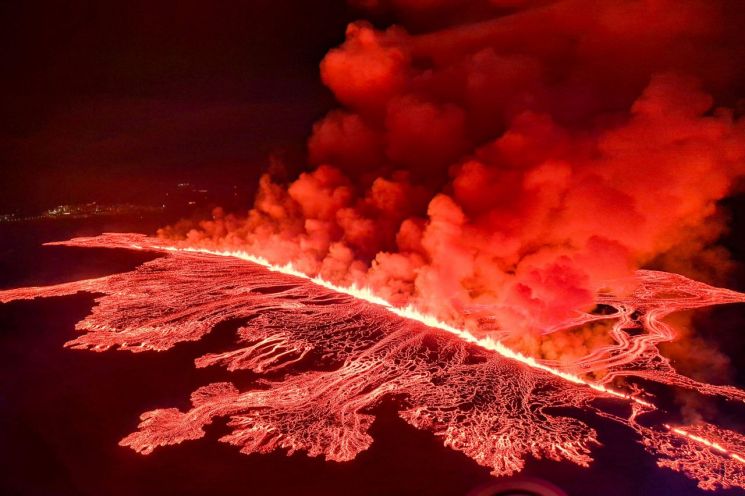
British BBC reported that the lava split into two streams flowing south and west respectively, and the lava flowing south reached the eastern boundary of Grindav?k.
The lava moving west covered the road leading to the Svartsengi geothermal power plant, which supplies hot water to the Reykjanes Peninsula. Authorities installed protective walls around the power plant, but there are concerns that fiber optic cables on the road were damaged, potentially disrupting phone and internet services.
Geophysicist Magn?s Tumi Guðmundsson said, "This eruption is the most powerful among recent ones."
Scientists also warned that volcanic eruptions in this area could continue for years. The Reykjanes Peninsula experienced a volcanic eruption on the 8th of last month as well. This is the fourth eruption in the area since December of last year.
Reykjavik International Airport, located 20 km northwest of the eruption site, is operating normally, but the famous hot spring tourist site Blue Lagoon has been closed, and tourists have reportedly been evacuated.
An evacuation order was also issued for the town of Grindav?k, home to about 4,000 residents. Iceland has 33 active volcanoes, but the Reykjanes Peninsula had no eruptions for eight centuries until March 2021. This is the seventh volcanic eruption in the southwest region of Iceland since 2021.
During the volcanic eruption on January 14, some houses in the southern fishing village of Grindav?k near S?lingarfell were burned. The 4,000 residents of Grindav?k evacuated early in November last year due to repeated signs of volcanic activity such as earthquakes and have not returned home yet.
When a volcano erupted in Iceland in 2010, a south wind spread volcanic ash across Europe, causing an unprecedented aviation crisis with about 100,000 flights canceled. Due to Iceland’s geographical location on the boundary between the North American and Eurasian plates, earthquakes and volcanic eruptions frequently occur.
© The Asia Business Daily(www.asiae.co.kr). All rights reserved.

















