Opposition "Investigation Evasion" VS Presidential Office "Prosecutor's Office Issue"
Possibility of 'Regime Judgment Theory' as a Spark Ahead of General Election
Some Ruling Party Members Express Concern "Quick Measures Needed"
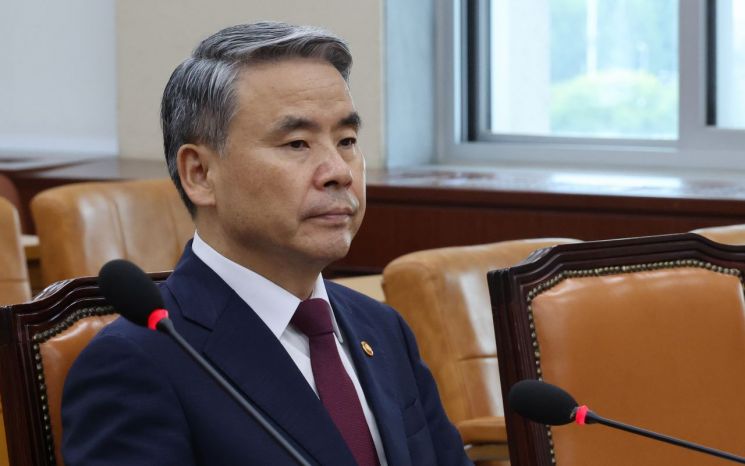
The presidential office and opposition parties are engaged in a fierce confrontation over Lee Jong-seop, the ambassador to Australia, who is suspected of external pressure in the investigation of a Marine Corps member's death. Amid intensified opposition attacks accusing the ruling party of 'hiding the suspect,' the presidential office maintains its stance against withdrawing the appointment despite some calls within the ruling party for cancellation. This situation appears to have caused a disruption in President Yoon Seok-yeol's rising approval ratings, which had been boosted by efforts such as medical reform. With less than a month remaining until the general election, the emergence of the 'Lee Jong-seop risk' has led to growing concerns not only from the opposition but also within the ruling party. In response, the presidential office posted a lengthy rebuttal on its website on the 15th and has taken an active stance. The related controversy is summarized in a Q&A format.
Why was the former minister appointed as ambassador to Australia?
▲ The presidential office states that he is the best candidate for the ambassador to Australia. Through the 'This is the Fact' section opened on its website that day, the presidential office explained, "Considering the achievements and expertise in allied relations, defense, and defense industry, we selected the most suitable candidate." Australia is the only country, aside from the United States, with which South Korea holds diplomatic and defense ministerial meetings, making it a very important security partner in the Indo-Pacific strategy. From the presidential office's perspective, considering defense, defense industry, and Korea-Australia relations comprehensively, the ambassador to Australia requires a heavyweight figure with expertise in defense rather than a typical diplomat. It is noted that during his tenure as Minister of National Defense, Lee expanded relations with Australia, secured a contract for the K9 self-propelled howitzer, and led the groundbreaking ceremony for the local production plant of the K9.
Jang Ho-jin, Director of the National Security Office, made an unusual appearance on an SBS news program the previous day, explaining, "He submitted a copy of his letter of credence to the Australian Foreign Ministry just two days after his appointment, which is unusually fast. This shows that Australia also holds a favorable view." However, the reaction in Australia differs. The Australian Broadcasting Corporation (ABC) reported with interest on the Korean ambassador's appointment, expressing concern that "a former defense minister involved in a criminal investigation has arrived in Australia to perform ambassadorial duties." Opposition parties such as the Democratic Party claim that Lee's appointment as ambassador to Australia is clearly intended to evade investigation.
Is there no problem with him being under investigation by the High-ranking Officials' Crime Investigation Unit (PCC)?
▲ According to the presidential office, Lee reportedly stated, "If the PCC calls me, I will come back tomorrow without hesitation and undergo investigation." This implies he is willing to return voluntarily even without a summons from the PCC. This statement is interpreted as an attempt to quell controversy amid concerns within the ruling party about negative public sentiment ahead of the general election.
The presidential office views the PCC's failure to conduct an investigation so far as a problem. Director Jang said, "The PCC's prolonged extension of the travel ban without conducting an investigation is a violation of basic rights and an abuse of investigative authority." The PCC received a complaint against Lee in September last year but did not summon him even once, and only imposed a travel ban three months later in December. Jang argued, "The investigation did not even start before the ambassador's appointment, so the opposition's claim that the investigation or inquiry is hindered is incomprehensible. If the opposition is sincere about the investigation, they should first criticize the PCC for not investigating for six to seven months." The controversy is expected to deepen further.
There are claims for the early return of the previous ambassador.
▲ Regarding the claims for the early return of the previous ambassador, the presidential office stated that these are not true. Former Ambassador to Australia Kim Wan-jung retired at the end of last year, having completed work related to a $2.4 billion armored vehicle export contract signed with Australia at the end of last year, and returned to Korea shortly after the appointment of his successor last weekend.
The opposition claims that Lee Jong-seop's appointment is 'hiding the suspect.'
▲ The presidential office stated that evading or fleeing from investigation is impossible. They explained that heads of overseas missions have fully public schedules and carry out their duties at a hectic pace as public officials. Since their residence is the embassy and they operate on a public stage as diplomats, claims of evasion or avoidance are groundless.
Did the presidential office not know about the travel ban during the personnel screening?
▲ Cha Gyu-geun, former head of the Immigration and Foreign Policy Bureau at the Ministry of Justice who joined the Innovation Party, recently said in a radio interview and elsewhere that "If a travel ban is imposed on an important figure, it is reported up to ministers and the Office of Civil Affairs. It is hard to believe that the personnel screening did not detect the travel ban." The opposition claims that the presidential office knew about Lee's travel ban but proceeded with his appointment as ambassador to Australia.
On the other hand, the presidential office firmly countered, saying, "If we had known about Lee's travel ban in advance, that would have been a bigger problem," and "The Immigration and Foreign Policy Bureau of the Ministry of Justice cannot disclose investigation secrets, so it cannot inform the Personnel Information Management Division about Lee's travel ban."
How far will the aftermath go?
▲ The opposition is expected to maintain its offensive. Since the 7th, the Democratic Party has issued critical statements every day without fail. Park Sung-jun, spokesperson for the Democratic Party, said, "Stop the trick of covering up the incident to blind the eyes and ears of the people and buy time." Regarding this, the presidential office firmly drew a line, stating that there is "no possibility and it is not right" to withdraw the appointment. However, as the fallout grows, there is also talk of Lee returning to Korea to complete the investigation before returning. The presidential office warned of repercussions, saying, "Many of the reports raised by some parties contain specific details that cannot be known without access to investigation secrets. If the PCC's investigation status continues to be leaked to the media, a thorough investigation must reveal the truth."
What impact will this have on the general election?
▲ It could emerge as a key issue in the general election. There are concerns it could fuel calls for regime judgment. President Yoon Seok-yeol's approval ratings, which had been rising due to issues such as expanding medical school quotas and public livelihood forums, appear to have declined amid the ambassador controversy. According to a public opinion poll released by Gallup Korea on the day (conducted from the 12th to 14th, nationwide, targeting 1,002 adults aged 18 and over, using 100% wireless telephone interviews; detailed information is available on the Central Election Poll Deliberation Commission website), President Yoon's approval rating dropped 3 percentage points from the previous week to 36%. Park Min-sik, former Minister of Patriots and Veterans Affairs and a People Power Party candidate for the Gangseo-gu E constituency in Seoul, commented the day before, "I wish this had been handled more neatly before his appointment." As concerns about negative impacts on the general election grew, Han Dong-hoon, emergency committee chairman of the People Power Party, also reflected a changed atmosphere that day, saying, "(The ambassador) should come back quickly and resolve the matter swiftly."
© The Asia Business Daily(www.asiae.co.kr). All rights reserved.

















