'Virtual Convergence Industry Promotion Act' to be Enforced in August
Private Sector-Led... Focus on 'Fostering' over Regulation
Expecting Revitalization of the Stagnant Metaverse Industry
"After 24 years since starting the business, I have finally found my company's identity."
‘InnoSimulation,’ located in Magok, Seoul, is a metaverse (extended virtual world) specialized company established in 2000. Focusing on the development of extended reality (XR) technology, it collaborates with major corporations such as Samsung Electronics and Hyundai Motor Company and is a KOSDAQ-listed company that even exports its products. CEO Jo Junhee, the founder of InnoSimulation, is considered the first generation of metaverse pioneers in Korea and is referred to as the ‘godfather’ or ‘senior’ in the industry.
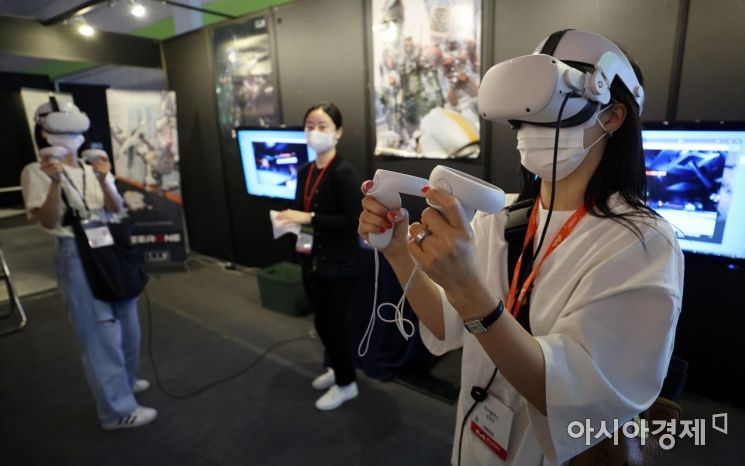
However, he was once unsure how to classify his company’s industry. This was because there was no law defining or regulating the metaverse industry. Earlier this year, the ‘Virtual Convergence Industry Promotion Act (Metaverse Act)’ passed the National Assembly, lifting a burden that had lasted over 20 years. He said, "Until now, we were confused whether to classify our company as a software development business or as other machinery and equipment manufacturing," adding, "Just being defined as a virtual convergence business gives us great strength."
On the 6th, a meeting with metaverse entrepreneurs hosted by the Ministry of Science and ICT was held at the InnoSimulation headquarters. The purpose was to explain the Metaverse Act, which is set to be enforced in August this year, and to hear the voices of the industry. The entrepreneurs who were given the opportunity to speak unanimously expressed their gratitude to the government, saying "Thank you" and "You worked hard." Why did entrepreneurs highly praise the Metaverse Act?
The Nation’s First Introduction of ‘Temporary Standards’
The Metaverse Act consists of two core pillars: ‘temporary standards’ and ‘self-regulation.’ In particular, the temporary standards are significant as they are the first system implemented in Korea. Temporary standards literally mean ‘standards prepared temporarily.’ When launching innovative services in new industries like the metaverse, legal grounds or technical standards are often unclear. In such cases, temporary standards are used to ensure consistent law enforcement.
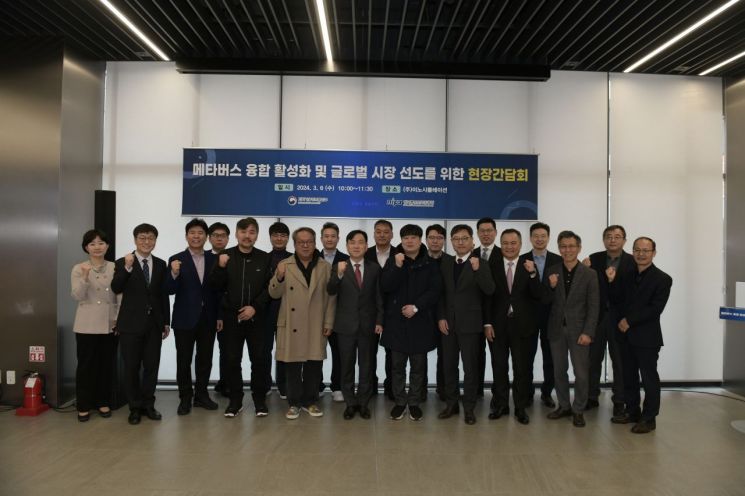 Kang Dohyun, Vice Minister of the Ministry of Science and ICT, held a meeting with metaverse companies at Innosimulation in Magok, Seoul on the 6th and is taking a commemorative photo.
 [Photo by Ministry of Science and ICT]
For example, if a metaverse platform intends to provide medical services in virtual reality and it is unclear whether it violates the Medical Device Act, temporary standards can be established. When proposals come from the industry, the Minister of Science and ICT reviews them and can request other ministry heads to prepare temporary standards, which are then implemented after deliberation and resolution by the strategy committee chaired by the Prime Minister.
Professor Hyun Daewon of Sogang University, who chairs the temporary standards subcommittee, said, "Temporary standards go beyond regulatory sandboxes and are a system being tried for the first time in Korea," adding, "We will strive to produce successful cases in the industry."
To foster the metaverse industry led by the private sector and supported by the government, self-regulation provisions were also included in the law. An association representing the domestic metaverse industry group is designated, and this association establishes and enforces codes of conduct and operational guidelines for businesses. It also conducts voluntary inspections and improvement activities regarding user protection. Lee Byungjin, Director of the Digital Content Division at the Ministry of Science and ICT, said, "For new technologies and services, it is important to build an ecosystem based on the self-purification efforts of businesses," adding, "The trend of expanding self-regulation is also spreading overseas."
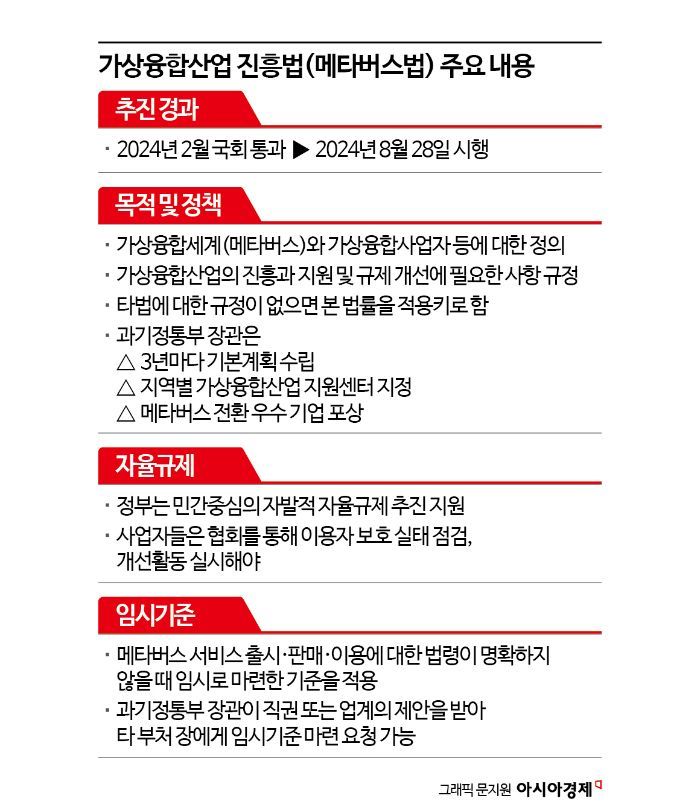
The Minister of Science and ICT establishes a basic plan every three years and designates institutions meeting certain criteria as ‘Virtual Convergence Industry Support Centers’ to enable budget support. Companies that achieve results by converting existing services into metaverse services can also receive awards. To promote the development of the metaverse industry, a clause was included stating that "except in cases where special provisions exist in other laws, this Act shall apply."
"A Signal for the Revival of the Metaverse"
The metaverse industry has recently been sluggish. Some metaverse specialized companies such as Com2Verse and ColorVerse have undergone restructuring.
However, the passage of the law is seen as a turning point. The government will join forces with the private sector to carry out follow-up work, including drafting subordinate legislation by next month. Hwang Hee, CEO of Kakao Healthcare, expressed expectations, saying, "The government spends a lot of budget on regional medical projects in chronic diseases, mental illnesses, and musculoskeletal fields, with 70% going to labor costs," adding, "Metaverse technology cannot completely replace manpower, but it can be applied efficiently and rapidly to local communities."
Recently, when Mark Zuckerberg, CEO of Meta, visited Korea and discussed metaverse industry growth plans with President Yoon Suk-yeol, voices calling for a change in atmosphere have grown louder. Choi Yonggi, Vice President of the Korea Metaverse Industry Association, emphasized, "Recently, LG Electronics has approached us to join the association. This is a signal announcing the revival of the metaverse," adding, "It is time for the government and industry to unite as one."
© The Asia Business Daily(www.asiae.co.kr). All rights reserved.
![Clutching a Stolen Dior Bag, Saying "I Hate Being Poor but Real"... The Grotesque Con of a "Human Knockoff" [Slate]](https://cwcontent.asiae.co.kr/asiaresize/183/2026021902243444107_1771435474.jpg)


















