Real Expense Support Up to 4 Million KRW per Month for New Hires
Strengthening Legal Protection for Military and Public Health Doctors
The Ministry of Health and Welfare will implement the 'Mild Patient Dispersion Support Project' starting from the 15th, investing 6.75 billion KRW from the contingency fund. The policy aims to reduce overcrowding in large hospital emergency rooms so that treatment can focus on severe emergency patients.
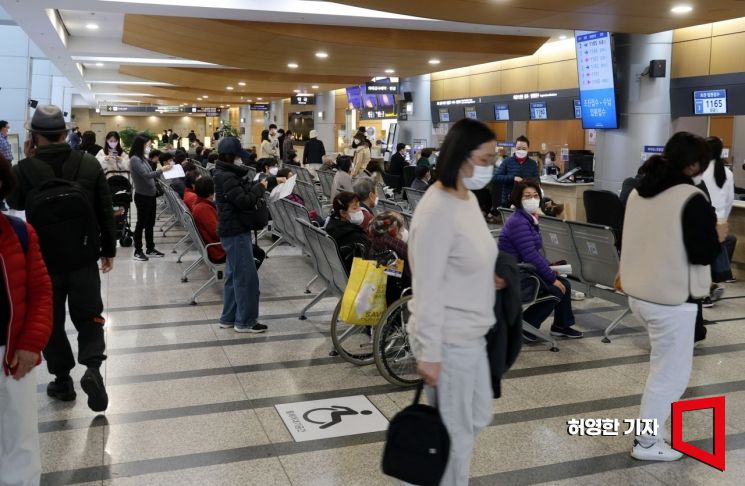 On the 15th, outpatients and their guardians are waiting in line at the reception desk of a university hospital in Seoul. Photo by Younghan Heo younghan@
Jeon Byeong-wang, Director of Health and Medical Policy at the Ministry of Health and Welfare, announced at the Central Disaster and Safety Countermeasure Headquarters briefing on the 15th, "From today, we will implement the Mild Patient Dispersion Support Project to prevent emergency room overcrowding." Director Jeon explained, "When mild and non-emergency patients are guided to nearby medical institutions from 43 regional emergency medical centers nationwide, policy support funds will be provided."
The required budget is 6.75 billion KRW from the contingency fund. For mild emergency patients transferred to primary and secondary hospitals, ambulance fees have been fully covered by the government since the 13th.
The government plans to designate 100 general hospitals as 'Medical Cooperation Hospitals' to establish cooperative systems with tertiary general hospitals, strengthening rapid patient transfer and collaborative treatment systems between tertiary general hospitals and general hospitals. It will also support the personnel costs of each hospital's medical cooperation center staff.
For new hires, actual expenses will be supported up to 4 million KRW per month, and for existing personnel, up to 2 million KRW per person per month will be provided.
When patients with scheduled admissions, surgeries, procedures, or radiation therapy at tertiary general hospitals are linked to capable medical cooperation hospitals, the referral hospital fee will be increased from 100% to 150%, and policy support funds will be provided to both tertiary general hospitals and medical cooperation hospitals.
Director Jeon stated, "A meeting was held yesterday (14th) with tertiary general hospitals and medical cooperation hospitals to implement the policy. Guidelines will be provided today, and full implementation will begin next week."
The government plans to ensure that public health doctors and military medical officers deployed to fill vacancies in 20 tertiary general hospitals closely cooperate with the dispatched hospitals and receive sufficient medical guidance and legal protection.
Director Jeon said, "Public health doctors will receive the same legal protection and support as regular staff at the dispatched medical institutions. We have requested that medical institutions with liability insurance include public health doctors as insured parties, and the government will cover the additional insurance premiums accordingly."
At the Central Disaster and Safety Countermeasure Headquarters meeting today, the 'Medical Dispute Mediation and Appraisal System Innovation Task Force (TF) Promotion Plan' was discussed. This is part of the government's 'Four Major Medical Reform Tasks,' specifically the 'Establishment of a Medical Accident Safety Net.' The government plans to launch the TF next week and announce innovation measures for the medical dispute mediation and arbitration system within the first half of this year.
Director Jeon explained, "The purpose is to prevent situations where doctors face lawsuits despite sincere treatment, allowing doctors to practice confidently and patients to receive adequate compensation." He added, "To address these issues, the government drafted the 'Medical Accident Handling Special Act,' made it public, and held a public hearing on the draft on February 29 to gather opinions."
He continued, "Along with enacting the Medical Accident Handling Special Act, the government will accelerate reforms of the medical dispute mediation and arbitration system to ensure fair and prompt resolution of medical disputes." Accordingly, the composition of the mediation and appraisal committees, which include medical professionals, legal experts, and consumers, will be reviewed to enhance fairness and objectivity, and the average mediation processing time, which exceeded 86 days last year, will be shortened.
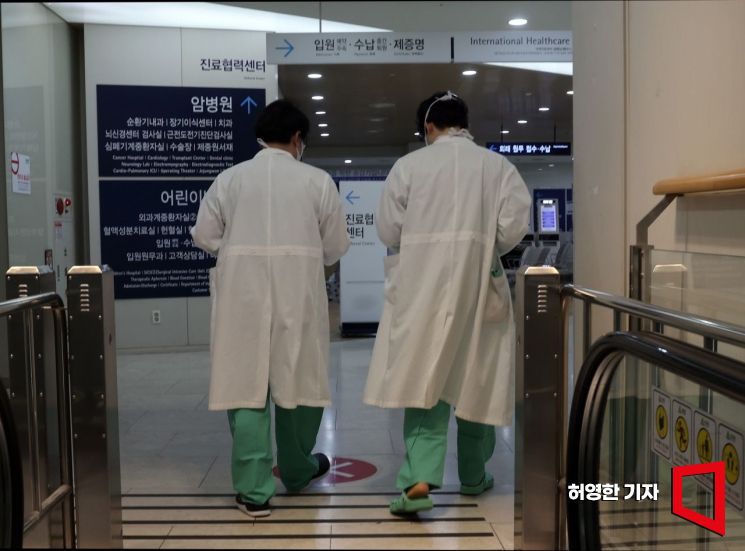 On the 15th, medical staff are entering the treatment area at a university hospital in Seoul, where the Emergency Response Committee of medical school professors from 19 universities is expected to decide on resignation. Photo by Huh Younghan younghan@
Meanwhile, the Ministry of Health and Welfare emphasized that the 'Medical Service Continuation Order' issued to residents who submitted resignation letters and left medical sites remains valid, and that resignation and concurrent employment are restricted. Currently, all residents are under the medical service continuation order, meaning even those who have already submitted resignation letters are obligated to maintain medical duties.
Director Jeon stated, "Resident training contracts are fixed-term contracts, so even under contractual relationships, resident resignations may be restricted." While the medical community believes that resignation letters take effect after one month based on Article 660 of the Civil Act, the government stressed that resignation letters cannot be accepted.
He added, "Residents cannot open medical institutions according to specialist training regulations, nor work concurrently at other medical institutions outside their training hospitals." He noted that cases of fewer than 10 residents being reported as overlapping personnel at other medical institutions have been identified.
Director Jeon further explained, "If residents in training open medical institutions or work concurrently at other hospitals, they may be disciplined by the training hospital director according to training rules. Additionally, if prescriptions or medical records are prepared under another person's name, not only will the resident be punished under the Medical Service Act, but the private practitioner who employed the resident may also be punished under criminal law."
© The Asia Business Daily(www.asiae.co.kr). All rights reserved.
![Clutching a Stolen Dior Bag, Saying "I Hate Being Poor but Real"... The Grotesque Con of a "Human Knockoff" [Slate]](https://cwcontent.asiae.co.kr/asiaresize/183/2026021902243444107_1771435474.jpg)

















