Wholesale Price (10kg) Apples 90,000 KRW, Pears in the 100,000 KRW Range
The burden on households is increasing as 'fruitflation,' where fruit prices drive up overall inflation, intensifies, but there is growing consensus that price stabilization will be difficult until the second half of this year.
On the 15th, Professor Lee Jeong-hwan of the Department of Economics and Finance at Hanyang University appeared on YTN's "News King Park Ji-hoon" and stated, "It is expected to take about a year for inflation to drop to the 2% range," adding, "For a while, inflation concerns will persist depending on energy and food prices, and especially in our country, inflationary pressure due to food prices is likely to continue for a considerable period because of the significant impact of climate change and crop yields."
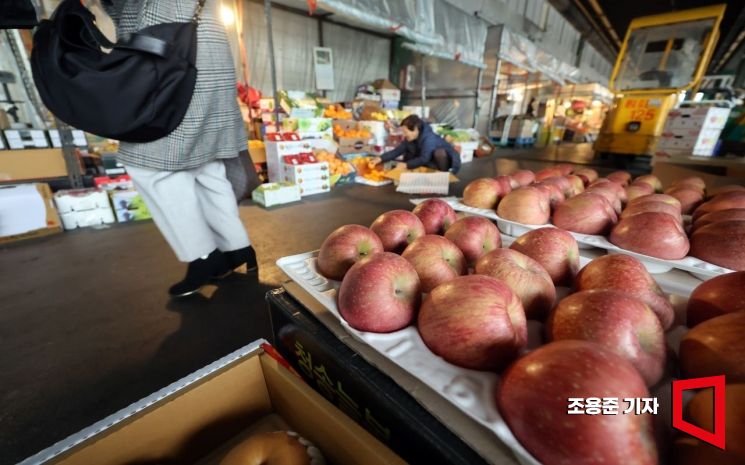 The prices of fruits, including apples, have skyrocketed, causing an emergency in food prices. Not only consumers trying to buy fruits but also small business owners running fruit shops in the produce market are sighing deeply. On the 12th, the Garak Agricultural Products Market in Songpa-gu, Seoul, showed a quiet scene. Photo by Jo Yongjun jun21@
Currently, the wholesale prices of apples and pears (per 10 kg) have risen to around 90,000 won and 100,000 won respectively and have not decreased much since. According to the Korea Agro-Fisheries & Food Trade Corporation (aT) Agricultural Product Distribution Information (KAMIS) as of the previous day, the wholesale price of 10 kg of apples (Fuji, standard grade) is 91,040 won. For pears, the wholesale price of 15 kg (Shingo, standard grade) is 101,000 won. The wholesale price of apples first surpassed 90,000 won on the 17th of last month (90,740 won) and then rose to a record high of 94,520 won on the 29th of the same month. Pear prices have also fluctuated after exceeding the 100,000 won mark for the first time in 2 years and 7 months since August 2021.
Professor Lee pointed to climate change as the main cause of the recent sharp rise in fruit prices. He said, "Agricultural products are sensitive to seasonal factors and crop yields," adding, "Ultimately, climate is important, but since we cannot control the climate, the burden on consumers continues." He further explained, "In the past, apples were mainly grown in Yeongju and Sangju, but now the production areas have moved up to Gangwon-do," and "This means that apples no longer grow well in the traditional orchards, and as existing farmers age and retire, closing their orchards, production volume is showing large fluctuations."
Regarding dining-out prices, he noted, "The burden from labor costs and rent is greater than raw material prices," explaining, "Labor costs are increasing, and rent is fixed, so the structure inevitably leads to higher dining-out prices."
The government is making every effort to 'control inflation.' The Ministry of Agriculture, Food and Rural Affairs has expanded the support for delivery prices of fruits and vegetables from 20.4 billion won to 28.9 billion won. Among 13 items, the delivery price support for apples, green onions, and napa cabbage, whose prices have risen significantly, has been increased by 1.5 to 2 times. Additionally, 23 billion won will be provided to support consumer discount events this month and next month.
In this regard, Professor Lee assessed, "It is difficult to stop inflation," but added, "This is a policy to prevent further price increases. Without such policies, prices could rise faster, so discount policies are being actively implemented."
© The Asia Business Daily(www.asiae.co.kr). All rights reserved.