Prices for the Same Product Vary Greatly
Up to 300,000 Won Difference When Paying by Card
"40% Additional Tax if Tax Evasion is Detected"
On the morning of the 13th, Jewelry Town in Jongno-gu, Seoul, where jewelry stores lined every alley, was bustling with people looking at precious metals, from young couples trying to match couple rings to middle-aged and older customers purchasing accessories.
When asking the merchants here about the price of a one-don (3.75g) stone ring, they showed the price after tapping on a calculator. Even though it was a typical stone ring, the prices quoted varied from store to store.
 Jewelry Town in Jongno-gu, Seoul, where jewelry stores line up on every alley.
 [Photo by Asia Economy DB, Shim Seong-ah]
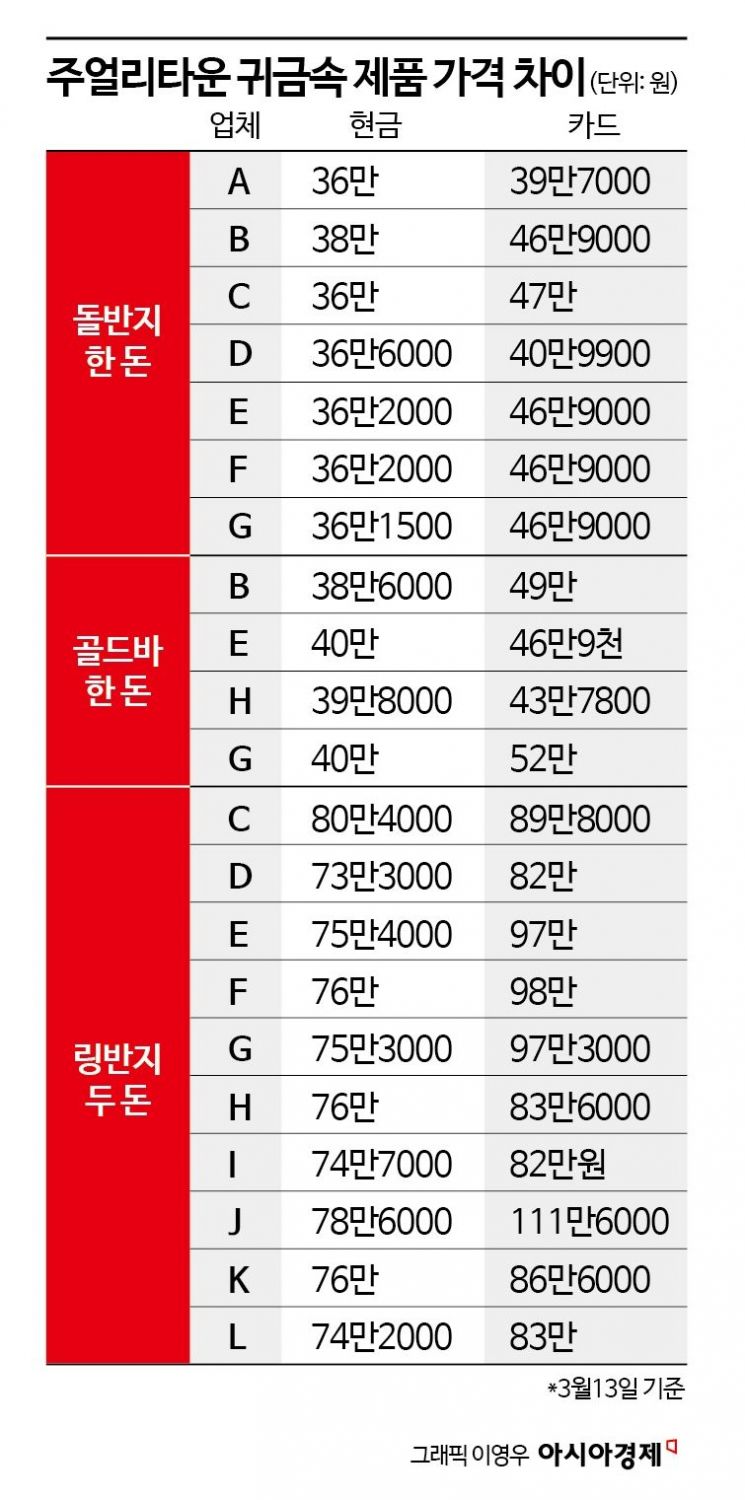
After visiting 12 precious metal stores in Jewelry Town that day, it was found that the price of gold varied depending on the payment method. Also, the difference between cash and card prices varied greatly from store to store. Some places sold a one-don stone ring for 360,000 KRW in cash and 397,000 KRW by card, about 10% higher, while others quoted 360,000 KRW in cash and 470,000 KRW by card.
The same applied to a one-don gold bar. Some stores quoted 398,000 KRW in cash and 437,800 KRW by card for 99.9% pure gold one-don bars, while others quoted 400,000 KRW in cash and 520,000 KRW by card, a 30% increase.
The price gap widened as the weight of the gold increased. The price of a so-called 'plain ring' without any pattern (cutting), weighing two don (7.5g), was quoted as 747,000 KRW in cash and 820,000 KRW by card, about 10% higher in some places, while others offered 786,000 KRW in cash and 1,116,000 KRW by card. Merchants explained that the reason for the price difference between cash and card payments was because "when paying by card, VAT and card fees must be paid."
Several places also mentioned the current individual consumption tax called the 'special consumption tax burden.' However, since the individual consumption tax is only imposed when the price of a single precious metal item exceeds 5 million KRW, it does not apply to stone rings or plain rings. Additionally, merchants encouraged cash payments by saying things like, "We have to buy gold from the factory in cash only, so selling by card is burdensome," and "You can pay by card first and then cancel and pay in cash later."
Regarding this phenomenon, a National Tax Service (NTS) official said, "It appears to be dual pricing due to the temptation of tax evasion," adding, "In the case of cash payments, records remain only at that store, which may tempt some to hide sales." However, if such acts are deemed tax evasion, they can lead to prosecution. According to the current Framework Act on National Taxes, sales must be reported regardless of the payment method. If a taxpayer fails to report the national tax base according to tax laws by the legal reporting deadline, additional taxes will be imposed according to the law on the tax amount payable based on the report.
An NTS official warned, "Hiding sales does not completely conceal them," and added, "The NTS continuously monitors through verification systems, and if caught, penalties such as up to 40% additional tax and interest for delay will be imposed, and in severe cases, prosecution for tax crimes may follow."
Experts advise increasing means to monitor tax evasion to maintain tax fairness. Jeon Byung-wook, a professor at the Graduate School of Taxation at the University of Seoul, said, "Among precious metals, gold had serious tax evasion issues in the past, so strict reporting was enforced at the import stage, which greatly reduced the problem," adding, "It could be effective to increase mutual monitoring methods, such as actively utilizing tax evasion reports from taxpayers who know the market well or adjusting the rewards for tax evasion reports to fit reality."
© The Asia Business Daily(www.asiae.co.kr). All rights reserved.


















