Continued High Interest Rates Lead to $1,169 Trillion in US Interest Costs
Inflation Control Continues... "No Stagflation"
U.S. Treasury Secretary Janet Yellen said on the 13th (local time) that "the likelihood of market interest rates returning to pre-COVID-19 pandemic inflation wave levels is low." This statement drew attention as it came amid expectations that the U.S. Federal Reserve (Fed) will cut interest rates in June.
According to Bloomberg News on the same day, when asked about the reason for the outlook announced at the White House on the 11th, which, unlike last year, predicted that the high interest rate trend would continue for the next few years, Secretary Yellen said, "I think it reflects the current market reality and the forecasts seen in the private sector."
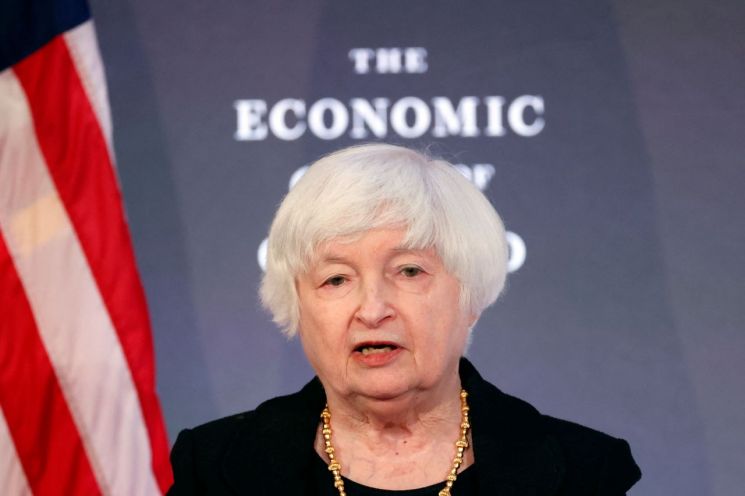
Secretary Yellen stated, "The government and private sector forecasts are aligned," adding, "It is important that the assumptions included in the budget are reasonable and consistent with the views of many experts."
U.S. Treasury yields remained low for ten years until 2019 following the financial crisis. However, after the pandemic, the Fed aggressively raised interest rates to curb inflation, pushing the yield above 5% in October last year, and it currently remains around 4.2%.
In the fiscal year 2025 budget, the White House projected that the average yields on 3-month and 10-year U.S. Treasury securities over the next three years would be higher than previously forecast last year. The average 3-month yield, previously forecast at 3.8%, rose to 5.1%, and the 10-year yield increased from 3.6% to 4.4% over the same period.
Higher interest rates increase fiscal deficits and government debt. According to the current outlook, which expects the high interest rate trend to continue, the White House estimates that net interest costs alone will amount to $890 billion (approximately 1,169 trillion won) this year. This is about 3.1% of the U.S. Gross Domestic Product (GDP).
Efforts to curb inflation are expected to continue. The day before, the U.S. Department of Labor reported that the Consumer Price Index (CPI) for February rose 3.2% year-over-year, exceeding expert forecasts and the previous month's increase. Bloomberg News analyzed that one-third of the CPI increase was due to rising housing costs.
Additionally, in an interview with Fox Business on the same day, Secretary Yellen said, "Housing costs are the biggest cause of the ongoing inflation," and added, "I expect housing costs to decline this year, which will ease price pressures."
In particular, regarding concerns about stagflation (rising prices amid economic stagnation) as inflation has fallen from its peak but has not yet reached the Fed's 2% target, she said, "I do not think stagflation will occur." She continued, "Inflation has slowed by about two-thirds compared to the peak in 2022," and added, "While I do not expect a smooth trend every month, the overall trend is clearly positive."
© The Asia Business Daily(www.asiae.co.kr). All rights reserved.

















