If You Have a Severe Disability That Makes Traveling Alone Difficult
Companion Caregivers Also Receive Up to 50,000 Won in Fare Support
The Seoul Metropolitan Government has provided 15 billion KRW in support to 660,000 people over the past six months through its bus fare assistance program for people with disabilities.
On the 13th, Seoul announced that since August last year, it has supported up to 50,000 KRW per month for bus fares incurred when transferring to Seoul buses or connected metropolitan area (Gyeonggi·Incheon) buses for residents aged six and older with disabilities registered in Seoul.
From August last year to January this year, 657,208 people benefited from the bus fare support, with a total amount of 14,996 million KRW provided. On average, about 110,000 people per month received a refund of 23,000 KRW in bus fares.
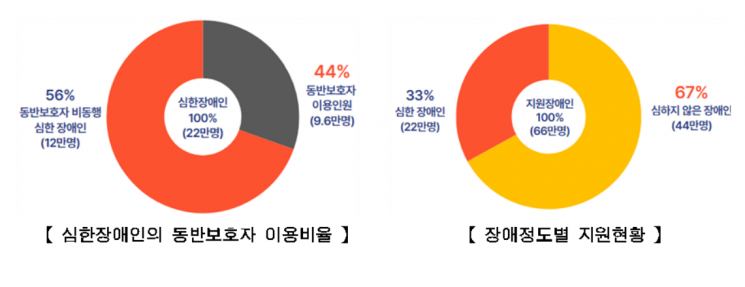 Status of Seoul City Bus Fare Support Project for Disabled Persons from August Last Year to January This Year./=Provided by Seoul City
For people with severe disabilities who find it difficult to travel alone, the city also supports bus fares up to 50,000 KRW for accompanying caregivers. About 33% (220,000 people) of the 660,000 beneficiaries fall into this category, and among them, approximately 96,000 accompanying caregivers also received bus fare support.
By type of disability, physical disabilities accounted for 43% (a cumulative total of 280,000 people), the largest group, followed by hearing disabilities at 18%, visual disabilities at 12%, intellectual disabilities at 7%, kidney disabilities at 6%, brain lesions at 5%, mental disabilities at 4%, and autism at 2%.
In addition, Seoul plans to increase special transportation options such as taxis to guarantee mobility rights for people with disabilities. As of this month, 722 disabled call taxis are in operation, and the city plans to expand this to 782 by the end of this year and 870 by 2025.
Moreover, voucher taxis and welfare call services for people with severe visual and kidney disabilities will be expanded. Voucher taxis will increase from the current 8,600 vehicles to 10,000 by the end of the year, and the welfare call service will replace 20 old vehicles and increase the number of drivers.
Regarding the subway, Seoul plans to complete 100% of the 'one station, one route' project by the end of this year to enable wheelchair users to conveniently move from ground level to platforms. As of the end of last month, 96.1% has been completed. Additionally, by next year, automatic safety plates will be installed within stations, and by 2026, platform announcement devices will be installed as part of ongoing improvements.
For buses, the city aims to deploy low-floor buses on all routes where their operation is feasible by next year.
Jung Sang-hoon, Director of the Welfare Policy Office of Seoul, said, "The bus fare support for people with disabilities was initiated not merely to reduce transportation costs but to help their social activities, participation, and interaction, so we expect it to assist in a wide range of activities." He added, "We will continue to discover and support policies that are essential to the lives of people with disabilities and provide practical help for their social activities."
© The Asia Business Daily(www.asiae.co.kr). All rights reserved.

















