Korea Employers Federation Conducts Survey of 515 Companies with 30 or More Employees
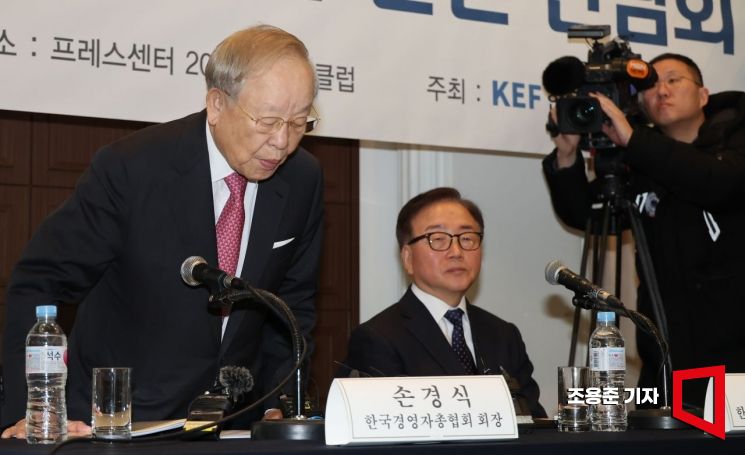 Son Kyung-sik, Chairman of the Korea Employers Federation, is greeting attendees at the New Year's press briefing held on the 29th at the Korea Press Center in Jung-gu, Seoul. Photo by Jo Yong-jun jun21@
Companies identified safety regulations such as the Serious Accident Punishment Act and labor time regulations like the 52-hour workweek as the most burdensome regulations this year. They expressed the need for temporary suspension of existing regulations rather than special regulatory innovations.
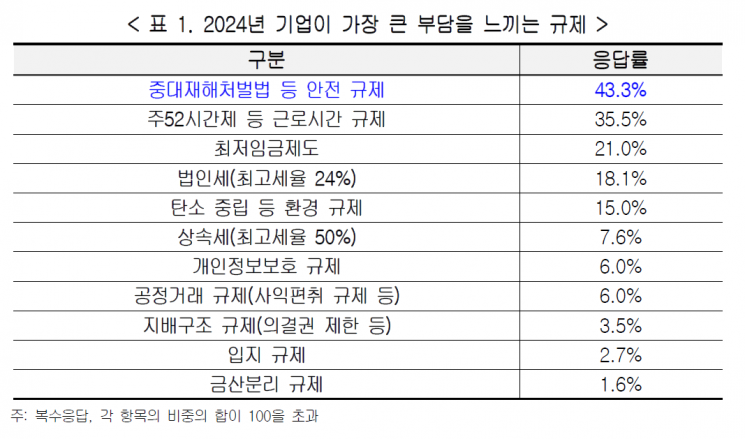
On the 12th, the Korea Employers Federation announced the results of the "2024 Corporate Regulation Outlook Survey," conducted among 515 companies nationwide with 30 or more employees. According to the survey, 43.3% of the responding companies (multiple answers allowed) cited "safety regulations including the Serious Accident Punishment Act" as the most burdensome regulation for companies this year. Since the bill to postpone the application of the Serious Accident Punishment Act to workplaces with fewer than 50 employees has not been passed, small and micro enterprises face significant burdens. Along with this, "labor time regulations such as the 52-hour workweek" ranked second at 35.5%. This was followed by ▲minimum wage system (21.0%) ▲corporate tax (18.1%) ▲environmental regulations such as carbon neutrality (15.0%) in order.
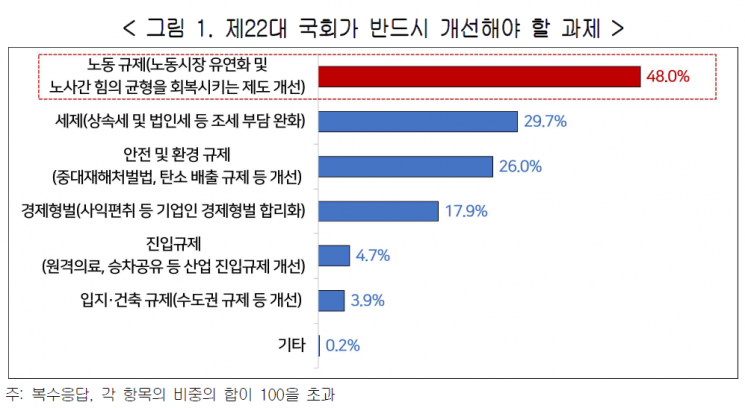
The companies that responded rated the regulatory innovation activities of the 21st National Assembly at 54.6 points out of 100. The most selected issue that must be improved in the upcoming 22nd National Assembly was "labor regulations (improving systems to flexibilize the labor market and restore the balance of power between labor and management)." It accounted for 48.0% (multiple answers allowed), significantly surpassing the second place, tax system (relief of tax burdens such as inheritance tax and corporate tax), at 29.7%. Other issues included ▲safety and environmental regulations (improvements to the Serious Accident Punishment Act, carbon emission regulations, etc.) at 26.0% ▲economic penalties (rationalization of economic penalties for businesspersons such as private interest appropriation) at 17.9% ▲entry regulations (improvements to industrial entry regulations such as telemedicine and ride-sharing) at 4.7% ▲location and construction regulations (improvements to regulations in the metropolitan area, etc.) at 3.9%.
70.2% of the responding companies expected the regulatory environment this year to be similar to last year. Their hopes for the government were "maintaining consistency and reducing regulatory uncertainty (40.2%, multiple answers allowed)" and "pursuing prompt corporate regulatory relaxation (39.0%)."
In particular, rather than special regulatory innovations, they preferred temporary suspension of regulatory application. 41.9% of the responding companies (multiple answers allowed) selected "temporary regulatory suspension" as the most effective regulatory innovation policy. This was followed by ▲‘establishment of an online regulatory innovation platform site’ at 21.4% ▲‘creation of opportunity development zones’ at 16.5% ▲‘creation of global innovation zones’ at 14.4% ▲‘improvement of killer regulations’ at 11.5%.
© The Asia Business Daily(www.asiae.co.kr). All rights reserved.

![Clutching a Stolen Dior Bag, Saying "I Hate Being Poor but Real"... The Grotesque Con of a "Human Knockoff" [Slate]](https://cwcontent.asiae.co.kr/asiaresize/183/2026021902243444107_1771435474.jpg)

















