Bank of Korea's Report on Changes in Domestic Companies' Price Adjustment Behavior After the Pandemic
Product Prices Change Every Six Months After the Pandemic
Prices Increased 'Frequently' Rather Than 'Significantly'
After the COVID-19 pandemic, an analysis revealed that domestic companies in South Korea have raised prices more frequently than in the past. During periods of high inflation, the frequency of price increases by companies rose, leading to an expansion in the inflation rate.
According to the “BOK Issue Note: Characteristics and Effects of Changes in Domestic Companies' Price Adjustment Behavior After the Pandemic,” published by the Bank of Korea on the 11th, domestic companies significantly increased the frequency of price adjustments after the pandemic. The magnitude of price adjustments (rate of increase or decrease) showed little change compared to before the pandemic. Additionally, companies responded to high inflation by increasing temporary price adjustments such as discounts or by adjusting the frequency of price changes by product category.
Responding to Inflation by Raising Prices Every Six Months... Also Increasing Discounts
According to the report, during the high inflation period after the pandemic, domestic companies adjusted prices once every six months. The frequency of price adjustments for domestic products increased significantly from an average monthly rate of 11% during the pre-pandemic period (2018?2021) to 15.6% during the high inflation period after the pandemic (2022?2023). The average duration that product prices remained stable shortened from about 9.1 months to 6.4 months.
Major foreign countries such as the United States also increased the frequency of price adjustments during the same period. In the U.S., prices were adjusted approximately every four months. The frequency of price adjustments in the U.S. rose from the 10% range before the pandemic to over 20% afterward, but it decreased after mid-2022, showing a pattern similar to that of South Korea.
On the other hand, the rate of price increases or decreases for products showed little change before and after the pandemic. Since 2019, the average price increase rate per adjustment for domestic daily necessities has been maintained between 20% and 25%, while the decrease rate has remained between 15% and 20%.
The frequency of price adjustments, including temporary adjustments such as discounts, also tended to increase overall. Based on data from the Korea Consumer Agency and the author's estimates, the frequency of price increases was about 13% and decreases about 14% during the pre-pandemic period (2018?2021), but both increased to around 16?18% during the high inflation period (2022?2023).
Furthermore, price disparities across different sellers for the same product widened. This indicates that manufacturers and distributors responded to high inflation by increasing the frequency of price increases while temporarily adjusting prices according to changes in consumer demand and inventory conditions.
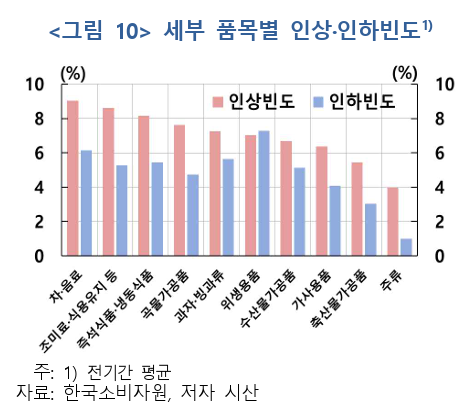
The frequency of price adjustments also varied by product category. Alcoholic beverages showed rigid price adjustments, whereas beverages and seasonings were adjusted more flexibly. Comparing before and after the pandemic, products with a high proportion of imported raw materials, which faced increased cost pressures since 2022, tended to show an increased frequency of price hikes.
Lee Dong-jae, head of the Price Trends Team at the Bank of Korea’s Research Department and author of the report, analyzed, "During periods of high inflation, companies appear to adjust the 'frequency' rather than the 'magnitude' of price increases, considering consumer resistance, insensitivity, and substitution effects with competing products. This likely explains the strong correlation observed between inflation rates and the frequency of price increases."
Significant Impact on Inflation from Oil Price Shocks and Compound Crises
When shocks that pressure cost increases, such as rising oil prices, become larger, the inflation rate expands more sharply. Additionally, when different shocks such as high oil prices and pent-up consumption occur simultaneously, the inflation rate increases more than when individual shocks occur separately.
Moreover, the higher the level of inflation, the faster shocks are transmitted to prices. During periods when inflation rates were high at 4?5%, the frequency of price increases rose even with the same shocks, amplifying the impact on inflation compared to periods of price stability.
Lee commented, "Currently, with inflation rates slightly exceeding 3%, companies’ price adjustment behaviors have not yet returned to pre-COVID levels. It is important to note that if large and diverse shocks such as fragmentation, geopolitical conflicts, or climate anomalies occur in the future, the volatility of inflation could be greater than during periods of price stability."
© The Asia Business Daily(www.asiae.co.kr). All rights reserved.

















