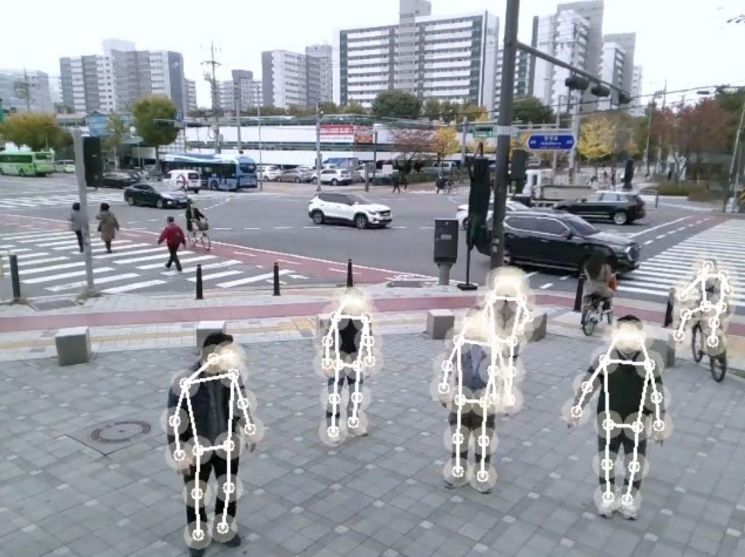
 It can recognize people and calculate behavior patterns from joint movements to identify falls, fights, and weapon possession. Photo by Sonide
Sonid Robotics, a subsidiary of Sonid, a company listed on the KOSDAQ, announced on the 11th that it has completed the development of 'Cloud Free On Device Vision AI.'
The Cloud Free On Device Vision AI can analyze video and image data captured by CCTV and other devices in real time on the device itself without connecting to the cloud, enabling detection of unexpected situations such as natural disasters, traffic accidents, and assault incidents. It recognizes objects such as bicycles, trucks, buses, motorcycles, passenger cars, and people, and in the case of people, it calculates behavior patterns through joint movements to identify events such as falling, fighting, or weapon possession.
Since the device itself analyzes unexpected situations, when linked with CCTVs installed in remote large construction sites, riverbanks, mountainous areas, and living spaces of elderly people living alone where cloud access is difficult, it can detect disasters and human-caused accidents. In the event of a hit-and-run accident, information about the suspect vehicle captured by one CCTV can be transmitted to other CCTVs installed elsewhere to aid in the apprehension of the culprit.
Additionally, when linked with non-destructive testing X-ray and medical X-ray terminals, as well as vision systems of vehicles and drones, it is expected to enable autonomous driving implementation.
Park Kwon-hwan, head of research at Sonid Robotics, stated, “The Cloud Free On Device Vision AI developed by our company is an advanced technology that can provide the information desired by users or operating systems directly from real-time video data collected by devices such as CCTV without transmitting it to the cloud.”
Sonid Robotics independently developed the 'Recognized, Identify and Generative Forgetting Renewable Generative AI' algorithm to enable compact, high-speed processing and vision AI implementation on devices. In the future, they plan to develop self-networked autonomous upgrading technology beyond devices.
Meanwhile, existing cloud-based AI requires users to send data to the cloud, where it is processed and then sent back to the user, causing bottlenecks due to the large volume of data transmission and reception, resulting in inconvenience. Generative AI, which has recently gained attention, is a representative cloud-based AI service that searches accumulated information in the cloud to generate and provide the results desired by users.
© The Asia Business Daily(www.asiae.co.kr). All rights reserved.

















