Unemployment Rate Hits Middle-Aged and Older Adults; Employment Rate Takes a Direct Hit on Youth
A study has found that suicide rates increase when the economy worsens. In particular, the youth suicide rate showed a strong correlation with the employment rate; when the employment rate dropped by 1%, the youth suicide rate increased by 1.7%.
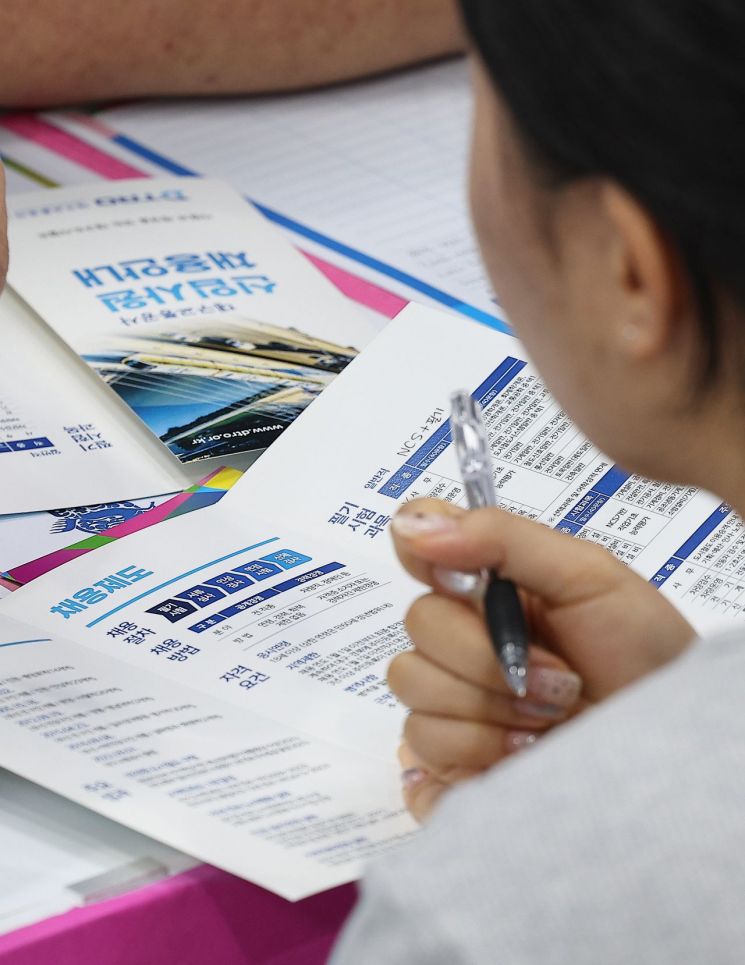 A university student hoping to find a job is looking for employment information.
 Photo by Yonhap News
This result is from the report titled "A Study on Economic Shocks and Suicide," published on the 10th by the Korea Labor Institute. Analyzing unemployment rates, employment rates, the ratio of regular to irregular workers, and suicide rates, the study found that suicide rates decrease when the economy is good, but increase when the economy deteriorates. This confirms a countercyclical relationship with the economy.
When the unemployment rate was 1% higher than the long-term trend, the suicide rate for that year increased by 0.185%. Conversely, when the employment rate was 1% higher than the long-term trend, the suicide rate decreased by about 1.448%.
The countercyclical relationship between unemployment rate and suicide rate was strongest among middle-aged and older adults, while the relationship between employment rate and suicide rate was most pronounced among youth aged 20 to 39. In years when the employment rate was 1% lower than the long-term trend, the youth suicide rate increased by 1.748%.
Suicide rates increased as the proportion of regular workers decreased and the proportion of irregular workers increased. The report stated that statistical significance was confirmed only among middle-aged and older men and young women.
Hong Jeong-rim, a senior researcher at the Korea Labor Institute, said, “Support from the socioeconomic perspective, which has been previously evaluated as insufficient for suicide prevention measures, urgently needs to be expanded,” and added, “This suggests the need for measures not only for middle-aged and older adults but also for youth who are in vulnerable positions.”
Maintaining the Highest Suicide Rate Among OECD Countries Since 2003
According to the "Quality of Life in Korea 2023 Report" released last month by Statistics Korea, the total number of suicides in 2022 was 12,906, which is 25.2 per 100,000 people. The suicide rate has shown a continuous upward trend from 13.7 per 100,000 people in 2000, reaching 24.8 in 2005, and peaking at 31.7 in 2011.
Compared to other OECD countries, Korea’s suicide rate is significantly higher, ranking among the highest of the countries compared. Since recording the highest suicide rate among OECD countries in 2003, Korea has maintained this position. As of 2020, Korea’s suicide rate was 24.1 per 100,000 people, the highest among OECD countries, showing a large gap compared to Lithuania’s 18.5, which ranked second.
※ If you have difficult-to-talk-about concerns such as depression, or if you have family or acquaintances facing such difficulties, you can receive 24-hour professional counseling through the Suicide Prevention Hotline (TEL)1393, Mental Health Counseling Hotline (TEL)1577-0199, Lifeline (TEL)1588-9191, Youth Hotline (TEL)1388, the youth mobile counseling app ‘Da Deureojul Gae,’ KakaoTalk, and other services.
© The Asia Business Daily(www.asiae.co.kr). All rights reserved.

















