
CJ CheilJedang, the vanguard of the 'Anti-Coupang Alliance,' has partnered with China's AliExpress. As the top player in the domestic food industry enters the previously unseen 'C-commerce' (China + e-commerce), it is expected that other latecomer food companies will also join AliExpress. The food industry, which has been sidelined in price negotiations with Korea's largest online platform Coupang, hopes that diversifying channels will help balance the power dynamics.
'Anti-Coupang' CJ CheilJedang enters AliExpress... Domestic food companies to follow

According to the distribution industry on the 8th, AliExpress recently began selling CJ CheilJedang products in its ‘K-venue’ section, which showcases domestic brand products. A total of 54 products, including Bibigo dumplings, napa cabbage kimchi, Spam, and Hetbahn, have been listed. AliExpress is currently running a 'CJ CheilJedang Grand Launch Event' advertisement, offering popular products at discounts of up to 70% or more. A CJ CheilJedang representative said, “It is natural for manufacturers to secure new distribution channels,” adding, “We expect this to help not only business growth but also expand consumer choices.”
CJ CheilJedang’s entry into AliExpress carries significance beyond just securing a new distribution channel. Due to conflicts over supply prices, CJ CheilJedang had not sold key products like Hetbahn and Bibigo on Coupang, the largest domestic e-commerce platform. Because of this, CJ was regarded as a leading figure in the 'Anti-Coupang Alliance.' Until now, the gap left by Coupang was sustained through its own platform and collaborations with Coupang competitors such as Naver and Shinsegae.
With CJ CheilJedang now partnering with AliExpress, which is rapidly growing in the domestic market, the anti-Coupang front is gaining more momentum. Currently, AliExpress has about 8.18 million users, ranking second after Coupang. Particularly, if this decision leads to increased sales, CJ CheilJedang’s independence from Coupang could be recorded as a successful case, significantly influencing other food companies’ decisions.
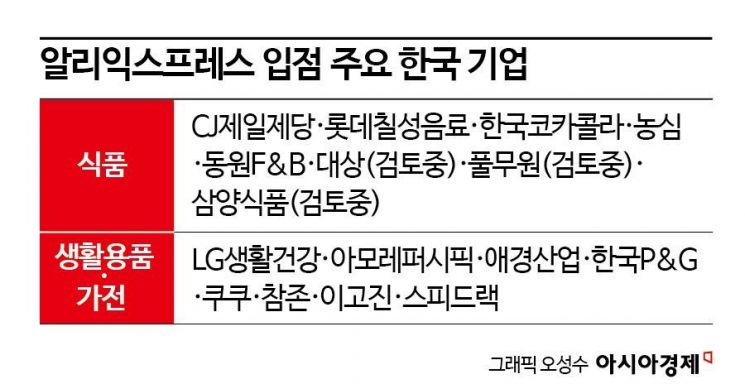
Major food companies are already scheduled to join AliExpress. Lotte Chilsung Beverage and Coca-Cola have already entered, and Dongwon F&B is pushing to join within the first quarter of this year. Dongwon F&B is reportedly considering selling processed foods such as Dongwon tuna. Other companies like Daesang, well known for its traditional kimchi, Samyang Foods, which sells 'Buldak Bokkeum Myun' (Hot Chicken Flavor Ramen), and Pulmuone are also reviewing entry into AliExpress. Until now, brands listed in K-venue were mainly household goods like Aekyung, Yuhan-Kimberly, P&G, Clean Country, Roborock, or beauty products from LG Household & Health Care and Amorepacific, but now the scope is expanding significantly to include food products.
Food industry expects improved negotiation power on supply prices... 'Low trust' image of AliExpress remains a variable
As AliExpress aggressively attracts Korean brands, the food industry expects negotiation power over supply prices with Coupang to recover. A food industry insider said, “Diversification of channels means an expansion of consumer choices,” adding, “If domestic food companies’ entry into AliExpress leads to increased sales, the influence of Coupang’s monopolistic power will be diluted, and food companies’ negotiation power regarding supply prices will improve.”
However, some view that because AliExpress and Coupang have different business models, the entry of domestic food companies into AliExpress is insufficient to drive changes in Coupang’s supply prices or commission fees. A distribution industry insider said, “AliExpress is an open market that makes money through product exposure and advertising fees, whereas Coupang buys products directly and sells them, so the business models are fundamentally different,” adding, “The impact of domestic food companies entering AliExpress on Coupang’s supply prices will be minimal.”
There are also concerns that AliExpress has yet to gain consumer trust in the domestic market, making it difficult to achieve remarkable results in food sales. AliExpress has so far grown its domestic market share mainly with low-priced Chinese-made products such as clothing and small electronics. Another distribution industry insider said, “AliExpress is a platform that carries the stigma of counterfeit product controversies and slow delivery,” adding, “Since trust is especially important for food products, a successful image transformation will be a key factor.”
© The Asia Business Daily(www.asiae.co.kr). All rights reserved.
![Clutching a Stolen Dior Bag, Saying "I Hate Being Poor but Real"... The Grotesque Con of a "Human Knockoff" [Slate]](https://cwcontent.asiae.co.kr/asiaresize/183/2026021902243444107_1771435474.jpg)


















