Social Security Committee Publishes Report on 'Characteristics of Poor Elderly in Korea'
Poverty Rate Among Elderly Population 45.6%
Advanced Age and Metropolitan Residence... Causes of Rising Elderly Poverty Rate
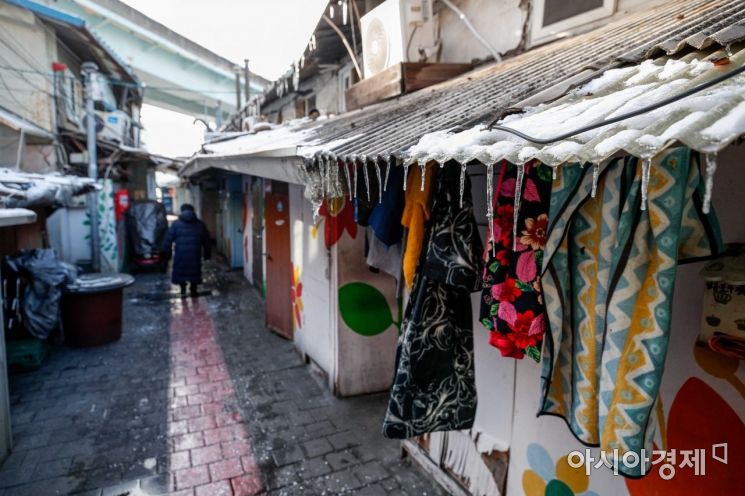 Icicles hang from the eaves of the jjokbangchon (small rooms village) in Yeongdeungpo-gu, Seoul, during the harsh winter. Photo by Jinhyung Kang aymsdream@
Nearly half of the elderly population in South Korea has been found to be living in poverty. Additionally, it was confirmed that 4 out of 10 impoverished elderly individuals reside in the Seoul metropolitan area.
On the 7th, the Social Security Committee released data titled "Characteristics of Impoverished Elderly in Korea," which analyzed social security administrative data based on 2020 figures. The social security administrative data is an integrated dataset compiled from information dispersed across various ministries, sampling about 10 million people, approximately 20% of the entire population.
Analyzing data on impoverished elderly defined as those earning "50% or less of the median income," the gender distribution (based on disposable income) showed that the proportion of women (60.3%) was about 20% higher than that of men (39.7%). Disposable income refers to income available for consumption and savings, calculated by subtracting taxes and adding transfer incomes such as pensions to personal income.
The elderly poverty rate by age group, based on market income, was ▲65?69 years old (53.6%) ▲70?74 years old (64.3%) ▲75?79 years old (70.5%) ▲80 years and older (69.6%). Based on disposable income, the rates were ▲65?69 years old (35.0%) ▲70?74 years old (44.2%) ▲75?79 years old (53.7%) ▲80 years and older (56.5%). It was observed that the poverty rate tends to increase with age.
By region, the highest proportion of impoverished elderly resided in the Seoul metropolitan area, accounting for 39.6% of all impoverished elderly. This was followed by ▲Gyeongsang region (30.5%) ▲Jeolla region (13.4%) ▲Chungcheong region (11.6%) ▲Gangwon Province (3.6%) ▲Jeju Island (1.3%). Their disposable income levels were about 10 million KRW lower than those of non-impoverished elderly; while the annual disposable income of non-impoverished elderly was 17.97 million KRW, that of impoverished elderly was only 8.04 million KRW. Furthermore, excluding pensions and social security benefits, the market income of impoverished elderly averaged a mere 1.35 million KRW per year, confirming that they rely almost entirely on the state for income.
The proportion of impoverished elderly among the total elderly population was 45.6% based on disposable income, meaning that 1 in 2 elderly individuals is impoverished. By gender, the poverty rate among elderly women was 49.0%, about 8% higher than the 41.2% poverty rate among elderly men. Additionally, the elderly poverty rate was highest in ▲rural fishing and farming areas (57.6%), followed by ▲small and medium-sized cities (47.0%), and ▲large cities (42.1%), showing a tendency for higher poverty rates in smaller regions.
The Social Security Committee stated, "Although average income increases by about 7 million KRW through state intervention, the situation remains serious," and announced that on the afternoon of the 8th, the 1st Statistical and Administrative Data Expert Committee will be held at the conference room of the Regenerative Medicine Promotion Foundation in Jung-gu, Seoul, to discuss the establishment and utilization plans of social security administrative data.
© The Asia Business Daily(www.asiae.co.kr). All rights reserved.
![Clutching a Stolen Dior Bag, Saying "I Hate Being Poor but Real"... The Grotesque Con of a "Human Knockoff" [Slate]](https://cwcontent.asiae.co.kr/asiaresize/183/2026021902243444107_1771435474.jpg)











