Fire Prevention Management Lapses Hinder Fire Truck Access
Negligence Accounts for Over Half of Residential Fire Causes
One-room apartments and villas, which are mainly sought after by people living alone, have been found to be fully exposed to fire hazards. Since the possibility of fire is higher in the relatively dry spring season, caution is required for 'new solo dwellers.'
According to the Fire Agency on the 7th, the average annual number of residential fires over the past 10 years (2012?2021) was 7,647, with 145 deaths caused by residential fires. In fact, on the 22nd of last month, fires caused by carelessness occurred consecutively in one-room apartments and detached houses in Tongyeong and Miryang, Gyeongnam, resulting in one death and one injury. Then, on the 26th, a fire broke out in a multi-family house in Chungju, Chungbuk, injuring one resident.
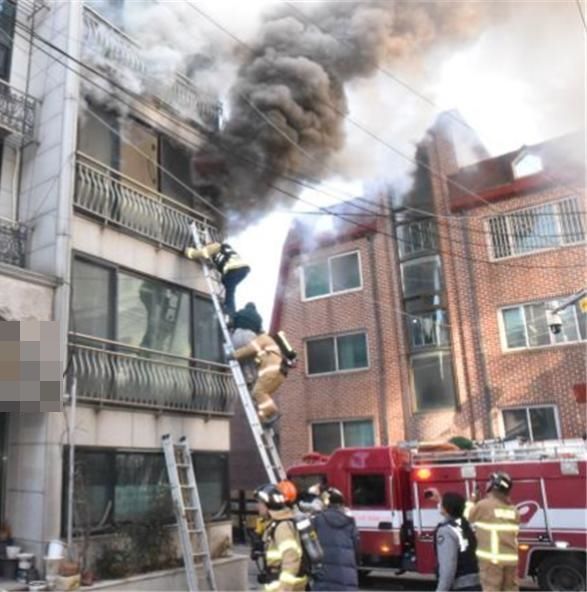 A fire broke out in a villa in Dongjak-gu, Seoul, last January, and firefighters are conducting extinguishing and rescue operations.
 [Photo by Dongjak Fire Station]
Since February 2012, under the Fire Safety Facilities Act, single-family, multi-family, row houses, and multi-unit houses are required to install residential fire safety facilities. Fire extinguishers must be installed at least one per household and per floor, and single-station smoke alarms (devices that detect fire by smoke and sound an alarm using an internal power source to enable quick evacuation) must be installed in each compartmented room.
However, according to the 2020 Population and Housing Census, the nationwide installation rate of residential fire safety facilities was only 35.4%. There are no penalties for not installing residential fire safety facilities, and in the case of one-room apartments, most are not registered as residential units and thus are not obligated to have residential fire safety facilities. A fire official stated, “There is no legal basis to punish for not installing fire extinguishers and single-station smoke alarms under current law.”
Another issue is that areas densely populated with one-room apartments and villas have narrow alleys, making it difficult for fire trucks to enter. According to the Fire Agency’s Architectural Committee standard guidelines, for apartment complexes, roads with a width of 7 meters or more, including sidewalks of at least 1.5 meters wide, must be installed. For complexes with fewer than 100 households and dead-end roads shorter than 35 meters, a minimum width of 4 meters is allowed.
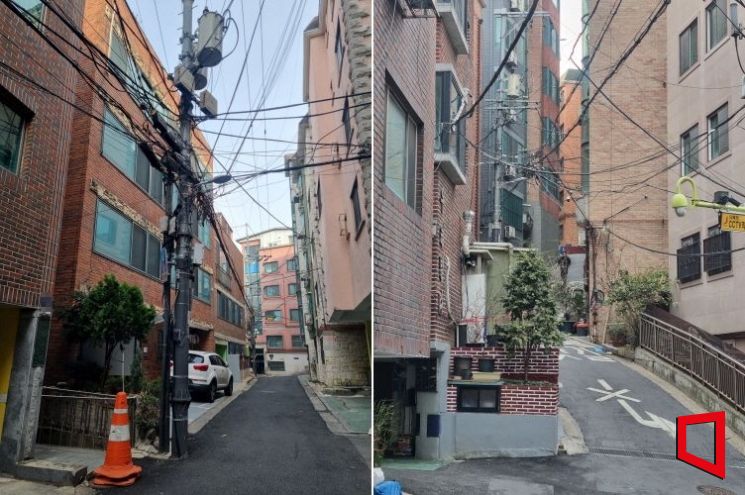 Areas densely packed with one-room apartments and villas face significant challenges during fires due to narrow alleys that make it difficult for fire trucks to access. The photo shows a villa neighborhood in Jangchung-dong, Jung-gu, Seoul. Photo by Seongah Shim heart@
Most of these areas are old, and long hanging power lines also hinder fire suppression efforts. The clearance height for fire truck access is at least 5 meters, but power lines hanging from utility poles often have a height of less than 3 meters from the road. When fire trucks enter, workers must simultaneously use insulated poles to move the power lines, making rapid fire response difficult.
Safety negligence by landlords and residents is also identified as a problem. Mr. Kang (79), who rents one-room apartments to university students in Seongbuk-gu, Seoul, said, “I didn’t install smoke detectors because they go off even with a little smell,” but added, “Still, I thought fire extinguishers were necessary, so I kept one in each room.” In the past 10 years, carelessness accounted for more than half (54.2%) of residential fire causes. This is twice as high as electrical causes, which were the second most common at 22.6%.
Experts also advise that fire prevention in apartment complexes ultimately depends on individual caution. Professor Lee Young-joo of the Department of Fire and Disaster Prevention at Kyungil University said, “For buildings in narrow alleys, it is physically difficult to solve space issues, and it is administratively impossible for firefighters to inspect every building one by one. Individuals need to focus on fire prevention and request help from fire stations when necessary. Local fire stations should meticulously plan fire activities to minimize accessibility limitations, which is a realistic approach.”
© The Asia Business Daily(www.asiae.co.kr). All rights reserved.


















