5 Stocks Increased Shareholding in February, 18 Decreased
4 of 5 Stocks with Increased Shares Are 'Low PBR Stocks'
Meanwhile, High PBR Stocks Removed from Portfolio
The National Pension Service (NPS), a major player in the domestic stock market, increased its holdings last month mainly in stocks with low price-to-book ratios (PBR). The recent popularity of 'low PBR stocks' thanks to the 'corporate value-up program' was partly influenced by the NPS. As the largest institutional investor in Korea, the NPS holds more than 5% stakes in as many as 283 companies.
According to the Financial Supervisory Service's electronic disclosure system on the 7th, from the 1st to the 29th of last month, the NPS disclosed changes in its stake in a total of 23 stocks where it holds more than 5%. Only 5 stocks saw an increase in stake, while the remaining 18 decreased. The stock with the largest increase in stake was Kiwoom Securities, which rose from 10.40% to 11.82%, an increase of 1.42 percentage points. Samsung Securities (8.42% → 9.56%) and Pan Ocean (5.74% → 6.77%) also increased their stakes by more than 1 percentage point. Hanwha Life Insurance (6.12% → 6.34%) and Daeduck Electronics (9.71% → 9.84%) saw slight increases in their holdings as well.
Three of the Five Stocks with Increased Stakes Are 'Financial Stocks'
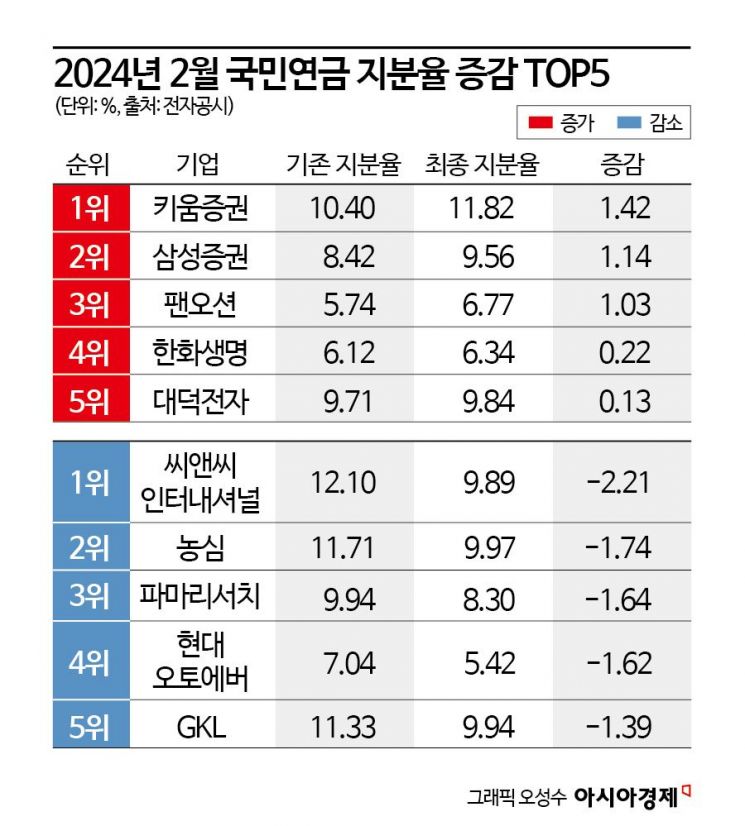
Among the stocks with increased stakes, Kiwoom Securities, Samsung Securities, and Hanwha Life Insurance are 'financial stocks' and share the common characteristic of being 'low PBR stocks' with PBRs below 1. PBR is the ratio of the stock price to the book value per share. A PBR below 1 means the stock price is lower than the book value. According to the Korea Exchange, Kiwoom Securities has a PBR of 0.71, Samsung Securities 0.59, and Hanwha Life Insurance 0.35. Although not a financial stock, Pan Ocean, which also saw an increase in stake, has a PBR of 0.56, below 1.
Among the five stocks in the NPS portfolio, Daeduck Electronics is the only one with a PBR above 1, at 1.38. Daeduck Electronics is classified as an artificial intelligence (AI)-related stock. Its automotive semiconductor substrate (FC-BGA) is used in central processing units (CPU) and graphics processing units (GPU). It is a semiconductor materials, parts, and equipment (so-bu-jang) company highlighted by the AI boom. The NPS has consistently shown interest in so-bu-jang companies related to AI. The stock in which it increased its stake the most last December was Isu Petasys, which produces multilayer boards (MLB). This company supplies MLBs to Nvidia, a U.S. semiconductor company leading the AI boom.
Four of the Top Five Stocks with Decreased Stakes Have PBRs Above 1
On the other hand, the NPS reduced its stakes by more than 1 percentage point in CNC International (12.10% → 9.89%), Nongshim (11.71% → 9.97%), PharmaResearch (9.94% → 8.30%), Hyundai AutoEver (7.04% → 5.42%), and GKL (11.33% → 9.94%). By industry, these are consumer goods (CNC International), food and beverage (Nongshim), bio (PharmaResearch), software (Hyundai AutoEver), and leisure (GKL), respectively. Except for Nongshim, all of the top five stocks from which the NPS reduced holdings have PBRs above 1.
In total, the NPS reduced its stakes in 18 stocks. By number, this is more than three times the number of stocks in which it increased holdings (5). Considering that pension funds including the NPS were net buyers of 110.1 billion KRW in the KOSPI in February, it is surprising that the number of stocks with net sales far exceeds those with net purchases. The stocks for which the NPS discloses stake changes are those where it holds more than 5%, which requires reporting. Taking this into account, it appears that the NPS has also added a large number of stocks with less than 5% holdings to its portfolio.
© The Asia Business Daily(www.asiae.co.kr). All rights reserved.
![Clutching a Stolen Dior Bag, Saying "I Hate Being Poor but Real"... The Grotesque Con of a "Human Knockoff" [Slate]](https://cwcontent.asiae.co.kr/asiaresize/183/2026021902243444107_1771435474.jpg)
















