AMD Declines Amid AI Semiconductor Export Challenges to China
Fed's Bostic: "Pause After Rate Cut in Q3"
Focus on Powell's Remarks on 6-7th and Employment Report on 8th
The three major indices of the U.S. New York stock market showed a broad decline in early trading on the 5th (local time). Investors are adopting a wait-and-see stance ahead of Federal Reserve (Fed) Chair Jerome Powell's messages on the 6th and 7th and the employment report on the 8th.
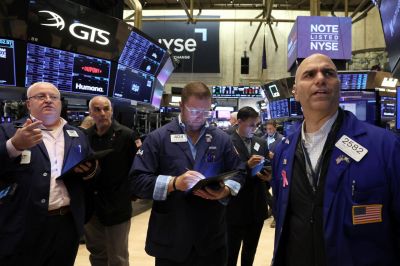
As of 9:38 a.m. at the New York Stock Exchange (NYSE) on the day, the Dow Jones Industrial Average was trading at 38,795.81, down 0.51% from the previous trading day. The S&P 500, which focuses on large-cap stocks, was down 0.54% at 5,103.34, and the tech-heavy Nasdaq index was down 1.01% at 16,044.37.
Among individual stocks, three major tech stocks declined, weighing on the market. U.S. semiconductor company AMD fell 1.62% after news that it faced U.S. government export restrictions on AI semiconductors destined for the Chinese market. Apple dropped 2.33% following an antitrust fine imposed by the European Union (EU) Commission the previous day and reports of weak iPhone sales in China. Tesla also declined 3.04% amid news of reduced shipments from its Chinese factory the day before. Target rose 11.63% after reporting earnings that exceeded market expectations.
Views on the future market outlook are divided. JP Morgan considers U.S. stocks to be in a bubble, while Goldman Sachs analyzes that the recent rally is justified.
Investors are focusing on Fed Chair Jerome Powell, who will testify before the U.S. Congress on the 6th and 7th to report on monetary policy for the half-year. Powell is expected to reiterate a cautious stance, emphasizing that he will not rush to cut interest rates.
Raphael Bostic, President of the Federal Reserve Bank of Atlanta, reaffirmed his hawkish (monetary tightening preference) stance the day before. Through the Fed's website, he projected that the Fed would cut rates for the first time in the third quarter of this year and then pause the cuts. He expected the total rate cut to be 0.5 percentage points over two occasions by the end of this year. This disappointed investors. The market expects the Fed to start cutting rates in mid-year and to make a total of three cuts.
Kenneth Brooks, strategist at Soci?t? G?n?rale, said, "If Bostic wants one cut and then a pause, I wonder if the Fed is hesitating to make three cuts," adding, "The data is telling us this, and it is not calling for the Fed to cut rates."
The February employment report, to be released by the U.S. Department of Labor on the 8th, is also a key point for investors. The market expects nonfarm payrolls to increase by 200,000 last month, significantly down from 353,000 in January. Above all, since January's nonfarm payrolls exceeded the forecast of 185,000 by more than double, confirming an overheated labor market, the key question is whether the February report will show signs of labor market slowdown. The unemployment rate for February is expected to remain at 3.7%, the same as January.
The January Job Openings and Labor Turnover Survey (JOLTS) from the U.S. Department of Labor and the February nonfarm payroll data from private employment data provider ADP will also be released on the 6th. The number of job openings in U.S. companies is expected to have decreased from 9.026 million in December last year to 8.895 million in January this year.
Government bond yields are falling. The U.S. 10-year Treasury yield, a global bond yield benchmark, dropped 7 basis points (1bp = 0.01 percentage points) to 4.14%, while the 2-year Treasury yield, sensitive to monetary policy, fell 3 basis points to 4.57%.
International oil prices are weak. West Texas Intermediate (WTI) crude oil fell $0.72 (0.91%) to $78.02 per barrel, and Brent crude dropped $0.57 (0.69%) to $82.83 per barrel. The lack of a 'surprise' following China's announcement the previous day of an economic growth target of 5.0% for this year, in line with expectations, appears to be the reason for the oil price decline. The decision by the major oil-producing group OPEC+ to extend production cuts has also failed to push oil prices higher.
© The Asia Business Daily(www.asiae.co.kr). All rights reserved.
![Clutching a Stolen Dior Bag, Saying "I Hate Being Poor but Real"... The Grotesque Con of a "Human Knockoff" [Slate]](https://cwcontent.asiae.co.kr/asiaresize/183/2026021902243444107_1771435474.jpg)
















