AI Meeting Hosted by Ministry of Science and ICT on the 5th
First AI Field Visit by Vice Minister Kang Dohyun Since Inauguration
Industry Urges Government Support and Regulatory Easing
Domestic artificial intelligence (AI) companies unanimously agreed that the era of 'economies of scale' has arrived, where survival is no longer possible with technology and services alone. They appealed for government financial support, such as tax credits, to secure competitiveness in the global market.
On the 5th, the Ministry of Science and ICT held a roundtable meeting at the headquarters of Conan Technology, a large language model (LLM) development company in Seocho-gu, Seoul, to gather opinions on creating an AI innovation ecosystem. This was the first AI field visit by Kang Dohyun, the ministry’s 2nd Vice Minister, since his appointment.
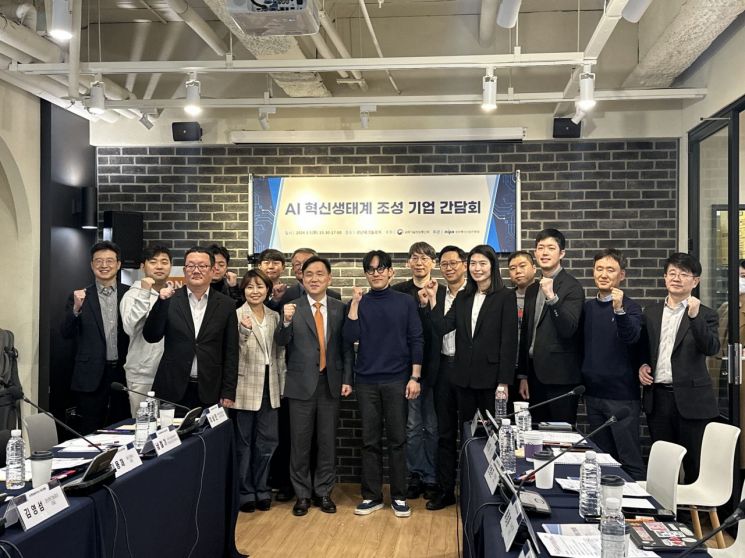 On the 5th, the Ministry of Science and ICT held a meeting to foster an AI innovation ecosystem at the headquarters of Conan Technology, a large language model (LLM) development company in Seocho-gu, Seoul, chaired by Kang Do-hyun, the 2nd Vice Minister of the Ministry of Science and ICT.
 Photo by Lee Sung-min minute@
The meeting was attended by representatives from domestic AI companies, including Kim Youngseom, CEO of Conan Technology; Jeong Sina, appointed CEO of Kakao; Bae Kyunghoon from LG AI Research Institute; Lee Yongjae, CEO of Masspresso; and Choi Woosik, CEO of Deepnoid.
In his opening remarks, Vice Minister Kang encouraged each AI company representative by name, pledging the government’s support. He said, “While the government cannot claim to lead the challenge in innovative technology, it will firmly back you from behind.”
The industry identified government capital support as the most crucial factor for fostering the AI ecosystem. Appointed CEO Jeong said, “Ten years ago, during the mobile era, individual companies could grow as points, but in the current AI era, capital limitations make this difficult,” adding, “Government cooperation is needed for costly areas such as graphics processing units (GPUs), data centers, and cloud services.”
Regarding capital support, there were calls to elevate AI to a national strategic technology to actively attract corporate investment. Researcher Bae stated, “Since the AI market is not yet fully mature, it is realistically burdensome for companies to invest aggressively in AI now,” and added, “If more tax credits for research and development (R&D) or facility investments were available, Korean companies could achieve better results.”
There were also demands for regulatory relaxation. Lee Yongjae, CEO of Masspresso, which operates the AI math study application ‘Qanda,’ said, “Global big tech companies secure data and quickly develop AI before discussing regulations,” expressing doubt about whether globally competitive companies can emerge in Korea under such conditions that disadvantage latecomers.
Choi Woosik, CEO of Deepnoid, a medical AI solution developer, said, “While direct government support to companies is important, I believe removing regulations is even more crucial,” adding, “It would be great if an environment where data can be freely utilized is created.”
Vice Minister Kang said, “We will discuss with relevant ministries to push forward policies boldly,” and added, “We will concentrate policy capabilities to ensure that the Republic of Korea is recognized as a G3 country in the AI field on the global stage.”
© The Asia Business Daily(www.asiae.co.kr). All rights reserved.
![Clutching a Stolen Dior Bag, Saying "I Hate Being Poor but Real"... The Grotesque Con of a "Human Knockoff" [Slate]](https://cwcontent.asiae.co.kr/asiaresize/183/2026021902243444107_1771435474.jpg)
















