Yuhan-Kimberly Collects Used Hand Towels to Create New Ones
Hansol Paper Produces Printing Paper from Milk Cartons
A ‘recycling’ trend is sweeping through the paper industry. Used hand towels are being collected and turned into new hand towels, and empty milk cartons are being made into printing paper, strengthening the resource circulation system. Although immediate profits are minimal, the industry expects effects such as carbon emission reduction.

Paper-based daily necessities company Yuhan-Kimberly announced on the 6th that it signed a Memorandum of Understanding (MOU) with Shinhan Life on the 29th of last month to establish a virtuous cycle system for collecting and recycling hand towels. The two companies plan to build a system to collect used hand towels centered around Shinhan Life’s headquarters building, Shinhan L Tower. Hand towels refer to square tissues hung next to sinks for users to pull out one sheet at a time. After collection and sorting, the hand towels are transported to Yuhan-Kimberly’s Gimcheon factory to be reused as raw materials for new hand towels. Hand towels used only for drying hands can be reused as product raw materials. This reduces incineration volume and partially replaces imported recycled pulp, thereby lowering carbon emissions.
Hand towel recycling has been a focus of Yuhan-Kimberly’s efforts since last year. In addition to Shinhan Life, 19 organizations including Lotte Mulsan, Seoul City, and HD Hyundai are participating.
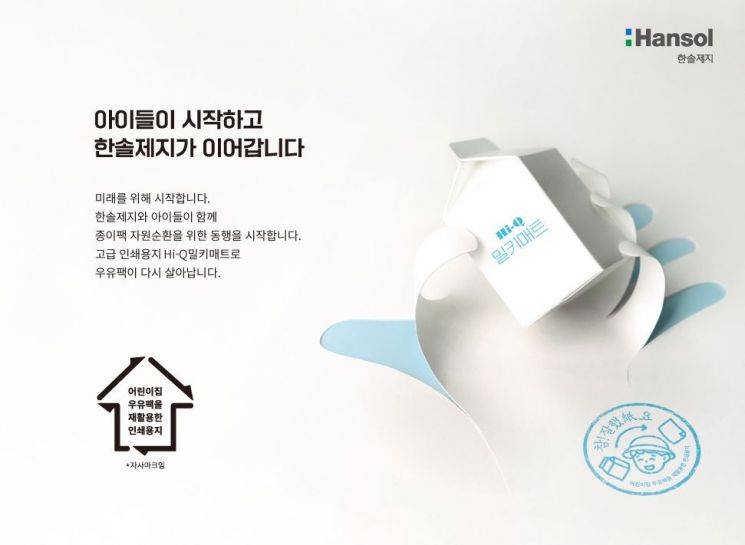
Hansol Paper launched a premium printing paper called ‘Hi-Q Milky Matte’ last month, made from milk cartons discarded at daycare centers. Milk cartons are known to be difficult to recycle because polyethylene (PE) film is laminated on both sides of the paper to prevent product spoilage and block oxygen. According to the Korea Recycling Resource Distribution Support Center, although the usage of paper cartons is increasing annually, the recycling rate dropped from 35% in 2013 to 14% in 2022. To address this, Hansol Paper invested 7 billion KRW last year to introduce paper carton recycling facilities and succeeded in stable mass production of the product.
Profits from recycling are still minimal. Used hand towels incur additional costs such as installation and labor for drying wet towels and collecting them. Milk cartons are also difficult to collect due to mold growth, resulting in a small amount that can be used as raw material. However, the industry expects long-term contributions to carbon emission reduction through resource circulation. Yuhan-Kimberly anticipates recycling about 3.9 tons of hand towels annually and reducing about 3.8 tons of greenhouse gases through the MOU with Shinhan Life. This is equivalent to planting approximately 415 thirty-year-old pine trees in the central region. Through HD Hyundai, it is predicted that about 21.8 tons of hand towels will be recycled annually, with a greenhouse gas reduction effect of 18.6 tons.
An industry official said, “Recycling does not become a reality just because companies try hard; it requires a nationwide campaign where used hand towels are separated into dedicated recycling bins or empty milk cartons are washed with water and dried.” He added, “We plan to gradually increase education and promotion through local governments and companies.”
© The Asia Business Daily(www.asiae.co.kr). All rights reserved.


















