Acknowledging Challenges Surrounding China's Economy... "Facing Multiple Issues"
Feasibility Questioned... Likely to Emphasize Science and Technology Innovation
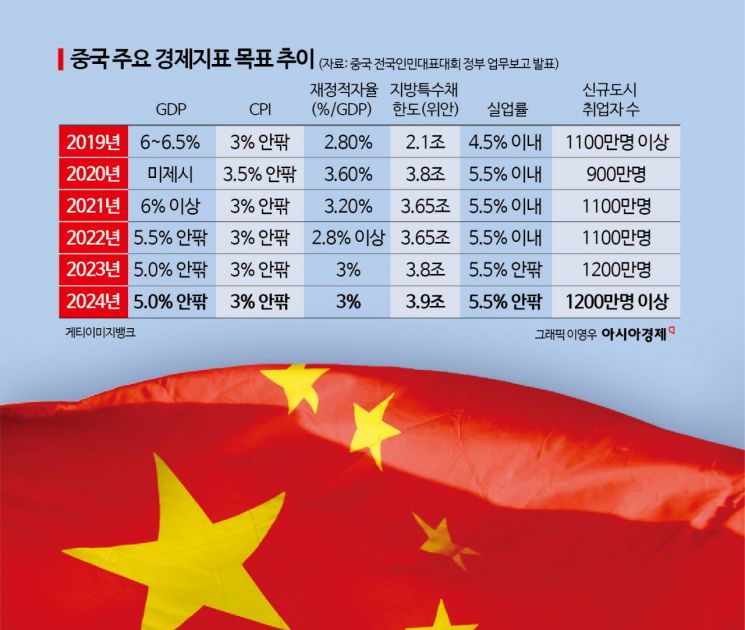
The highlight of China's Two Sessions (National People's Congress and Chinese People's Political Consultative Conference), the government work report at the opening ceremony of the NPC that reveals the future economic policy, contained no unexpected 'surprises.' The economic growth target of around 5%, anticipated by the market, was set as the Chinese government's goal for the second consecutive year following last year. Targets for fiscal deficit, inflation rate, and defense budget were also presented at levels not significantly deviating from previous estimates.
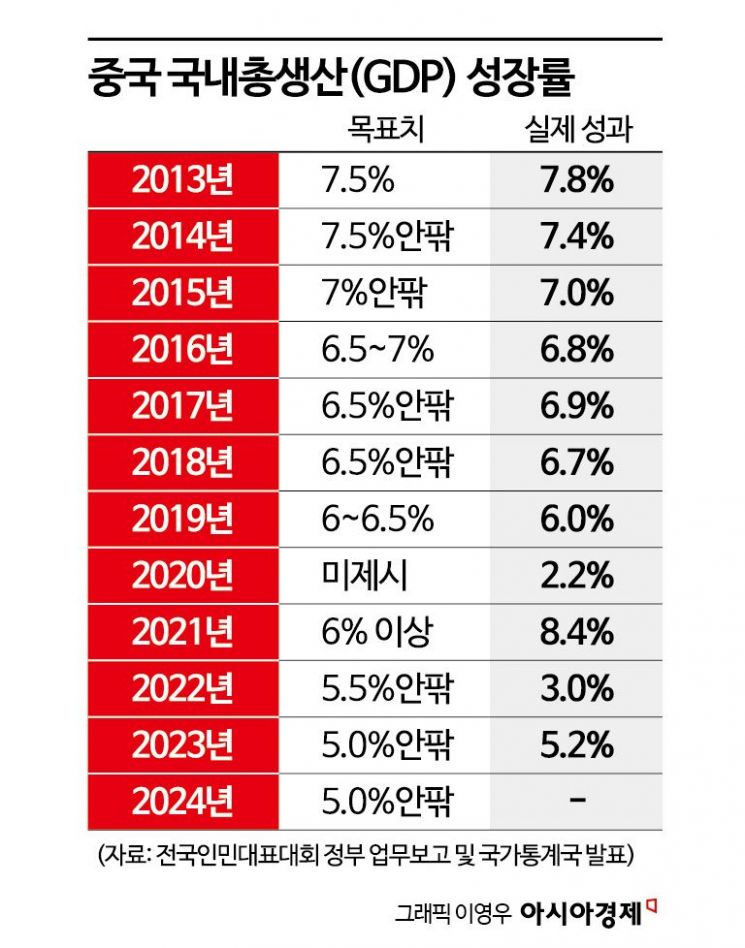
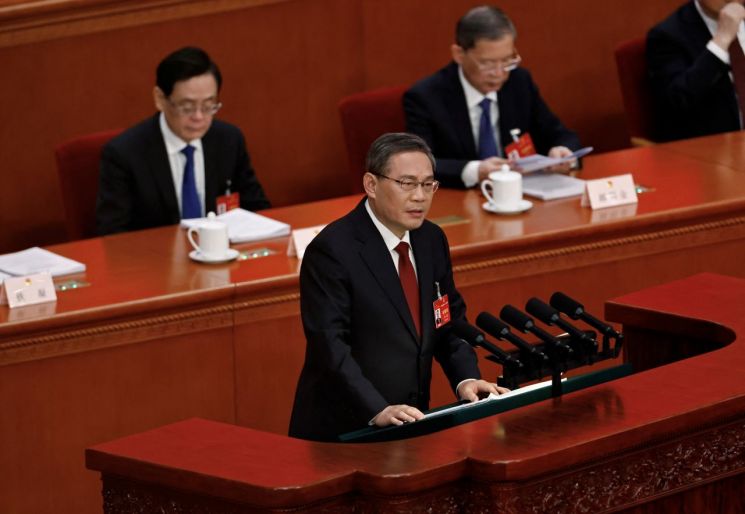
On the 5th, Premier Li Qiang announced an economic growth target of around 5.0% for this year during the government work report at the opening ceremony of the National People's Congress (NPC) held at the Great Hall of the People in Beijing. This figure aligns with earlier market forecasts but is slightly below the projections of China's leading think tank, the Chinese Academy of Social Sciences (5.3%), and the weighted average of regional growth targets (5.3%).
Acknowledging Challenges Surrounding China's Economy: "Facing Multiple Issues"
This target is the same as last year's for the second consecutive year and is also the lowest in history except for 1991 (4.5%). China set a growth target of around 5.0% in the first year of 'With-COVID' last year, and the actual growth rate was 5.2%. However, considering that unlike last year, the first year of With-COVID, there is no base effect to expect, this target is regarded as somewhat challenging.
This target, which does not significantly deviate from both domestic and international forecasts including major Western media, is also seen as an implicit acknowledgment by China of the ongoing internal and external adversities this year. Indeed, Premier Li mentioned during the work report that the Chinese economy has been facing multiple problems since last year.
He explained, "In the global environment, external factors have negatively impacted our country's development, and domestically, after three years of the pandemic, deeply rooted problems have accumulated, making economic recovery difficult." Premier Li also added, "In setting the growth rate around 5%, we considered the need to increase employment and income while preventing and mitigating risks."
Gary Ng, Chief Economist at Natixis, a US investment bank, told the Hong Kong South China Morning Post (SCMP), "The growth target range shows that China acknowledges the presence of economic headwinds and aims to maintain flexibility in policy decisions." He added, "It is inevitable that the government will accumulate more debt and ease monetary policy to stimulate the economy, but the policy direction and messaging do not seem sufficient to restore the confidence of households, businesses, and investors."
Question Marks Over Achievability... Emphasis Likely on Scientific and Technological Innovation
External views on the achievability of the '5% growth' target are mixed. Before Premier Li Qiang's announcement, Lin Song, an ING China analyst, stated, "Considering a smaller base effect than last year and the weakness in the already oversupplied real estate market, reaching 5% growth this year will be difficult."
On the other hand, Larry Hu, Chief China Economist at Macquarie Group, believed the target is achievable. He explained, "(The Chinese government) set an ambitious target to boost confidence and avoid a deflationary spiral, which involves more aggressive measures than last year and could ultimately improve growth prospects for households and businesses."
Judging by the budget size, China appears set to accelerate its existing strategy of leveraging scientific and technological development to speed up growth. The annual science and technology budget announced on this day was 370.8 billion yuan (approximately 68.6239 trillion KRW), a 10% increase from the previous year. This is estimated to be the largest increase since 2019. Premier Li emphasized, "We will move faster to achieve self-reliance and strengthen capabilities in science and technology," adding, "We will comprehensively enhance China's innovation capacity by leveraging the strengths of new systems nationwide." He also announced plans to launch multiple science and technology programs, including in big data and artificial intelligence (AI).
The defense budget, increased by 7.2% year-on-year to 1.6655 trillion yuan (approximately 308 trillion KRW), also stands out. This figure more than doubles the US defense budget increase rate of 3% for this year (886 billion USD, approximately 1,182 trillion KRW). Despite delayed economic recovery, the substantial increase in the defense budget, which far exceeds the economic growth target, suggests the government's proactive response to tensions with neighboring countries over the South China Sea and issues related to the Taiwan Strait.
Meanwhile, the fiscal deficit target announced on the same day was set at 3.0% of GDP, with a deficit budget size of 4.06 trillion yuan. This is the same as last year's target (3.0%) but significantly lower than the actual fiscal deficit rate of 3.8% last year. The local government special bond quota was raised to 3.9 trillion yuan from 3.8 trillion yuan the previous year, and plans were announced to issue 1 trillion yuan in ultra-long-term special government bonds. The urban unemployment rate remained at 5.5% for the fifth consecutive year since 2020, and the number of new urban jobs was over 12 million, similar to last year's 12 million. The consumer price index (CPI) was targeted to rise around 3%, marking the fourth consecutive year with the same target since 2021.
© The Asia Business Daily(www.asiae.co.kr). All rights reserved.



















