Bank of Korea-KDI Labor Market Seminar Held
'Changes in Labor Market Structure and Response Measures'
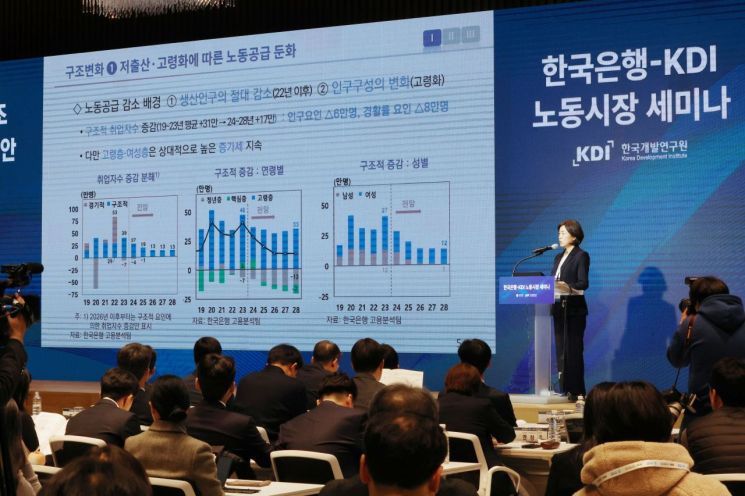
Seo Young-kyung, a member of the Monetary Policy Committee, said on the 5th, "If there is no structural improvement in the labor market, the burden on monetary policy will become excessive."
Seo attended the 'Bank of Korea-KDI Labor Market Seminar' held at the multipurpose conference hall of the Bank of Korea's integrated annex in Jung-gu, Seoul, and made this remark during her keynote speech on the topic of 'Macroeconomic Effects of Structural Changes in the Labor Market.'
Seo emphasized that South Korea's labor market is facing issues such as a slowdown in labor supply due to low birth rates and aging, a reduction in working hours, and a deepening mismatch in employment.
In fact, the number of employed people in South Korea has been declining. Although the number of employed increased at times due to higher economic participation rates among women and the elderly, labor supply is expected to slow to the 100,000 range next year due to a decrease in the working-age population caused by low birth rates and aging, as well as a decline in the average economic participation rate following the retirement of the first and second baby boomer generations.
Working hours per person have also steadily decreased. Since the introduction of the 52-hour workweek system in 2016, working hours have sharply declined, and factors such as rising income levels, a preference for leisure, and an increase in part-time jobs among the elderly have contributed to the reduction in working hours.
Seo stressed that this reduction in working hours is a factor behind the decline in the unemployment rate. She particularly noted that in the manufacturing sector, where the proportion of regular workers is high, the decrease in the unemployment rate is more pronounced.
Employment mismatches are also occurring. After the pandemic, labor supply increased mainly in low-skilled face-to-face service industries such as wholesale and retail, food and accommodation, and real estate brokerage, which reduced the average supply-demand mismatch. However, supply-demand mismatches in high-skilled service industries such as information and communication and professional scientific technology, as well as in manufacturing, have persisted.
Seo emphasized that such structural changes in the labor market are acting as factors hindering growth. Regarding the impact of labor market structural changes on inflation, she said, "There are both views of increase and decrease," but added, "In the short term, labor market tightness is closely related to inflation." She also mentioned that the recent easing of labor market tightness has contributed to the slowdown in inflation.
Seo highlighted that future challenges in the labor market lie in utilizing the elderly population, preventing career interruptions among women, and responding to polarization in employment demand. She pointed out the need to consider measures to utilize retirees from the first and second baby boomer generations by establishing flexible job and wage systems and supporting senior ventures.
She also mentioned the necessity of preventing career interruptions among women. To this end, she emphasized the importance of creating conditions for work-family balance by reducing not only the direct costs of childbirth but also the 'opportunity costs.'
Furthermore, to respond to polarization in employment demand, she explained that policies such as opening the labor market to foreign workers in high-skilled and low-skilled sectors, where labor shortages have intensified, are necessary.
© The Asia Business Daily(www.asiae.co.kr). All rights reserved.

















