This year, cocoa prices have surged by more than 50%, prompting global food companies such as Nestl? and Hershey to respond by reducing the chocolate content in their products. Instead of raising prices and risking consumer backlash, they are first cutting costs through 'shrinkflation' by lowering the expensive cocoa content.
According to Bloomberg on the 4th (local time), global food company Nestl? launched a new product in the UK last January with only about one-third the chocolate content of its previous products and began extensive promotion. Another food company, Hershey, added a product to its existing 'Chocolate Frosted Donut KitKat' line that is coated with chocolate on only half rather than the entire surface. This product contains below-average amounts of chocolate and cocoa butter compared to other KitKat products.
Last month, during the Super Bowl, the final game of the U.S. National Football League (NFL), food companies Mars and Hershey focused on selling M&M’s and Reese’s Cups filled with peanut butter coated with caramel instead of chocolate in vending machines. Additionally, Bloomberg reported that some food companies are exploring ways to reduce the cocoa butter content, which makes up about 20% of milk chocolate, replacing it with cheaper alternatives such as palm oil.
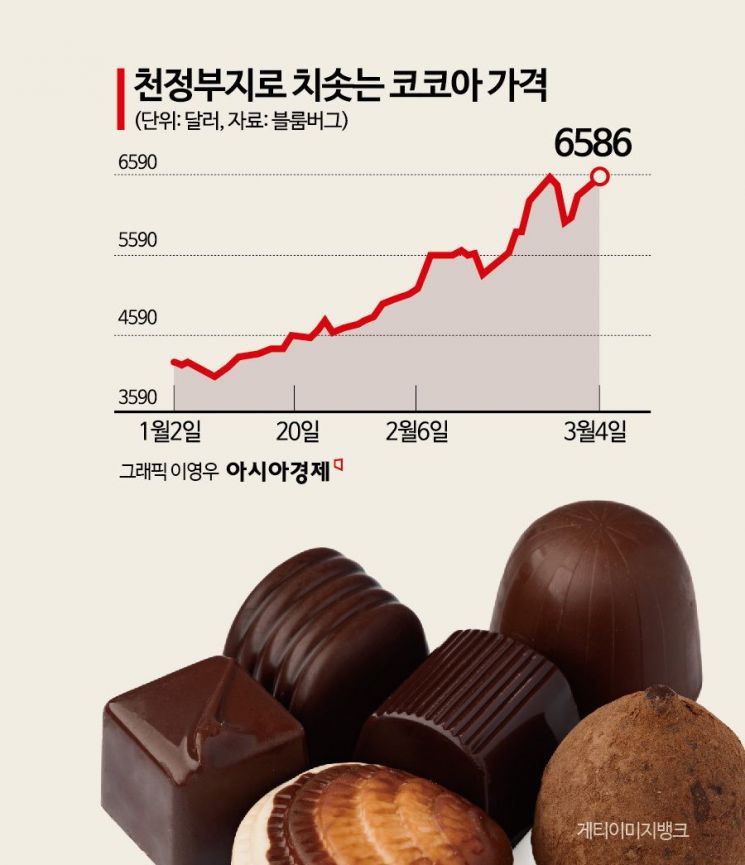
The reason global food companies are focusing on reducing cocoa content is that cocoa prices have skyrocketed. On the same day, cocoa futures prices on the Intercontinental Exchange (ICE) in New York rose 4.09% to $6,586 (approximately 8.78 million KRW). Cocoa prices have surged 54% so far this year and surpassed the $6,000 mark for the first time last month, continuing their upward trend. Cocoa-producing countries in West Africa, such as C?te d'Ivoire and Ghana, experienced severe droughts last year, drastically reducing production. Furthermore, heavy rains early this year caused outbreaks of diseases, worsening cocoa crop conditions.
Billy Robert, senior analyst at CoBank, a U.S. agricultural cooperative bank, said, "(Companies) are considering marketing products with lower chocolate content." Karl Quarsh III, head of food at market research firm Euromonitor International, noted that over 40% of chocolate bar products sold in the U.S. nowadays are filled with caramel, nuts, or fruit, adding, "This trend had subsided for a while but is expected to reemerge due to rising cocoa prices."
The upward trend in cocoa prices is expected to continue for some time. Consequently, gradual chocolate price increases are inevitable. Hershey and UK chocolate company Cadbury have recently mentioned product price hikes as a last resort response to rising cocoa prices. Bloomberg reported that "food companies are showing interest in diversifying their product lines due to cocoa price issues," expanding into products such as jelly and candy.
© The Asia Business Daily(www.asiae.co.kr). All rights reserved.

















