Professor Kim Hyuntak Presents 'PCPOSOS'... Claims "Room-Temperature Superconductor"
Introduces Sample via Photos and Videos Instead of On-Site Demonstration
Academic Conference Presentation Not Easily Accepted as Scientific Validation
Thorough Verification Required
Domestic researchers have revealed the levitation of a material claimed to be a room-temperature commercial superconductor. This material, called 'PCPOSOS,' was newly introduced by the research team behind 'LK-99,' which sparked controversy last year over whether it was a room-temperature, ambient-pressure superconductor. The academic community is expressing the view that thorough verification is needed rather than premature expectations this time as well.
 Research Professor Kim Hyuntak of William & Mary University in the United States is explaining the levitation of the material 'PCPOSOS,' claimed to be a room-temperature commercial superconductor, at the American Physical Society meeting held in Minneapolis, USA, on the 4th. Photo by Twitter capture
Hyuntak Kim, a research professor at William & Mary in the United States, presented research results on the material 'PCPOSOS,' claimed to be a room-temperature and ambient-pressure superconductor, at the superconductivity session of the American Physical Society (APS) March meeting held in Minneapolis, USA, at 8:12 a.m. local time on the 4th. Professor Kim was also one of the researchers involved in the LK-99 study at the Quantum Energy Research Institute. According to the APS website, Seokbae Lee, director of the Quantum Energy Research Institute, is also an author of this presentation. The domestic and international academic communities have previously concluded that LK-99 is not a superconductor.
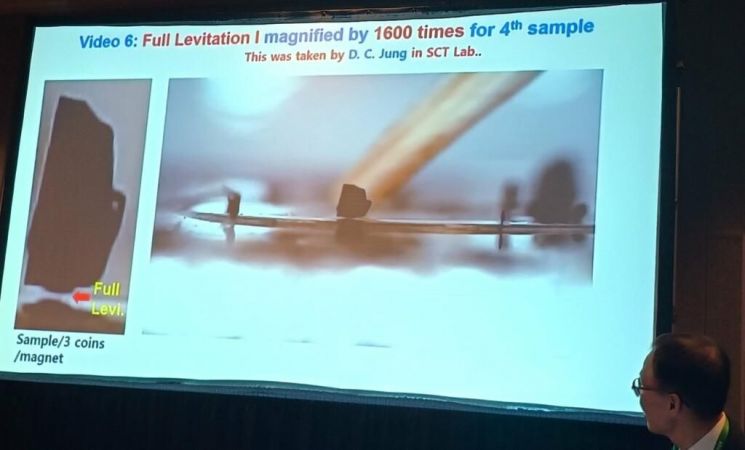
In his presentation, Dr. Kim claimed that the material PCPOSOS exhibited superconducting properties such as zero resistance, the Meissner effect (the phenomenon where a superconductor repels an external magnetic field), and partial levitation above a magnet, as previously disclosed in the abstract. Dr. Kim appeared to emphasize that PCPOSOS is a superconductor by showing photos of the material levitating above a magnet under certain conditions.
However, the presentation did not include a physical sample of the room-temperature, ambient-pressure superconductor that some had hoped to see. This has led to evaluations that the claims are one-sided.
Dr. Kim seemed aware of the verification controversies surrounding LK-99, emphasizing that the levitation video and zero-resistance experiments of PCPOSOS were conducted in a separate laboratory called 'STCL.' After Dr. Kim's presentation, STCL released a 20-second video on YouTube showing PCPOSOS levitating.
However, there was a lack of explanations to prove STCL's credibility, and the zero-resistance data released alongside the levitation video was also criticized for having too much noise to be clearly interpreted.
Since Dr. Kim announced that the production method of PCPOSOS would be disclosed on the preprint site 'arXiv' on the same day, verification attempts are expected to follow, similar to the LK-99 case.
Before this presentation, attention was focused on whether it could overturn the situation where LK-99 was not recognized by the academic community. Since it was a conference presentation, expectations spread that the academic community might acknowledge this announcement.
With interest rising both domestically and internationally, the venue was crowded with people eager to watch the presentation. On social media platforms such as X (formerly Twitter), many shared real-time updates of the event and its content. Victoria Menimen, editor of the British Physical Society Publishing, who witnessed the presentation on-site, tweeted on her X account that "several technical issues disrupted Dr. Kim's 10-minute presentation," reporting on the situation at the venue.
Petr Cermak, a researcher at Charles University in the Czech Republic, who shared the on-site situation on social media and participated in the Q&A, stated, "It was nothing new to me," adding, "The lecture did not bring new information. Everything remains speculative and highly unlikely."
On the other hand, Brian Wang, operator of the science blog 'Next Big Picture,' said, "The presentation proceeded in the form of releasing related videos as previewed in the abstract, and the approximately 10 minutes allocated by the conference was not enough time for a demonstration," while asserting, "This sample is potentially highly valuable." Wang also reported that the Chinese side is attempting to reproduce this sample.
The Quantum Energy Research Institute stated that Professor Kim's presentation had been scheduled since last year and is a routine activity as a physicist, adding that the institute has no official position on the announcement.
© The Asia Business Daily(www.asiae.co.kr). All rights reserved.
![Clutching a Stolen Dior Bag, Saying "I Hate Being Poor but Real"... The Grotesque Con of a "Human Knockoff" [Slate]](https://cwcontent.asiae.co.kr/asiaresize/183/2026021902243444107_1771435474.jpg)
















