Presiding over the 16th Public Discussion in Daegu
Accelerating Daegu-Gyeongbuk New Airport Construction
Promising 'Robot and Digital' Future Industry Hub
Emphasizing Medical School Expansion... "Will Invest Financially"
President Yoon Suk-yeol promised on the 4th to provide bold government support to ensure "revolutionary changes" in the construction of the Daegu-Gyeongbuk integrated new airport, a key long-cherished project of Daegu City with a target opening in 2030, the opening of the privately funded expressway, and the fostering of the robot, future mobility, and digital industries.
On the afternoon of the same day, President Yoon presided over the 16th Public Livelihood Discussion Forum at Kyungpook National University in Buk-gu, Daegu, under the theme "Daegu Rising with Advanced New Industries," emphasizing, "I will try to change Daegu ('bakka-boketda' in Daegu-Gyeongbuk dialect, meaning 'I will change it')."
President Yoon recalled Daegu’s past status as the former location of the Gyeongbuk Provincial Office and the birthplace of the textile industry and Samsung, stating, "President Park Chung-hee’s Saemaul Undong (New Village Movement), which revolutionized our spirit, also started nearby in Cheongdo and was first raised in Daegu and Gyeongbuk."
He said, "Although Daegu has played a significant role in Korea’s development, it is currently facing many difficulties," adding, "For Daegu to make a new leap forward, it must innovate its outdated industrial structure and significantly improve its old transportation infrastructure." He continued, "The government will provide bold support to enable revolutionary changes in Daegu."
'Catalyst for TK Transportation Network Innovation' Accelerating Construction of Daegu-Gyeongbuk New Airport
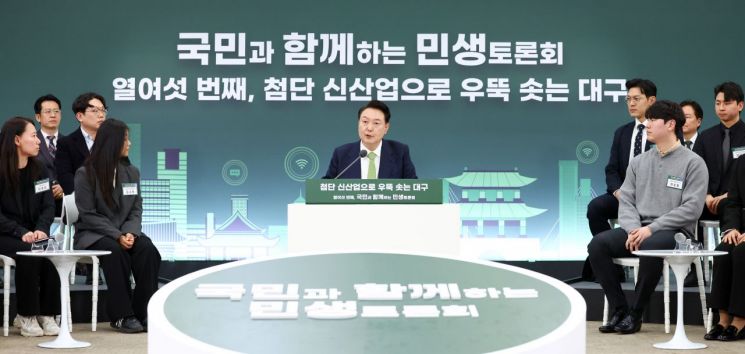
In particular, the central government will support the smooth construction of the Daegu-Gyeongbuk integrated new airport, targeted to open in 2030, and the construction of a metropolitan express railway connecting West Daegu, the new airport, and Uiseong to expand the linked high-speed transportation network. President Yoon’s plan is to push forward the construction of the Daegu-Gyeongbuk integrated new airport without delay and make it a catalyst for innovation in Daegu’s transportation network.
President Yoon said, "The construction of the new airport is a promise I made to you during my presidential campaign and a long-standing wish of Daegu citizens," adding, "We will accelerate the construction of the new airport to achieve the 2030 opening goal while also expanding the linked high-speed transportation network."
Regarding the time required to form the Special Purpose Corporation (SPC) responsible for the new airport construction, President Yoon urged the Ministry of Land, Infrastructure and Transport, saying, "Public enterprises such as LH and the Korea Airports Corporation should actively participate to expedite the launch of the SPC."
He also explained that the privately funded expressway passing through Palgongsan will open smoothly in time for the new airport’s opening, improving accessibility between East Daegu and Donggunwi. President Yoon emphasized, "We will decide on the candidate site for relocating the urban military base within this year and develop the existing airport site into an advanced industrial hub," adding, "This will improve military mission conditions, revitalize the Daegu-Gyeongbuk regional economy, and simultaneously achieve the three goals of national balanced development."
'Fostering Robots and Future Mobility... Establishing the National Patriotic Movement Memorial Hall'
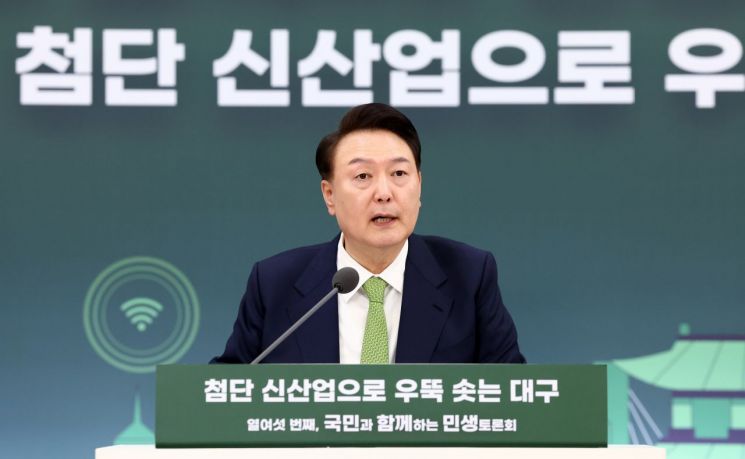
In addition to expanding the transportation network, plans were explained to make southwestern Daegu a hub for robots and future mobility, and the eastern part a hub for digital research and development (R&D).
President Yoon particularly emphasized, "Daegu’s traditional strengths in machinery, metal, and parts industries will serve as a foundation for robots and future mobility to lead the industry," adding, "We will support Daegu to make a great leap forward as an AI (artificial intelligence) and big data R&D forward base."
The government plans to invest 200 billion won in the 'National Robot Test Field' in Dalseong-gun, which passed the preliminary feasibility study last August. The National Robot Test Field is a space designed to simulate real environments across various fields such as logistics, commerce, and daily life, where the service quality, safety, and reliability of robots are tested.
President Yoon also announced plans to develop Suseong Alpha City in Daegu as a 'National Digital Innovation Zone' to become a core R&D hub, promising tax benefits and regulatory exemptions if Daegu City applies for an opportunity development special zone in Suseong Alpha City.
While supporting the success of the Daegu-type autonomous public high schools and agreement-type specialized high schools promoted in the Daegu Education Development Special Zone, the government also plans to develop culture and arts to create a virtuous cycle model where young people do not leave. The Daegu-type autonomous public high schools will receive educational support from universities and research institutes such as Kyungpook National University and Daegu Gyeongbuk Institute of Science and Technology (DGIST), while the agreement-type specialized high schools will operate customized specialized education linked to regional industries such as robots, mobility, health, and medical care. President Yoon promised to build a musical complex and the National Museum of Modern and Contemporary Art for Daegu’s culture and arts.
Furthermore, President Yoon said, "We will build the National Patriotic Movement Memorial Hall near Seomun Market, which will symbolize the patriotic city of Daegu," adding, "It will be a space to widely promote and inherit the spirit of Daegu, which has always taken the lead in national crises, including the National Debt Repayment Movement that started in Daegu."
Yoon: "Strongly Promoting Medical School Quota Expansion... Ensuring Local Benefits"
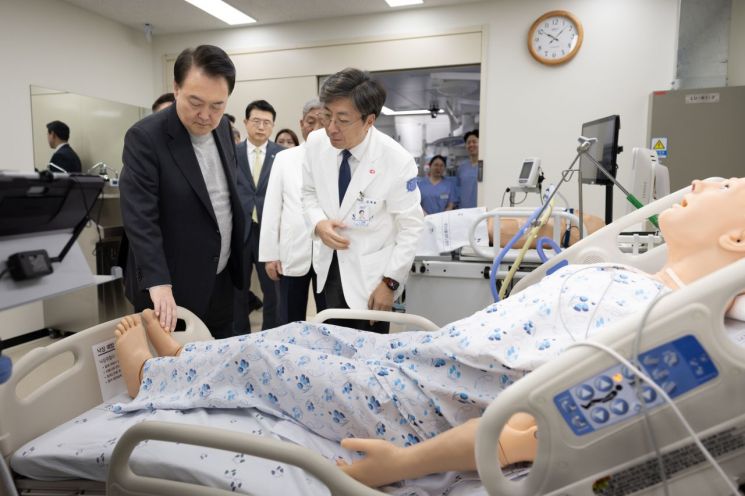 President Yoon Suk-yeol is touring the facilities during a visit to the "Smart Simulation Center" ahead of the "Eighth Public Discussion on Livelihood with the People: Medical Reform to Save Lives and Communities," held on the 1st of last month at Bundang Seoul National University Hospital in Seongnam, Gyeonggi Province.
 [Image source=Yonhap News]
Regional medical schools based in Daegu and Gyeongbuk were also a key topic at the discussion forum. President Yoon has emphasized in public forums such as the Public Livelihood Discussion Forums and Cabinet meetings that expanding medical infrastructure is essential not only for essential healthcare but also to prevent the collapse of local areas, and that increasing medical school quotas is necessary.
In his opening remarks, President Yoon stressed that the quotas of prestigious regional medical schools based in the area, such as Kyungpook National University, Yeungnam University, Keimyung University, and Daegu Catholic University medical schools, will be sufficiently increased, and the number of local talent quotas will be greatly expanded to ensure high-quality medical services in local areas. Regarding facility investments in national university medical schools, he said, "The government is currently strongly promoting the increase of medical school quotas," adding, "We will make sure that local areas, including Daegu, fully benefit from this."
Hong Won-hwa, president of Kyungpook National University, who attended as a panelist, said, "Compared to Seoul, the medical environment in Daegu and Gyeongbuk has fewer doctors and very outdated facilities. We plan to apply to the Ministry of Education to increase the medical school quota from 110 to 250 students by adding 140," and earnestly requested, "When the medical school quota increases by 230%, the number of faculty members capable of ensuring education must be secured."
President Yoon responded, "The government will actively support this. Do not worry," reiterating the necessity of expanding medical school quotas. He also evaluated Kyungpook National University Medical School and Kyungpook National University Hospital as top-level medical institutions but acknowledged the reality of essential and less-preferred medical fields, responding to President Hong’s remark that "there was a shortage of disaster response and forensic doctors even during the Daegu subway fire disaster," saying, "I also feel this very keenly. When I worked as a prosecutor in Daegu about 30 years ago, there was only one forensic medicine professor at Kyungpook National University Medical School."
Moreover, President Yoon mentioned that during the 2000 separation of drug prescribing and dispensing, medical school quotas were reduced by 350, and about 700 graduates annually, roughly 25%, enter non-reimbursed fields, stating, "The essential and regional medical system cannot hold up," emphasizing, "Quota expansion is a necessary condition, and providing incentives for doctors to work harder is a sufficient condition."
He stressed, "The government will firmly invest financially in regional base medical schools and base hospitals, so do not worry and proceed with medical school expansion." The day of the forum was also the deadline for 40 universities nationwide to submit their medical school quota increase demands to the Ministry of Education.
Additionally, President Yoon promised to promptly resolve odor problems from the dyeing industrial complex, landfill, and sewage treatment plant, which have been causing inconvenience to Daegu citizens.
About 100 people, including entrepreneurs, parents, students, local residents, and Daegu City Local Era Committee members engaged in advanced industries such as robots, secondary batteries, and data in the Daegu region, attended the discussion forum. From the government and local governments, Woo Dong-gi, chairman of the Local Era Committee; Han Hwa-jin, Minister of Environment; Baek Won-guk, 2nd Vice Minister of Land, Infrastructure and Transport; Hong Joon-pyo, Mayor of Daegu Metropolitan City; Kang Eun-hee, Superintendent of Daegu Metropolitan Office of Education; Hong Won-hwa, president of Kyungpook National University; and from the Presidential Office, Lee Gwan-seop, Chief Secretary; Sung Tae-yoon, Policy Chief; Hwang Sang-moo, Senior Secretary for Civil Society; Park Chun-seop, Senior Secretary for Economic Affairs; and Jang Sang-yoon, Senior Secretary for Social Affairs, participated together.
© The Asia Business Daily(www.asiae.co.kr). All rights reserved.



















