Samgyeopsal Prices Down 17% Over Past 6 Months Amid Continued Decline
Supply Surplus and Weak Demand Cause Supply-Demand Imbalance
Pig Breeding Cycle Suggests Price Rise Expected from April
The price of pork continues to decline. This is because consumption remains sluggish due to high inflation and an economic downturn, with demand not increasing while supply has surged rapidly. However, there are concerns that pork prices may have hit bottom and could rise quickly as slaughter volumes are adjusted to resolve supply-demand imbalances, and the production decrease period approaches due to the pig breeding cycle.
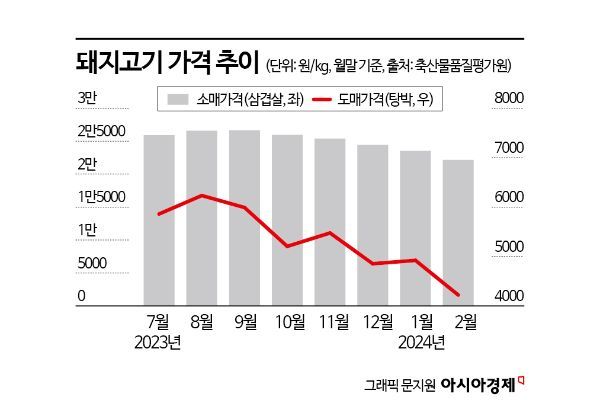
According to the Livestock Products Quality Evaluation Service on the 5th, as of the end of last month, the wholesale price of pork carcasses (pigs that have been skinned) was 4,222 KRW per kilogram, down 14.2% compared to the end of January (4,922 KRW) and 11.7% compared to February last year (4,782 KRW). The wholesale price of pork has been continuously falling since it recorded 6,233 KRW per kilogram at the end of August last year. The 6,000 KRW mark was broken at the end of September last year (5,991 KRW), the 5,000 KRW mark fell at the end of December (4,854 KRW), and last month it dropped to the low 4,000 KRW range.
As wholesale prices fall, retail prices sold at large supermarkets and traditional markets are also declining. At the end of last month, the nationwide average retail price of pork belly was 22,160 KRW per kilogram, down 5.8% from a month earlier (23,520 KRW) and 7.2% from a year earlier (23,890 KRW). Compared to the end of August when wholesale prices began to fall (26,570 KRW), it has dropped 16.6% over six months.
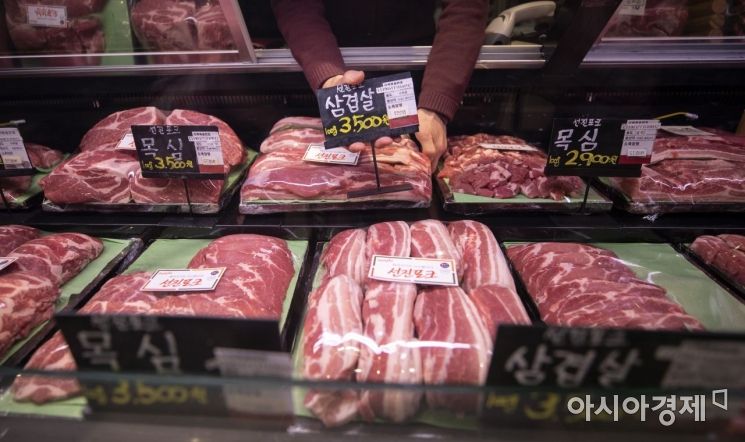
The continuous decline in pork prices is due to ongoing supply-demand imbalances. While demand remains stagnant due to sluggish consumption amid high inflation, supply continues to increase. Both the number of pigs raised and slaughtered in the domestic pig farming industry increased last year. As of the end of last year, the total number of pigs raised domestically was 12.06 million, up 1.6% from a year earlier (11.87 million) and 2.2% higher than the average year (11.8 million). As the number of pigs raised increased, the number of pigs slaughtered also rose. In January, 1.831 million pigs were slaughtered, a 19.3% increase compared to the same period last year (1.534 million).
The increase in pork imports has also contributed to oversupply. In January, pork imports reached 40,000 tons, a 36.4% increase compared to the same period last year. The representative item, pork belly, saw imports rise to 15,162 tons, up 24.6% from 12,164 tons in the same period last year. Last month, 38,000 tons were imported, a 16.2% increase from 33,000 tons in February last year. Additionally, the government's application of a 0% tariff on imported pork until the end of last year to stabilize consumer prices has resulted in a large volume of imported pork still circulating in the market, which also affects the price decline.
Although pork prices have been falling for several months, consumers should not be complacent. Prices may begin to rise soon. Pork supply is fundamentally affected by seasonal factors, with supply typically decreasing in summer and increasing in winter according to the pig breeding cycle. It takes about 10 to 11 months from pregnancy to slaughter, including a 4-month gestation period and a 6-month growth period. However, during the hot months from June to September, the conception rate of sows (female pigs) drops. The pigs conceived during this period are shipped starting in April, and production begins to decline sharply from that point.
Supply is expected to start decreasing from this month. According to the Korea Rural Economic Institute, the number of pigs slaughtered in March is expected to be between 1.56 million and 1.6 million, down from 1.7 million in the same period last year, and imports are also expected to decrease to around 38,000 tons from 39,000 tons last year. However, due to existing inventory, price increases are expected to be limited this month.
However, as the decline in the number of pigs raised and slaughtered intensifies, pork prices are expected to shift back to an upward trend. Kim Tae-hwan, a researcher at the Korea Rural Economic Institute, predicted, “The number of pigs expected to be slaughtered this year is forecasted to decrease compared to last year due to a reduction in the number of sows and thus a decrease in the number of pigs raised.” He added, “However, the number of pigs slaughtered may fluctuate depending on the occurrence of consumptive pig diseases such as Porcine Reproductive and Respiratory Syndrome (PRRS) and Porcine Epidemic Diarrhea (PED).”
© The Asia Business Daily(www.asiae.co.kr). All rights reserved.
![Clutching a Stolen Dior Bag, Saying "I Hate Being Poor but Real"... The Grotesque Con of a "Human Knockoff" [Slate]](https://cwcontent.asiae.co.kr/asiaresize/183/2026021902243444107_1771435474.jpg)

















