Naju City in Jeollanam-do is making multifaceted efforts to prevent ‘fire blight,’ a bacterial disease known as foot-and-mouth disease for fruit trees.
According to Naju City (Mayor Yoon Byung-tae) on the 4th, fire blight is a bacterial disease that causes the most fatal damage to Rosaceae plants such as pear and apple.
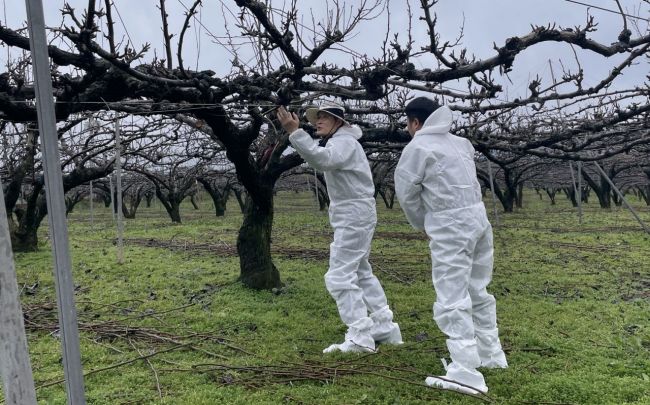 A representative from the Naju Agricultural Technology Center is conducting on-site surveillance to prevent fire blight disease in fruit trees.
 [Photo by Naju City]
When it occurs, leaves, flowers, branches, stems, and fruits wither black as if burned, and in severe cases, the entire tree dies.
Above all, it spreads rapidly and there is no treatment after infection, so it is so fatal that the entire orchard must be buried immediately upon occurrence, making thorough management and prior prevention the only solution.
The city will invest 860 million won this year in operating control teams and supplying chemicals for the prevention of fire blight.
First, from mid-January to mid-April, the intensive management period for fire blight prevention, the city has focused on field surveillance guidance for winter ulcer removal and operates surveillance and control teams year-round aiming for zero occurrence of fire blight.
The control teams patrol the entire orchard area of 1,713 hectares in the jurisdiction, proactively monitor the disease, guide reporting of suspected infections, and instruct on pruning techniques for ulcerated areas.
The Agricultural Technology Center has conducted fire blight prevention education 10 times for about 1,200 farmers and is also working with town and township administrative welfare centers and farmer counseling offices to provide guidance on preventive practices to farms.
In addition, considering the warmer winter weather compared to average years, which caused early dormancy release of pear and apple trees, the distribution of fire blight control chemicals will be advanced by ten days from last year and is scheduled to be distributed from the 4th to the 12th of this month.
Chemicals will be supplied to 2,226 farms that applied in advance at the end of last year, selecting three types of chemicals according to the area, through Naju Pear Horticultural Cooperative, town and township administrative welfare centers, and village heads.
Farmers are to spray the chemicals once in winter and twice during flowering according to the usage instructions for each chemical, and must keep the empty chemical containers for one year after use.
Jo Seong-eun, head of the Naju Agricultural Technology Center, said, “With the determination of ‘I protect my orchard,’ we hope farmers will thoroughly manage their orchards by regular surveillance, disinfecting tools, and controlling outside access,” adding, “We will do our best to operate the fire blight control teams and supply chemicals to maintain the reputation of the premium Naju pear and produce high-quality fruit for each farm.”
Naju = Kim Yuk-bong, Honam Reporting Headquarters, Asia Economy baekok@asiae.co.kr
© The Asia Business Daily(www.asiae.co.kr). All rights reserved.

















