Daegu-Gyeongbuk New Airport Targeted to Open in 2030
Daegu Southeast Region to New Airport Travel Time Reduced by Over 15 Minutes
The Daegu-Gyeongbuk Integrated New Airport (hereinafter referred to as the New Airport), aiming to open in 2030, will begin construction next year. The Palgongsan Tunnel Expressway, which will reduce travel time from the southeastern Daegu area to the New Airport by more than 15 minutes, will be promoted as a private investment project this year.
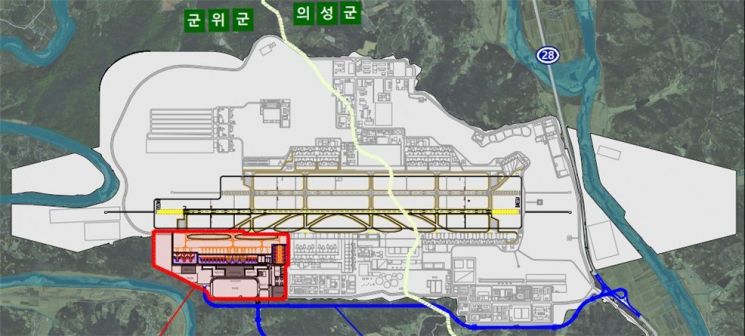 Daegu-Gyeongbuk Integrated New Airport Civil Airport Facility Plan / Image provided by the Ministry of Land, Infrastructure and Transport
On the 4th, the Ministry of Land, Infrastructure and Transport announced these plans at the 16th Public Discussion held at Kyungpook National University under the theme "Daegu Rising with Advanced Industries."
The New Airport, to be constructed on a 17.82 million square meter area spanning Sobo-myeon, Gunwi-gun, Daegu, and Bian-myeon, Uiseong-gun, Gyeongbuk, will be the first case where both civilian and military airports are relocated together, expected to serve as a hub airport for the central and southern regions.
Regarding the military airport, a basic plan for relocation was established in August 2022, and in November last year, a memorandum of understanding was signed between the Ministry of National Defense and Daegu City. Daegu City is proceeding with the military airport relocation through a special purpose corporation (SPC) established for the development of the former site, following the donation-for-transfer project procedure (where those who donate alternative facilities to the project management institution are granted ownership of the decommissioned property to relocate state-owned facilities). The existing Daegu Airport site will be developed into a complex space for advanced industries and residential culture.
Daegu City is currently negotiating participation with public institutions and private companies to form the SPC within the first half of this year. Public institutions involved in the discussions include local public enterprises such as Daegu Urban Development Corporation, Daegu Transportation Corporation, Gyeongbuk Development Corporation, as well as Korea Land and Housing Corporation (LH) and Korea Airports Corporation.
The civilian airport will be built as an economic logistics airport and a carbon-neutral, smart airport equipped with advanced information and communication technology (ICT). It will have facilities capable of handling 12.26 million passengers and 218,000 tons of cargo by 2060, with a 3,500-meter runway to accommodate medium- and long-distance routes. Since the announcement of the preliminary feasibility study results in August last year, the project has been exempted from the preliminary feasibility study and has been establishing the basic plan since December. Design and construction are planned for next year.
To secure accessibility to the New Airport, the New Airport Railroad and the Palgongsan Tunnel Expressway project are also being promoted.
This expressway is a 25.3 km road directly connecting Dongdaegu and Gunwi areas. It will reduce travel time from southeastern Daegu to the New Airport by more than 15 minutes. Based on the economic feasibility study (B/C=1.29) secured by Daegu City in November last year to promote the project as a private investment, private companies are being consulted for participation.
A Ministry of Land, Infrastructure and Transport official stated, “If proposed as a private investment project, we will promptly proceed with follow-up procedures such as requesting eligibility reviews to ensure the project advances quickly.” The Ministry of Economy and Finance also plans to submit the agenda to the Private Investment Project Deliberation Committee after the Korea Development Institute (KDI) completes the private investment eligibility review to proceed with subsequent steps.
© The Asia Business Daily(www.asiae.co.kr). All rights reserved.

















