The Financial Services Commission announced on the 4th that it will conduct a notice of regulatory changes to the partial amendment of the "Supervisory Regulations on Financial Consumer Protection" until April 15 to enhance the rationality, transparency, and fairness of early repayment fees.
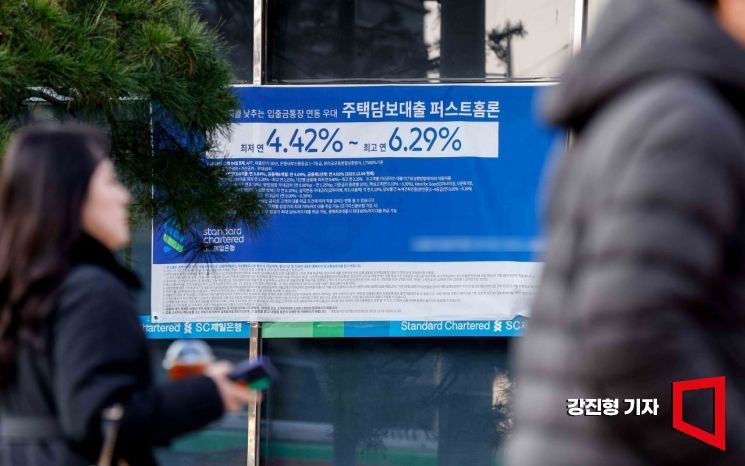 On the 26th, when the 'Stress DSR,' which precisely reflects future interest rate fluctuation risks in the Debt Service Ratio (DSR), was implemented, a real estate mortgage loan interest rate table was posted on the exterior wall of a branch of a commercial bank in Seoul. The Stress DSR system is a measure that applies an additional interest rate (stress interest rate) when calculating the DSR, considering the possibility that borrowers using variable interest rate loans may face increased principal and interest repayment burdens due to rising interest rates during the loan period. The stress interest rate applied until the first half of this year is 0.38%. Photo by Jin-Hyung Kang aymsdream@
Currently, early repayment fees are generally prohibited under the Act on the Protection of Financial Consumers (Financial Consumer Protection Act), but an exception allows fees to be charged if the consumer repays within three years from the loan date.
However, there have been criticisms that early repayment fees are uniformly imposed without reasonable charging criteria considering the financial companies' business practices and product characteristics. In fact, the early repayment fees for mortgage loans at the five major commercial banks are all the same despite differences in each bank's situation: 1.4% for fixed (mixed) interest rates and 1.2% for variable interest rates.
Accordingly, the authorities plan to amend the regulations to ensure that early repayment fees are charged only within actual costs such as losses due to disruption in fund management and administrative and recruitment costs related to loans, and to prohibit adding other items beyond these costs as unfair business practices under the Financial Consumer Protection Act.

Additionally, the financial authorities will work with the financial sector to prepare model guidelines to ensure that necessary measures following this amendment are implemented smoothly, and will also require disclosure of the criteria for calculating early repayment fees as well as the status of imposition and exemption.
Meanwhile, the amendment is expected to be finalized in the second quarter of this year and implemented six months thereafter. Along with the implementation, revisions to the model guidelines and improvements to the comparison and disclosure system will also be completed.
© The Asia Business Daily(www.asiae.co.kr). All rights reserved.


















