BAI100 1787... Lowest Since Late February 2020
Entering Early Year Off-Season... Impact of Major Production Facility Shutdowns
Ocean Freight Rates Steady... Red Sea Windfall 'Not Much'
Global air cargo freight rate indices have fallen back to pre-COVID-19 pandemic levels. This is attributed to the first quarter being a traditional off-season and the combined effects of production facilities closing around the year-end and New Year period. There are also expectations that this will impact the bidding price for the sale of Asiana Airlines' cargo division.
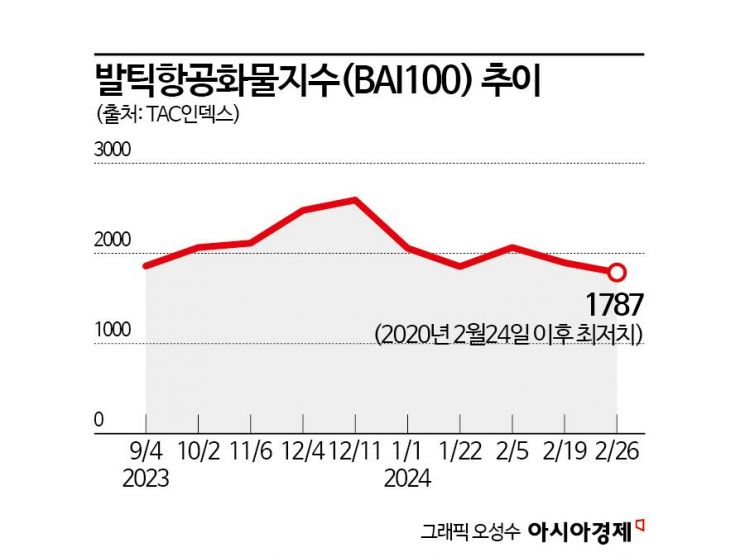
According to the Hong Kong TAC Index, which publishes global air cargo freight indices, the Baltic Air Freight Index (BAI100) for the last week of February was recorded at 1787.00. After soaring to 2591.00 at the end of last year due to a surge in air cargo demand, it has declined to the 1700 level for the first time in four years. This is the lowest since the fourth week of February 2020, before COVID-19 spread widely, when it was 1692.00. It represents a drop to about one-third of the peak of 5254.00 at the end of 2021, when the COVID-19 demand surge was at its height.
Freight rates on major routes are also mostly declining. The air cargo freight rate on the Hong Kong-North America route rose from $4.69 per kg in July last year to $7.10 per kg at year-end, but fell 26.5% to $5.22 per kg as of January. This is close to the $5.26 per kg level seen in September 2020. Freight rates on the Hong Kong-Europe and Frankfurt-North America routes also dropped by 23.1% and 17.0%, respectively, during the same period.
Industry insiders attribute this to the off-season leading to reduced cargo demand and the fact that the threat from the Houthi rebels has not significantly affected air freight rates. Despite instability in the Red Sea trade routes, ocean freight rates remain high. According to the Shanghai Shipping Exchange, the Shanghai Containerized Freight Index (SCFI) was 1979.12 on the 1st of this month. Although this is a 6.2% decrease from the previous week, it still exceeds twice the level of the first week of March last year. This suggests that the Red Sea situation has not brought significant benefits to shipping rates. An industry source explained, "Since air cargo and ocean freight have inherently different characteristics, the expected benefits were only partially priced in. As those expectations fade, freight rates are stabilizing."
The decline in air cargo freight rates could also affect the valuation of Asiana Airlines' cargo division, which is currently up for sale. The estimated sale price for Asiana Airlines' cargo division is around 500 billion to 700 billion KRW, but industry insiders expect the acquisition cost, considering debts and other factors, to exceed 1.5 trillion KRW. Currently, Jeju Air, Air Premia, Eastar Jet, and Air Incheon are participating in the preliminary bidding. An aviation industry official commented, "There are already concerns that the sale price is high due to debts and the cost of replacing aging aircraft, and depending on future air cargo freight rate forecasts, there is a strong possibility of further price negotiations."
© The Asia Business Daily(www.asiae.co.kr). All rights reserved.
![User Who Sold Erroneously Deposited Bitcoins to Repay Debt and Fund Entertainment... What Did the Supreme Court Decide in 2021? [Legal Issue Check]](https://cwcontent.asiae.co.kr/asiaresize/183/2026020910431234020_1770601391.png)

















