At the ‘Mobile World Congress (MWC) 2024,’ where a global alliance for the adoption of AI (artificial intelligence) in the telecommunications industry is being promoted, Samjong KPMG identified the key trends of MWC 2024 as ▲AI ▲6G ▲form factor ▲semiconductors ▲mobility in its report titled ‘The Future of the ICT Industry Seen Through MWC 2024,’ published on the 4th.
Held annually in Barcelona, Spain, MWC is the world’s largest mobile communications exhibition, with over 2,400 companies from 200 countries and approximately 93,000 visitors attending this year. A total of 165 Korean companies also participated.
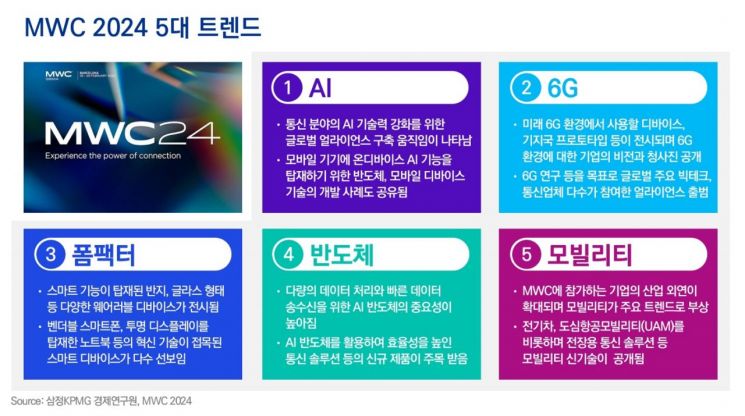
In the AI sector, innovative cases based on AI in the telecommunications industry, such as efficient network management solutions and large-scale data processing capabilities, were introduced. The expansion of smart device lineups based on on-device AI also attracted attention. Lenovo, having launched a laptop equipped with on-device AI functions in January, unveiled new products diversifying its on-device AI laptop lineup at MWC 2024.
Ericsson LG, a joint venture between Swedish telecommunications equipment company Ericsson and LG Electronics, exhibited prototypes of terminals and base stations for the upcoming 6G era. During the MWC 2024 event, major global big tech and telecommunications companies such as Samsung Electronics, NVIDIA, ARM, Microsoft, and Ericsson launched the ‘AI-RAN Alliance’ aimed at researching 6G technology and expanding its ecosystem.
Many next-generation smart devices incorporating various wearable technologies were also introduced. Samsung Electronics unveiled the actual smart ring ‘Galaxy Ring,’ equipped with a biosignal detection sensor, for the first time. The U.S. startup Humain exhibited a smart device operated through voice communication with an AI assistant without a separate display via its ‘AI Pin.’
As the importance of AI semiconductors related to data processing speed capabilities grows, NVIDIA introduced a DGX server-based cloud system utilizing AI semiconductors. Global semiconductor companies such as Samsung Electronics, SK Hynix, AMD, Intel, and Qualcomm presented network and mobility solutions centered on AI semiconductor technology.
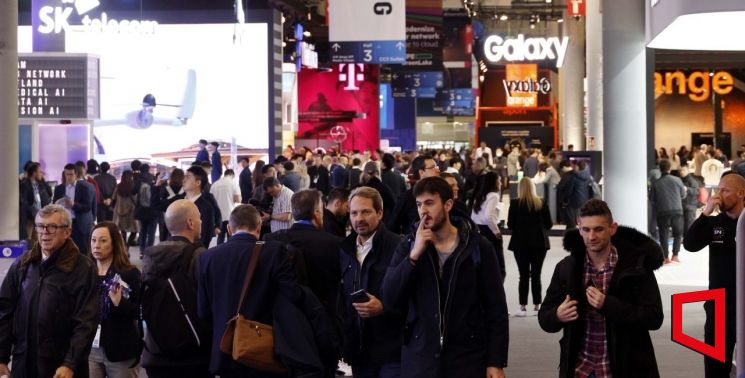 On the morning of the opening day, the 27th (local time), visitors are exploring the Fira Gran Via exhibition center in Barcelona, Spain, at the world's largest mobile telecommunications exhibition, Mobile World Congress (MWC) 2023. At this MWC, the telecom companies' move beyond traditional telecommunications with AI robots and other technologies, along with network usage fees, are expected to be the biggest topics. Photo by Joint Press Corps
In the mobility sector, intelligent future cars utilizing telecommunications technology were also a hot topic. SK Telecom collaborated with U.S. air taxi manufacturer Joby Aviation to operate an urban air mobility (UAM) boarding experience space based on LED screens on the route between Gimpo Airport and Walkerhill. KT introduced an intelligent traffic management system for UAM operations using aviation network-specialized network technology.
Seongbae Park, Vice President of Samjong KPMG, stated, “In addition to the competition among telecommunications companies in 6G and form factor innovation, strategic moves to secure technological superiority based on collaboration with related industries such as semiconductors and mobility have emerged. It is time for telecommunications companies to proactively capture newly created business opportunities in AI and mobility based on their accumulated experience in convergence with other industries.”
© The Asia Business Daily(www.asiae.co.kr). All rights reserved.
![Clutching a Stolen Dior Bag, Saying "I Hate Being Poor but Real"... The Grotesque Con of a "Human Knockoff" [Slate]](https://cwcontent.asiae.co.kr/asiaresize/183/2026021902243444107_1771435474.jpg)

















