Over the past 20 years, South Korea has led the world in patent applications for screen sports. In particular, the global screen sports market is expected to grow from 4.7 trillion KRW in 2022 to 11.1 trillion KRW in 2029, with an average annual growth rate of 13.1%. This makes it increasingly important for domestic companies to develop screen sports-related technologies and secure patents to gain a competitive edge.
On the 4th, the Korean Intellectual Property Office (KIPO) analyzed the status of screen sports patent applications filed with the world's top five patent offices (Korea, the United States, Japan, Europe, and China, hereinafter IP5). From 2002 to 2021, a total of 2,938 screen sports-related patents were filed with the IP5. During the same period, South Korea filed 1,715 screen sports-related patents, accounting for 58.4% of the total (the highest in the world).
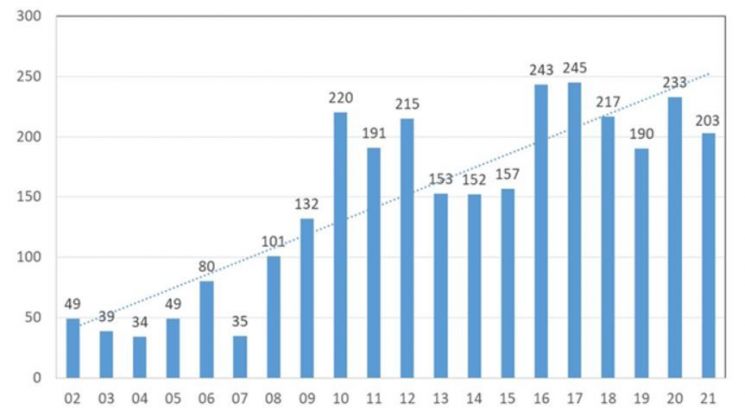 Status of screen sports patents filed in IP5 by year from 2002 to 2021. Provided by the Korean Intellectual Property Office
By nationality, the United States accounted for 17.0% (500 patents), Japan 8.9% (262 patents), China 6.4% (188 patents), and Denmark 4.1% (119 patents), following South Korea in the share of screen sports-related patents.
It is analyzed that patent applications in the screen sports field have paralleled the growth of the screen golf market. Around 2016, when domestic screen golf companies such as Golfzon and SG Golf began to grow in earnest, patent applications in the screen sports field also surged sharply.
The number of applications, which was only 49 in 2002, increased to 220 in 2010, 191 in 2011, and 215 in 2012, averaging about 200 applications annually over three years. After a slight slowdown to around 150 applications from 2012 to 2015, patent applications again surpassed 240 in 2016.
In the trend of screen sports patent applications, the strong performance of domestic screen golf companies stood out. From 2002 to 2021, among the top patent applicants in the IP5, the domestic company Golfzon filed a total of 463 patents (15.8%), ranking first, and SG Golf filed 132 patents (4.5%), ranking second.
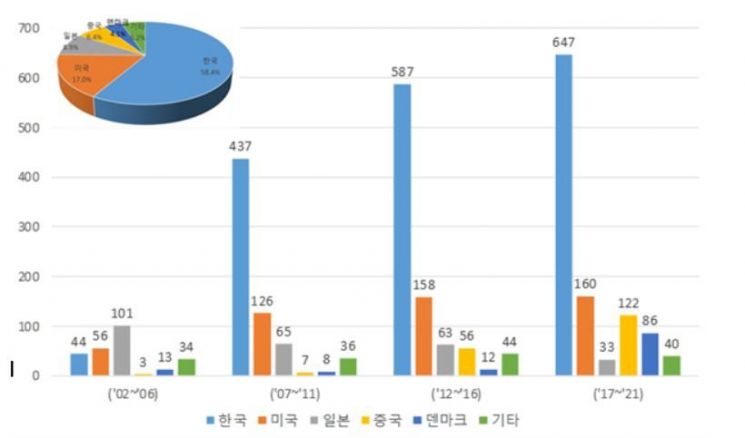 Status of screen sports patents filed by nationality in IP5 from 2002 to 2021. Provided by the Korean Intellectual Property Office
Additionally, X-Golf filed 66 patents (2.2%, 5th place), Real Baseball Zone 50 patents (1.7%, 6th place), Electronics and Telecommunications Research Institute (ETRI) 36 patents (1.2%), and Real Design Tech 30 patents (1.0%) were also among the top 10, demonstrating that domestic companies have led global screen sports-related patent applications.
By technology, patent applications related to peripheral devices such as ball supply and swing mats accounted for 1,536 cases (52.3%), more than half of the total. Content-related patents, such as golf and baseball simulation, accounted for 882 cases (30.0%), sensing technologies including ball tracking and motion sensors 324 cases (11.0%), and visualization technologies such as motion image processing and mini-map provision 196 cases (6.7%) followed in proportion.
Recently, patent applications related to sensing and visualization technologies have shown a noticeable increase. Compared to 2012?2016, sensing technology patent applications increased from 94 to 177 cases in 2017?2021, and visualization technology patent applications rose from 60 to 89 cases. This is interpreted as a result of the industry accelerating technology development to implement screen sports with a more immersive experience.
Lee Sang-ho, an examiner at the Household Goods Examination Division of the Korean Intellectual Property Office, said, “Screen sports are not only complementing or substituting on-site sports but are also becoming established as a new popular culture. As the screen sports market grows, global technological competition is expected to intensify, making it a crucial time for domestic companies to secure patent competitiveness.”
He added, “The Korean Intellectual Property Office will strive to provide high-quality patent examination services so that domestic companies can consistently maintain global competitiveness in the screen sports market.”
© The Asia Business Daily(www.asiae.co.kr). All rights reserved.


















