Most Commonly Done Together: USA, Australia, Korea
"Responding to China's Military Expansion and Maritime Advances, North Korea's Nuclear and Missile Threats"
Japan's Self-Defense Forces participated in 56 multinational joint exercises last year, an 18-fold increase compared to 2006, when the current operational system was established. More than 60% of these exercises were high-level 'tactical and combat training' conducted under the assumption of emergencies, in response to China's expanding maritime presence and North Korea's nuclear and missile threats.
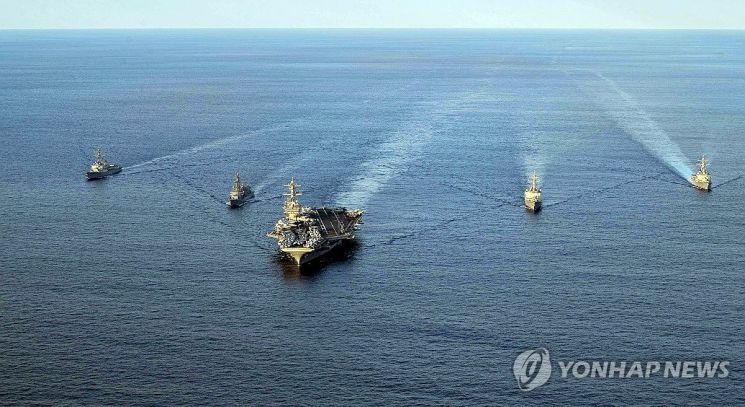
On the 3rd, Japan's Yomiuri Shimbun reported that the Japanese Ministry of Defense established the Joint Staff Office in 2006, equivalent to South Korea's Joint Chiefs of Staff, creating a system that integrates the operations of the three Self-Defense Forces: Ground, Maritime, and Air.
According to Yomiuri Shimbun's analysis of training data published by the Self-Defense Forces since then, multinational joint exercises were held only three times in 2006 but gradually increased to between 2 and 10 times annually, reaching 20 times in 2013. This period coincided with heightened tensions when Maritime Self-Defense Force escort ships were targeted by firing radar from Chinese vessels. The number rose to 30 times in 2016 and surged to 56 times last year.
Yomiuri explained that 2016 was the year when a Chinese aircraft carrier appeared in the Pacific Ocean for the first time. Conversely, joint exercises significantly decreased in 2018, when peace sentiments were fostered on the Korean Peninsula due to the North Korea?United States summits, and in 2020, during the global COVID-19 pandemic.
Joint exercises cover a wide range of activities involving multiple countries' militaries, from searching for distressed ships and transporting humanitarian supplies to detecting submarines and intercepting ballistic missiles. To facilitate these joint exercises, Japan has signed the 'Acquisition and Cross-Servicing Agreement' (ACSA), which allows participating countries to mutually provide supplies such as food and fuel, with the United States, Australia, the United Kingdom, Canada, India, and Germany.
"Multilateral exercises see participation from countries emphasizing shared values"
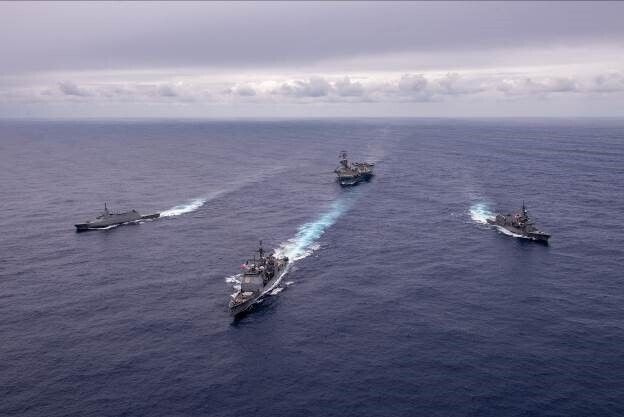 The U.S. Navy and the Japan Maritime Self-Defense Force conducted joint exercises in September last year.
 [Photo by Japan Maritime Self-Defense Force SNS]
Training that includes tactical and combat elements has increased since the 2010s, accounting for 64% of the total last year. These exercises, assuming emergency scenarios, were often conducted with a small number of countries that maintain close relations, such as the United States and Australia.
There were 18 exercises around Japan, including the Sea of Japan targeting North Korea, the Senkaku Islands (Chinese name Diaoyu Islands), and the East China Sea where Taiwan is located, 10 in Southeast Asia, and 4 in the South China Sea. Among Japan's joint exercises, the United States, an ally, participated the most with 50 times, followed by Australia (23 times) and South Korea (16 times).
Yomiuri Shimbun emphasized, "Amid China's military threats and North Korea's continued missile launches, the Self-Defense Forces are strengthening deterrence by cooperating with countries in the Indo-Pacific region." Yasuhiko Kawakami, a security research group member affiliated with the Sasakawa Foundation, told Yomiuri, "Multilateral exercises involve countries that emphasize shared values such as 'realizing a free and open Indo-Pacific' participating simultaneously," adding, "It sends a strong message to China and others."
© The Asia Business Daily(www.asiae.co.kr). All rights reserved.
![Clutching a Stolen Dior Bag, Saying "I Hate Being Poor but Real"... The Grotesque Con of a "Human Knockoff" [Slate]](https://cwcontent.asiae.co.kr/asiaresize/183/2026021902243444107_1771435474.jpg)

















