40.6% of Working Women Experience Wage Discrimination
2nd Place Recruitment and Hiring Discrimination... 3rd Place Education and Promotion Discrimination
A survey revealed that 4 out of 10 working women have experienced gender discrimination by receiving lower wages than men for doing the same work. The proportion of male workers who reported experiencing wage discrimination was half that of women, with 2 out of 10 men responding affirmatively.
The civic group Workplace Bullying 119 commissioned the public opinion research firm Global Research to conduct a survey on "Experiences of Gender Discrimination in Employment at the Workplace" among 1,000 workers nationwide from the 2nd to the 13th of last month, and announced the results on the 3rd.

According to the survey, when asked, "Have you ever experienced discriminatory treatment where wages were paid differently based on gender for work of equal value?" 40.6% of the 431 female respondents answered yes. Among male respondents, 21.8% of the 569 answered that they had experienced such discrimination.
In fact, South Korea is known to have the largest gender wage gap among OECD member countries. As of 2021, South Korea's gender wage gap stands at 31.1%, meaning that when men earn 1 million won, women earn 689,000 won.
When asked, "Have you ever experienced gender discrimination during recruitment and hiring?" 34.6% of women and 22.0% of men responded affirmatively. Gender discrimination at the recruitment and hiring stage refers to denying recruitment or hiring opportunities to a specific gender or hiring a particular gender at a lower rank or position compared to the other gender despite similar educational background or experience.
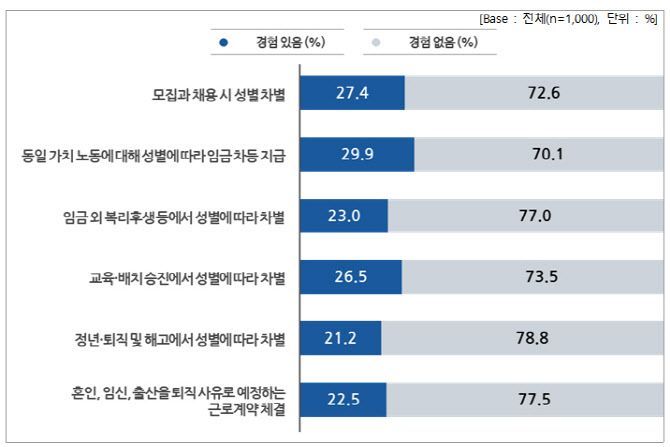
Regarding experiences of gender discrimination in job placement or promotion, 35.5% of women and 19.7% of men responded affirmatively, showing nearly double the gap. In terms of welfare benefits such as payments other than wages, 29% of female respondents reported experiencing discrimination, while 18.5% of men reported the same type of discrimination.
Following wage discrimination, the types of employment gender discrimination with high response rates were "gender discrimination during recruitment and hiring" (27.4%) and "gender discrimination in education, placement, and promotion" (26.5%). Notably, over 30% of women reported experiencing "recruitment and hiring gender discrimination" (34.6%) and "education, placement, and promotion gender discrimination" (35.5%), with a response gap exceeding 10 percentage points compared to men.
Next in order were "gender discrimination in welfare benefits other than wages" (23%), "employment contracts that stipulate marriage, pregnancy, or childbirth as reasons for resignation" (22.5%), and "gender discrimination in retirement, dismissal, and termination" (21.2%).
Although the Act on Equal Employment Opportunity and Work-Family Balance for Men and Women includes provisions that prohibit employers from entering into employment contracts that stipulate marriage, pregnancy, or childbirth of female workers as reasons for resignation and penalizes employers who violate this, Workplace Bullying 119 pointed out that many workers are still forced to sign such contracts. By characteristics, these responses were relatively higher among women (27.1%), people in their 30s (29.2%), and office workers (25.6%).
Workplace Bullying 119 also analyzed that structural gender discrimination can be confirmed through various statistical indicators. South Korea's female labor force participation rate ranked 31st out of 38 OECD member countries as of 2022, placing it in the lower tier. According to the Global Gender Gap Index (GGI) published annually by the World Economic Forum (WEF), South Korea ranked 105th out of 146 countries in 2023. The gender gap in earned income ranked 119th, and female representation in senior positions ranked only 128th.
Park Eun-ha, a labor attorney at Workplace Bullying 119, said, "The results of this survey clearly show the reality that women face pervasive discrimination throughout their career from entry to exit," and added, "We request that the National Assembly, which will be formed after the upcoming general election, bring about institutional changes."
© The Asia Business Daily(www.asiae.co.kr). All rights reserved.


















