The National Police Agency's National Investigation Headquarters will intensively block eight major methods used in phishing crimes and conduct special crackdowns on criminal organizations operating or members involved in crimes from March 4 to July 31.
Since 2021, the police have been conducting crackdowns on methods exploited throughout the entire phishing crime process. As a result, phishing crime damages began to decrease from 2021, with the amount of damage in 2023 decreasing by 18% compared to the previous year, while arrests of organized members increased by 35%.
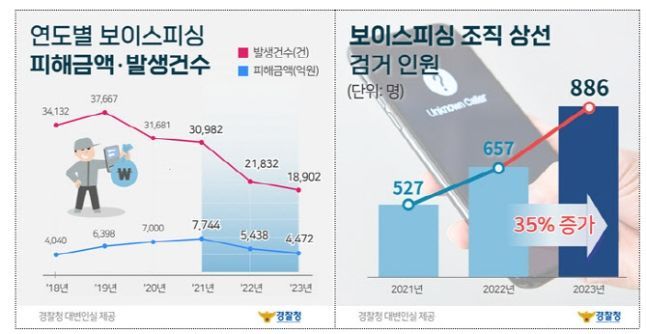
However, phishing crimes are showing the form of ‘wide-area organized crime’ combining multiple methods and roles divided among specialized organizations. Not only are burner phones, malicious apps, bait messages, and messenger accounts used, but various means such as burner bank accounts, gift certificates, and virtual assets are also mobilized during the money laundering process.
The police plan to block each method alongside arresting organization members to prevent the attempt of crimes itself. To this end, they will carry out intensive blocking activities on major crime methods and strongly promote arrest activities targeting organization members involved throughout the entire crime process, from attempts at call centers to the money laundering stage.
In particular, for arrested high-ranking members, the police will apply charges of organizing or joining criminal groups to induce heavy sentences, and actively cooperate with overseas investigative agencies through information sharing and suspect extradition to block criminals’ intentions to reoffend. They also plan to focus on victim recovery by immediately confiscating and preserving criminal proceeds discovered during investigations.
A police official stated, “Recent phishing crimes have become highly sophisticated by approaching victims with various types of bait messages impersonating institutions, loan scams, impersonation of children or acquaintances, obituaries, weddings, deliveries, fines, card issuance, etc., inducing victims to click on malicious app installation (URL) buttons, and stealing calls and text messages from victims’ mobile phones through malicious apps,” emphasizing, “You must be cautious when checking unknown calls or text messages.”
He added, “Since crime methods are rapidly changing even at this moment, if you become complacent thinking ‘I won’t be fooled’ just because you remember the traditional phishing method of deceiving victims over the phone to transfer funds, you could become a target of criminal organizations. If the police recognize the phone numbers or contents of bait messages, they can prevent additional damage using the same number, so please report bait messages using your mobile phone’s spam reporting function.”
© The Asia Business Daily(www.asiae.co.kr). All rights reserved.
![Clutching a Stolen Dior Bag, Saying "I Hate Being Poor but Real"... The Grotesque Con of a "Human Knockoff" [Slate]](https://cwcontent.asiae.co.kr/asiaresize/183/2026021902243444107_1771435474.jpg)
















