Goh Wook, Head of Gwangbokhoe Gwangju Branch, and Over 200 People from All Walks of Life Attend
Seating Arrangement Highlights Equal Representation Regardless of Age, Gender, or Status
The 105th anniversary 3·1 Movement Commemoration Ceremony was held at the first-floor Citizen Hall of Gwangju Metropolitan City Hall.
About 200 people, including Kang Gi-jung, Mayor of Gwangju, Jeong Mu-chang, Chair of the City Council, Ko Wook, Head of the Gwangju Branch of the Liberation Association, Ha Sung-il, Head of the Gwangju Regional Veterans Affairs Office, Han Chang-hoon, Chief of Gwangju Police Agency, National Assembly members Kim Kyung-man and Kang Eun-mi, Joo Ki-hwan, Chair of the Gwangju People Power Party, district mayors, and city council members, gathered to brighten the occasion.
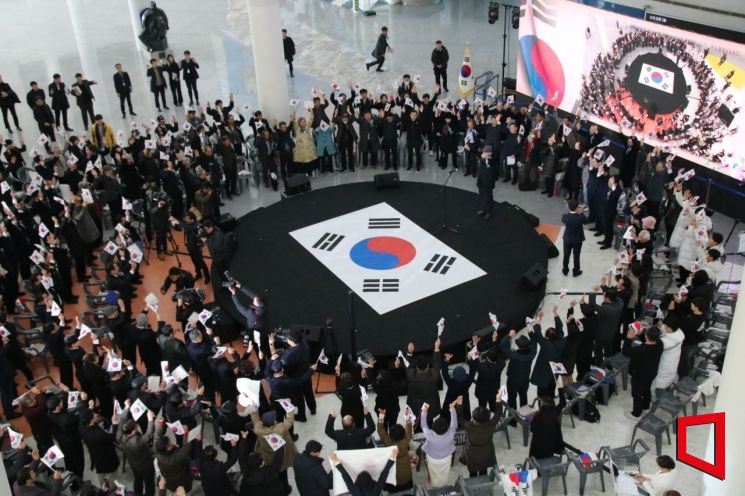 At the 105th anniversary of the March 1st Movement ceremony held in the Citizens' Hall on the first floor of Gwangju Metropolitan City Hall, attendees are shouting the three cheers of "Manse."
The seating arrangement of attendees at this ceremony drew attention. The stage with the Taegeukgi (Korean national flag) was placed at the center, and attendees were seated in a circle around it, symbolizing an equal world without distinctions of gender, age, or social status.
The ceremony proceeded in the order of the national anthem, report on the progress of the 3·1 Movement, reading of the Declaration of Independence, awards for patriotic merit, commemorative speeches, commemorative performances, singing of the 3·1 Movement song, three cheers of "Manse," and closing.
Ko Wook, Head of the Gwangju Branch of the Liberation Association, said in his commemorative speech, "The 3·1 Movement was an anti-Japanese independence movement in which the entire nation rose up with one heart and one mind across the country on March 1, 1919," adding, "It continued for three months until May 30 of the same year and spread overseas."
He continued, "The most notable aspect of the 3·1 Movement was that our people, regardless of gender, age, or social class, shouted for independence. Different religions such as Cheondogyo, Christianity, and Buddhism transcended their doctrines and rituals to unite under the grand theme of national independence. This should be remembered as one of the most moving events in our history," emphasizing the unity.
He also stated, "The 3·1 Movement is not only the highest and greatest peak of our nation but also a world-historical movement that inspired hope and spirit of independence among oppressed nations worldwide. It is a monumental symbol of peace, justice, and conscience triumphing across the globe."
Following this, Park Jung-jung, Chair of the Dong-gu and Nam-gu branches of the Gwangju Liberation Association, Lee Guk-eon, Chair of the Forced Mobilization Citizens’ Association, Kim Yoo-eun, student representative of Gwangju Sophia Girls' Middle School, and Jeon Woong-tae, modern pentathlon athlete, read the Declaration of Independence.
At this ceremony, awards for patriotic merit were also presented. Recipients included Lee Jung-soo, who worked on expanding honorary allowances for public officials in veterans affairs; Park Eun-ha, who expressed and spread the spirit of independence through traditional Korean dance Geommu; and Kim Bo-hyun, who has consistently participated in independence movement commemorations and actively supported Liberation Association members with mobility difficulties.
Kang Gi-jung, Mayor of Gwangju, said, "I bow my head in gratitude to all the ancestors who risked their lives to fight for independence and their families," adding, "This day was when we declared to the whole world and our entire nation the reasons why we must be independent and our determination to fight for independence."
He further explained, "The wave of the 3·1 Movement crossed mountains and rivers, spreading nationwide, beyond borders, and to the world. In Gwangju, the Manse protests began on the 10th day. The democratic republic we earnestly wished for in 1919 has become our daily life."
Moreover, he said, "The spirit of the 3·1 Movement, which sought to love our homeland, is a spirit we desperately need. Our Gwangju is a place worthy of love and pride," emphasizing, "Gwangju is a proud city that led Korea’s democratization through the May 18 Democratic Movement, and just as the 3·1 Movement is inscribed in the preamble of the Constitution, I believe the day when May 18 will be inscribed is not far off."
He also stated, "To overcome the disease of concentration in the metropolitan area and protect our homeland, creativity is necessary. We must not follow Seoul but create a new standard model, and Gwangju must become an inclusive city that accepts small differences."
He added, "I believe the spirit of the 3·1 Movement is the spirit of inclusion that breaks down barriers of disability and skin color so that differences do not become discrimination," and expressed gratitude to all who participated in the 105th anniversary 3·1 Movement event.
In the commemorative performance that followed, the Korean traditional music a cappella group Toris reinterpreted in fusion style the song sung by seven patriotic martyrs including Yu Gwan-sun in prison, expressing the earnest hope for the moment of independence.
After the performance, attendees sang the 3·1 Movement song written by Jeong In-bo and composed by Park Tae-hyun in 1946.
Finally, with the lead of Im Bang-won, child of patriot Choi Poong-o, who participated in the 1930 student release and colonial abolition test blank alliance, attendees returned to 105 years ago today and shouted three cheers of "Manse," concluding the event.
© The Asia Business Daily(www.asiae.co.kr). All rights reserved.

















