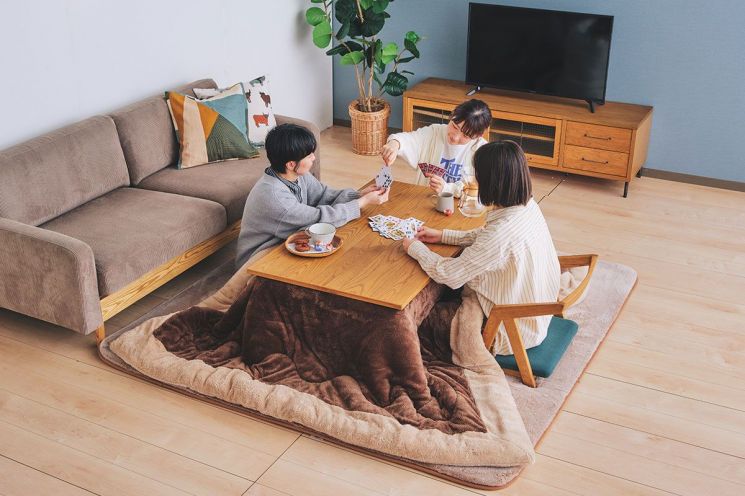
 Kotatsu, popularized in Japan where floor heating is uncommon. The photo shows a kotatsu product sold on an online shopping mall.
Even in the middle of winter, it is common for most households to wear thermal underwear or simple clothing. Unlike Korea, Japan's lifestyle culture is a bit different. Except for the rooms, the living room and bathroom are all very cold.
On the 29th, the Japanese lifestyle specialty hint-pot introduced the experience of a man who immigrated from the United States to Japan. The American, who identified himself as Eric, was surprised that something that is naturally present in his home country was missing in Japan. Eric is currently learning Japanese at a language school while working as a missionary. First, he was very surprised by the hectic scenes of people coming and going in Japan. It is similar to Korea's "ppali-ppali" (hurry-hurry) culture. He says he has gotten used to it now. The culture of eating while standing anywhere was also shocking. In Japan, it is called tachigui (立ち食い), and it is popular on the streets and in subways. Eric now also eats udon standing at subway stations.
What surprised Eric the most after moving to Japan was that "Japanese houses do not have central heating." Typical houses in the United States all have central heating, so the entire house stays warm at the same temperature even in winter. But Japan is different. Eric said, "I always put on clothes right before leaving the living room. I even brace myself when going to the bathroom." Usually, only the rooms are warm, and people feel cold in the living room, bathroom, and toilet. In fact, unlike Korea, Japan does not have floor heating. Instead, it is common to use a kotatsu. A kotatsu is a wooden table covered with a blanket or quilt. Underneath the table, there is a heater or stove.
© The Asia Business Daily(www.asiae.co.kr). All rights reserved.

















