BBC Highlights South Korea's Low Birthrate Issue
Household Chores and Desire for Self-Development Are Main Causes
Last year, the total fertility rate in the fourth quarter fell below 0.6 for the first time in history, marking the beginning of the 'ultra-low birthrate' era. In response, the British public broadcaster BBC conducted an in-depth analysis of South Korea's low birthrate situation.
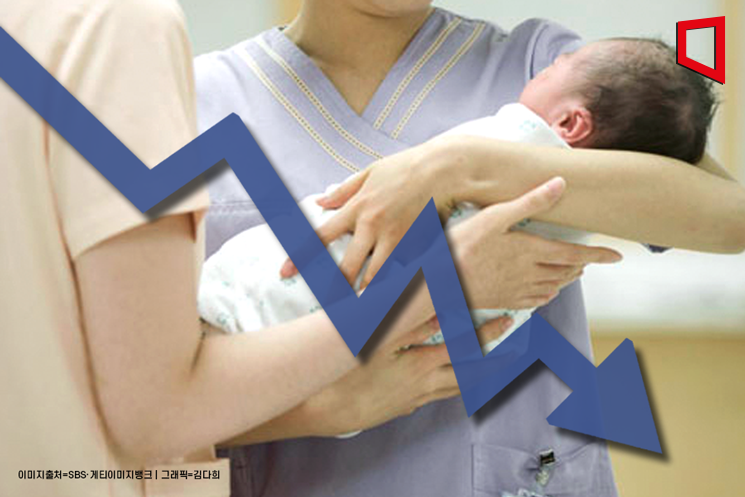
On the 28th (local time), the BBC cited the fertility rate announcement from Statistics Korea and published an article titled "Why Korean Women Are Not Having Children." The article was written by the Seoul correspondent, who added a note at the top stating, "Criticism has arisen that policymakers on low birthrate do not actually listen to the needs of young people and women, so over the past year, I traveled across the country interviewing Korean women."
The BBC conducted interviews with women currently living in South Korea. Yejin, a 30-year-old TV producer, explained her situation in detail: "It is difficult to find a man who will equally share housework and childcare. Also, South Korea is not kind to women who have children alone." She added, "I leave work at 8 p.m., so I don't have time to raise a child. The fear that I will fall behind if I don't engage in self-development makes things even harder for me." She continued, "There is an unspoken pressure to leave the workplace once you have a child," and lamented, "In fact, my younger sister and two news anchors resigned. If you take parental leave, you might get fired or be excluded from promotions."
Stella, a 39-year-old English academy instructor, said, "I like children, but I was too busy working and enjoying life. Now I admit that childbirth and childcare are impossible with my current lifestyle." She expressed frustration over housing costs, saying, "I am being pushed further and further away from Seoul, but I still haven't been able to buy a house."
Private Education Expenses, a Unique Culture in South Korea... Koreans Fear 'Failure'
Additionally, the BBC pointed out that 'private education expenses' are a unique cultural phenomenon in South Korea. Children born in South Korea receive expensive lessons in subjects like math and English from the age of four, which the BBC described as a harmful consequence of the societal belief that "children must not be allowed to fail." Stella claimed, "I have seen families spending up to 700 pounds (about 1.2 million won) per child per month. If you don't do this, children fall behind." Minji, a 32-year-old living in Busan, said, "South Korea is not a place where children can live happily," adding, "I was exhausted from studying from childhood through my twenties. My husband, who wanted children, has now started to accept my decision not to have any."
The BBC emphasized the role of 'wife and mother' as a key issue in the declining birthrate. While South Korea's economy has grown rapidly over the past 50 years, pushing women into higher education and the workforce and encouraging ambition, the roles of wife and mother have not evolved at the same pace. Jeongyeon Cheon, a webtoon artist living in Daejeon, shared, "I didn't think having a child was a major decision, but after childbirth, I faced social and economic pressures, and my husband did not help." She added, "I was taught that men and women are equal, so I couldn't accept the reality. Seeing everyone around me depressed made me wonder if this is a social phenomenon." The BBC concluded by noting that although President Yoon Suk-yeol has stated he will address low birthrate as a structural issue, it remains uncertain how this will be reflected in policy.
Meanwhile, last year’s total fertility rate recorded 0.65, marking the first time it fell into the 0.6 range. According to the 'December 2023 Population Trends' released by Statistics Korea on the 28th, the number of births in December last year was 16,253, a 3.8% decrease compared to the same month the previous year. The number of births in the fourth quarter of last year was 52,618, down 6.9% year-on-year. The total fertility rate, which estimates the number of children a woman of childbearing age is expected to have in her lifetime, was 0.65, a decrease of 0.05 from the previous year. With fewer births and an increasing number of deaths due to aging, the natural population decline per quarter exceeded 40,000 for the first time.
© The Asia Business Daily(www.asiae.co.kr). All rights reserved.

![User Who Sold Erroneously Deposited Bitcoins to Repay Debt and Fund Entertainment... What Did the Supreme Court Decide in 2021? [Legal Issue Check]](https://cwcontent.asiae.co.kr/asiaresize/183/2026020910431234020_1770601391.png)















