Special Act on Jeonse Fraud Amendment Bill Directly Submitted to National Assembly Plenary by Opposition
Possible Plenary Vote Before April 10 General Election
If Passed, Victim Support Method Changes from 'Indirect' to 'Direct'
Issues on Scope, Funding, and Fairness Remain
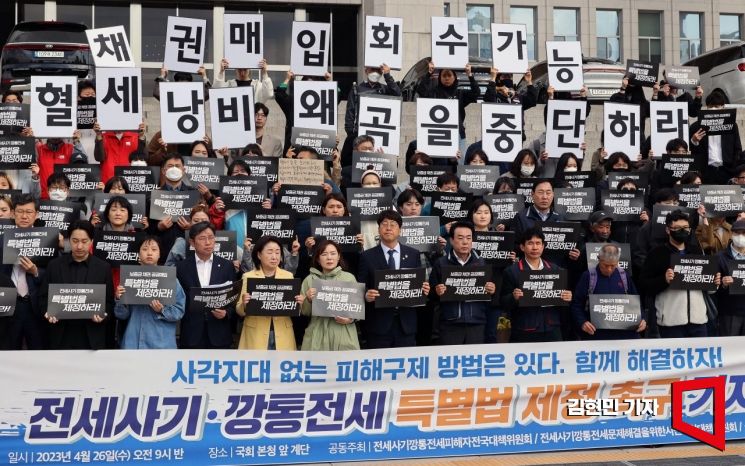 On the 26th, members of the National Countermeasure Committee for Jeonse Fraud and Empty Jeonse Victims held a press conference in front of the main building of the National Assembly in Yeouido, Seoul, urging the enactment of a special law on Jeonse fraud. Photo by Hyunmin Kim kimhyun81@
The amendment to the Special Act on Jeonse Fraud Victims, which proposes to "refund victims' deposits with taxes first," has been directly referred to the plenary session, sparking intense controversy. As debates intensify over the scope of victims eligible for the 'prior relief, later recovery' application, the plan to secure trillions of won in funding, and fairness compared to victims of other fraud cases, difficulties are expected until the amendment is implemented.
The bill was processed on the 27th by the National Assembly Land, Infrastructure and Transport Committee, led by the opposition Democratic Party of Korea, despite opposition from the ruling People Power Party. It is expected to take more than a month before it is put to a vote in the National Assembly plenary session. A Ministry of Land, Infrastructure and Transport official said, "If it is directly referred to the plenary session, the ruling and opposition parties must go through a consensus period, which is 30 days," adding, "If no agreement is reached, the opposition party can unilaterally submit it to the plenary session." Currently, it is highly likely to pass the National Assembly plenary session before the general election on April 10.
What changes if the amendment passes
If the amendment passes, the support method for victims of jeonse fraud will change from 'indirect' to 'direct.' The opposition party focused on the government refunding the deposits defrauded from victims first, arguing that the current support measures are insufficient. The Housing and Urban Guarantee Corporation (HUG) will purchase the deposit return claims of jeonse fraud victim houses to prioritize relief for affected tenants and later claim compensation from the landlords to recover costs.
The amendment also includes provisions to "prevent victims' rented homes from being auctioned." The Korea Asset Management Corporation (KAMCO) will be required to compulsorily purchase senior mortgage claims from banks on the victim houses to protect the housing rights of subordinate creditors. Additionally, the limit on tenant deposits, one of the criteria for recognizing jeonse fraud victims, will be raised from 300 million won to 500 million won to allow more people to be recognized as victims. Foreign tenants are also included among those who can be recognized as victims.
Until now, the government has implemented support measures by postponing public and private auctions to prevent the victim's home from immediately going to auction. If the victim wants to purchase the home they rented, they are given the right of first refusal when the property is auctioned and provided with loans to buy it.
If the victim wishes to continue living in their original rented home, the Korea Land and Housing Corporation (LH) will purchase the house on their behalf so the victim can move into public rental housing. Considering that victims must continue repaying bank deposit loans, support measures have also been introduced to refinance these loans at low interest rates.
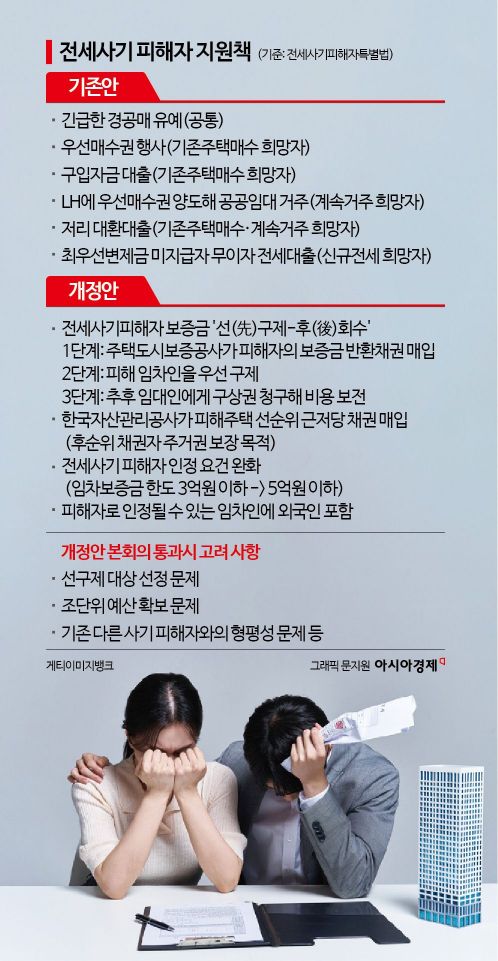
Issues on scope of prior relief, budget, and fairness
The bill's passage, which changes the victim support method as described, has sparked various controversies. First, there is debate over how far the scope of prior relief should be recognized. According to the amendment, only those recognized as victims who currently hold 'tenant deposit return claims' are eligible for prior relief.
A Ministry of Land, Infrastructure and Transport official said, "For example, victims who have already purchased their rented homes through auction have fully settled their tenant deposit return claims and are therefore not eligible for prior relief," adding, "There is such a loophole in the current amendment." This means that whether a victim is eligible for prior relief depends on whether they bought the home they lived in after being recognized as a victim, despite having suffered the same jeonse fraud. As of the 21st, the Ministry has recognized a total of 12,928 jeonse fraud victims. The official explained, "If the bill passes, each of these individuals will need to be thoroughly reviewed to determine if they qualify for prior relief."
Securing the budget to pay the deposits is also necessary, and controversy is expected over this. The Ministry stated on the 27th, "If the amendment passes, trillions of won of taxpayers' money will be invested, and a significant portion is expected not to be recovered." The budget for this year was already finalized in December last year, so there is no immediate way to secure funding. There may also be fairness issues compared to victims of other fraud cases. The Ministry said, "It is akin to paying off the debts of malicious landlords with taxes, raising concerns about fairness with other fraud victims."
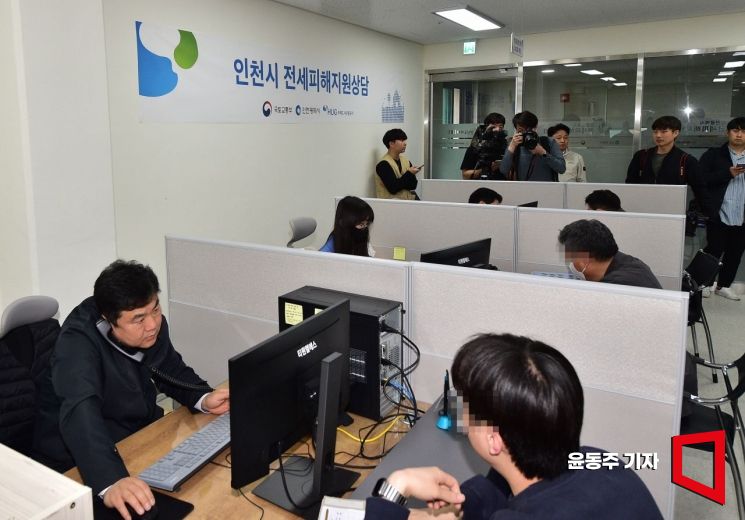 On the 24th, victims of jeonse fraud visited the Jeonse Damage Support Counseling Center in Bupyeong-gu, Incheon, to receive consultations. Photo by Dongju Yoon doso7@
Shin Se-don, an emeritus professor of economics at Sookmyung Women's University, expressed concerns, saying, "There are victims of various fraud cases such as voice phishing and used car loan fraud, but helping only jeonse fraud victims with taxpayers' money will raise fairness issues," and added, "If tenant deposits are fully repaid with taxes, jeonse fraud may intentionally increase."
Victims insist that prior relief is essential. Ahn Sang-mi, a member of the Jeonse Fraud Countermeasures Committee in Michuhol-gu, Incheon, said, "Until now, the government has said it would provide a place for us to live, but told us to borrow money to prepare a home and slowly repay the debt from the defrauded deposit, which only added debt and was of no help," adding, "Therefore, prior relief measures are necessary, and if the law passes, it should be applied retroactively to as many victims as possible."
© The Asia Business Daily(www.asiae.co.kr). All rights reserved.
![Clutching a Stolen Dior Bag, Saying "I Hate Being Poor but Real"... The Grotesque Con of a "Human Knockoff" [Slate]](https://cwcontent.asiae.co.kr/asiaresize/183/2026021902243444107_1771435474.jpg)


















