Eight specialized colleges located in Busan (Gyeongnam Information University, Daedong University, Dong-Eui Science University, Busan University of Science and Technology, Busan Gyeongsang University, Busan Health University, Busan Women's University, and Busan Arts University) reached a final agreement on the afternoon of the 27th to jointly participate in the Ministry of Education's Glocal University 30 Project Phase 2 as a consortium university to overcome the joint crisis faced by the region and universities due to rapid changes in population structure and industry. They will promote joint work to submit an innovation plan (preliminary designation application) by March 22.
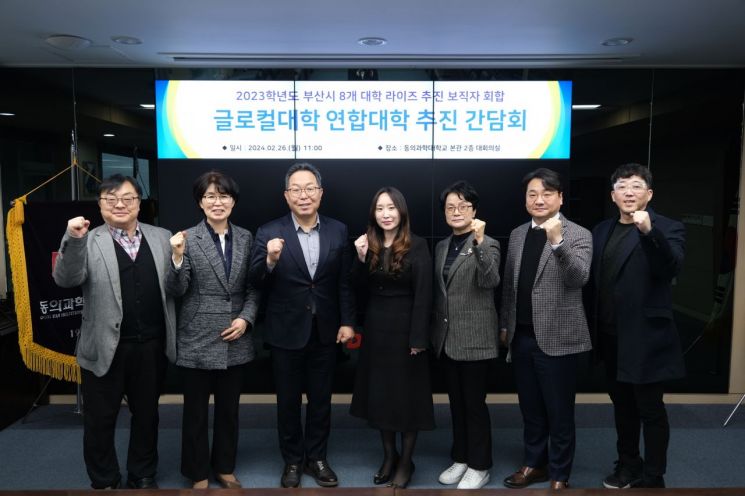
Dong-Eui Science University (the lead university) and the other seven specialized colleges will participate as a consortium university to implement specialized higher vocational education based on independence and autonomy according to each university’s development plan (specialization plan) by strengthening higher vocational education.
Through this, they aim to secure continuous government financial support in the future, strengthen cooperation with the local community, prevent the outflow of local talent, and contribute to regional development and prevention of regional extinction by fostering field personnel linked to regional strategic industries. They plan to establish a “Busan-type community university system” and have specialized colleges take charge of higher vocational education and vocational training opportunities.
This also means contributing to the future foundation of the city by nurturing local industry field personnel and settling them in the region in line with Busan City's “Global Hub City Special Act” initiative for Busan’s future, thereby making Busan a “business-friendly” and “livable” city.
Additionally, to respond to regional extinction and population decline, they intend to attract international students and play a significant role in further developing Busan as a global city.
As Dong-Eui Science University (the lead university) and the other seven specialized colleges decided to participate in the Glocal University project as a consortium university, consultations among the eight specialized colleges are expected to accelerate.
The “Busan Consortium Glocal Specialized Colleges (tentative name)” will promptly proceed with internal public discussions and opinion collection processes regarding the future promotion process.
The eight specialized colleges are expected to jointly present a university innovation model to develop as a consortium university. They aim to create synergy effects by forming a single governance structure to achieve common goals such as sustainable development in field personnel areas like manufacturing and social welfare and health sectors, specialization fields of each university, and attracting international students.
The eight specialized colleges will maximize the advantages of specialized colleges as world-class vocational education institutions by offering professional vocational education courses and programs, practice-based industry-academia cooperation, practical education, high employment rates supported by vocational counseling, and flexible education programs tailored to learner demands.
In particular, they plan to build a “vocational education innovation platform (offline and online)” without school distinctions, divide the 16 districts and counties to assign university-responsible regions, and establish a dense and robust network with the basic local governments (districts) where the eight specialized colleges are located under organic communication and cooperation with Busan City as regional education service centers. Through this, they set a goal to lead a “major transformation in vocational education in the Busan region.”
By uniting, the eight universities are expected to become the largest higher vocational education institution nationwide in terms of scale and human and physical infrastructure, with an admission quota of about 7,700 students and an enrollment of about 24,000 students.
Kim Young-do, president of Dong-Eui Science University (chairman of the Busan Area Specialized Colleges Presidents’ Association), presented a blueprint stating, “The consortium university will share and cooperate all resources among the member schools and take full responsibility for nurturing practical field personnel in Busan.”
President Kim also said, “Busan is facing a crisis due to the decline and outflow of the youth population. By uniting the eight specialized colleges, we plan to create conditions for young people to settle in the region and actively attract international students to build a higher vocational education platform to achieve the vision of Busan as a youth-friendly city for business and a global hub city.” He added, “Five years after the Glocal project, our goal is the ‘Busan 2030 Generation 1 Million (2030 Million Busan) era.”
The Ministry of Education plans to receive preliminary designation applications by the 22nd of next month and select preliminary designated universities in April. In June, the Ministry will collect implementation plans for final designation from the preliminary designated universities and announce the final designation results in July. The final selection and confirmation of Glocal universities will take place in August.
© The Asia Business Daily(www.asiae.co.kr). All rights reserved.
![Clutching a Stolen Dior Bag, Saying "I Hate Being Poor but Real"... The Grotesque Con of a "Human Knockoff" [Slate]](https://cwcontent.asiae.co.kr/asiaresize/183/2026021902243444107_1771435474.jpg)
















