Promotion of Ugly Apples and Pears Sales
Banana and Other Quota Tariff Imported Fruits Sold at Large Supermarkets
Han-don Pork and Hanwoo Beef Up to 40-50% Discount
Following the Lunar New Year holiday this year, fruit and vegetable prices such as apples and pears remain high, prompting the government to continue extensive discount support by investing 16.6 billion KRW until April, when alternative fruits like chamoe and watermelon are fully harvested.
On the 27th, the Ministry of Agriculture, Food and Rural Affairs and the Ministry of Oceans and Fisheries announced that they will comprehensively implement these measures tailored to each item’s situation to quickly reduce the burden of grocery prices on the public.
Apples up 27.4% YoY … Focused discount support and promotion of imperfect fruit sales
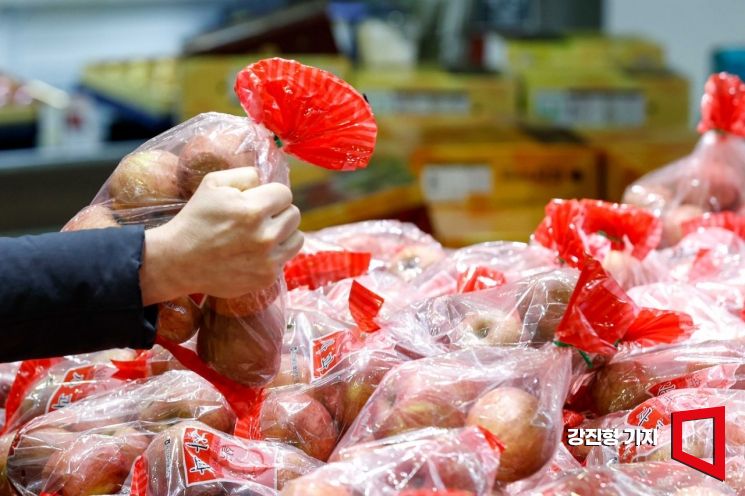 A customer is purchasing apples at Hanaro Mart Yangjae Branch in Seocho-gu, Seoul. Photo by Jinhyung Kang aymsdream@
According to the Ministry of Agriculture, Food and Rural Affairs, as of late February, the price of apples (10 pieces) is 29,310 KRW, which is 27.4% higher than the previous year. Accordingly, the ministry plans to invest 16.6 billion KRW to support discounts of up to 40%, focusing on apples and pears, until May when alternative fruits are fully harvested.
In addition, they will promote sales of irregularly shaped apples and pears in collaboration with large retailers, and manage the storage volumes at the Nonghyup and nationwide Agricultural Product Distribution Centers (APCs) to be released gradually until June.
To disperse demand for apples and pears, which have limited supply, support will be provided to help consumers purchase imported fruits more easily at large retailers. The ministry will allocate a total of 20,000 tons from the tariff quota import volumes, including 13,700 tons of bananas, 3,600 tons of pineapples, 300 tons of grapefruits, 1,800 tons of mangoes, and 500 tons of avocados, based on the demand volume for imported fruit sales at large marts. To activate the distribution of imported fruits, large retailers were also granted tariff quota import and sales qualifications as of the 23rd.
Proactive stockpiling and release of open-field vegetables, promotion of facility-grown vegetable shipments, and strengthening of growth management will also be undertaken. To prepare for supply instability during the storage and shipment period of cabbage and radish from March to May, the ministry will additionally stockpile 2,000 tons of cabbage and 6,000 tons of radish in February and release them flexibly into the market depending on price conditions. For green onions, which have high prices due to recent rain and difficulties in harvesting, the ministry plans to support the delivery prices supplied to large retailers to directly reduce consumer burden.
For facility-grown vegetables such as cucumbers, zucchini, and Cheongyang peppers, whose shipments have been delayed and prices remain high due to recent insufficient sunlight, partial support will be provided for shipment costs to major Nonghyup Hanaro Marts nationwide to promote shipments and induce lower consumer prices. Strawberries will have special discount sales events for irregularly shaped fruit to disperse demand, and growth management will be strengthened to stabilize production of alternative fruits such as chamoe and watermelon, which begin shipping after March.
Continued maximum half-price discounts on Korean pork and beef as before the Lunar New Year
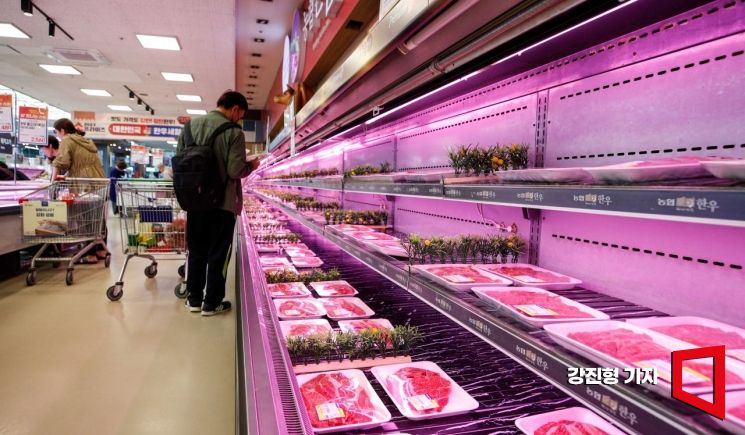 Customers visiting Yangjae Hanaro Mart in Seocho-gu, Seoul, are looking at Korean beef. Photo by Jinhyung Kang aymsdream@
Korean beef and pork will continue to have discount events of up to 40-50% in March. Sirloin, soup cuts, and bulgogi cuts will be sold at prices up to 50% lower than usual, and domestic pork will be sold at large and small marts nationwide at prices discounted by about 20-40%, the same as before the Lunar New Year holiday.
Regarding eggs, daily production in February is expected to increase by 2.8% compared to the previous year and 6.4% compared to the average year, reaching 46.21 million eggs, leading to a continuous decline in farm gate prices. Accordingly, the ministry has been cooperating with large marts and Nonghyup since the 22nd to promote their own discount events so that the price drop at the farm level is quickly reflected in consumer prices, and through Nonghyup, has lowered the delivery price to distributors by 500 KRW per 30 eggs to stabilize consumer prices.
The Ministry of Oceans and Fisheries is implementing various price stabilization measures including the "Korea Seafood Grand Sale - February Special" and surprise half-price special sales of government-stocked squid and chamjogi. The special sale runs until March 3, offering consumers discounts of up to 50% (20% government + 20-30% participating companies) when purchasing domestic seafood at marts and online malls. This event targets price-managed items such as pollock, chamjogi, mackerel, squid, dried anchovies, as well as domestic seafood like rockfish and sea eel. During the event period, the government plans to actively respond to ease perceived prices by cooperating with distributors to increase discount rates if necessary.
Along with the February discount events, surprise half-price special sales of squid and chamjogi, which have somewhat limited supply due to the end of their main production season, will also be held. Until March 22, government stockpiles will be sold at about half the market consumer price at three major marts: E-Mart, Homeplus, and Lotte Mart.
Park Soon-yeon, Director of Distribution and Consumer Policy, said, "Although prices of agricultural and livestock products remain high due to reduced production of fruits and facility-grown vegetables caused by weather conditions, supply conditions for open-field vegetables and livestock products are relatively stable. The Ministry of Agriculture, Food and Rural Affairs will implement comprehensive measures such as expanding domestic and international supply, continuing discount support, and strengthening growth management to quickly reduce the burden of grocery prices on the public."
Hong Rae-hyung, Director of Fisheries Policy at the Ministry of Oceans and Fisheries, said, "We have prepared various discount events including discount sales and half-price special sales of government stockpiles to maintain the seafood price stabilization trend that has continued since the end of last year. We will closely monitor supply and demand and continue to implement various price stabilization measures for seafood consumption channels such as traditional markets, marts, and online malls after February to alleviate the burden of seafood food prices."
© The Asia Business Daily(www.asiae.co.kr). All rights reserved.
![Clutching a Stolen Dior Bag, Saying "I Hate Being Poor but Real"... The Grotesque Con of a "Human Knockoff" [Slate]](https://cwcontent.asiae.co.kr/asiaresize/183/2026021902243444107_1771435474.jpg)

















