Operating Licenses for 10 Nuclear Reactors Expire by 2030
7 Reactors Have Already Applied for Continued Operation
However, Missing the Golden Time Makes a Gap Inevitable
The continued operation procedures for Wolsong Units 2, 3, and 4 will officially begin next month. Korea Hydro & Nuclear Power (KHNP) plans to apply for the continued operation of Wolsong Units 2, 3, and 4, whose operating licenses expire between 2026 and 2029, within March. This marks the full-scale push to continue operating all 10 nuclear reactors whose licenses expire by 2030.
A KHNP official stated on the 28th, "We plan to submit the Periodic Safety Review (PSR) report to the Nuclear Safety and Security Commission (NSSC) next month for the continued operation of Wolsong Units 2, 3, and 4."
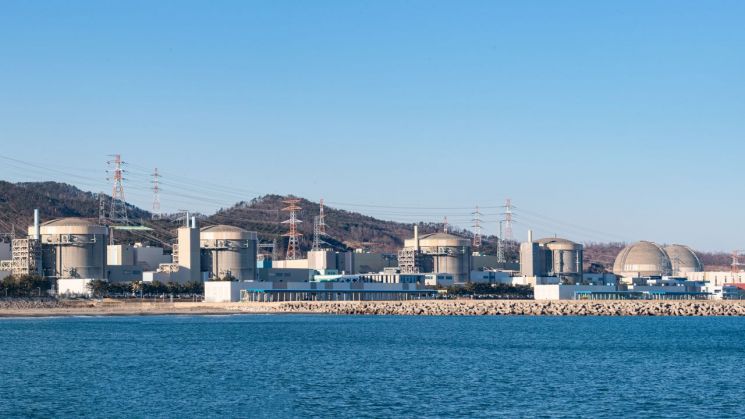
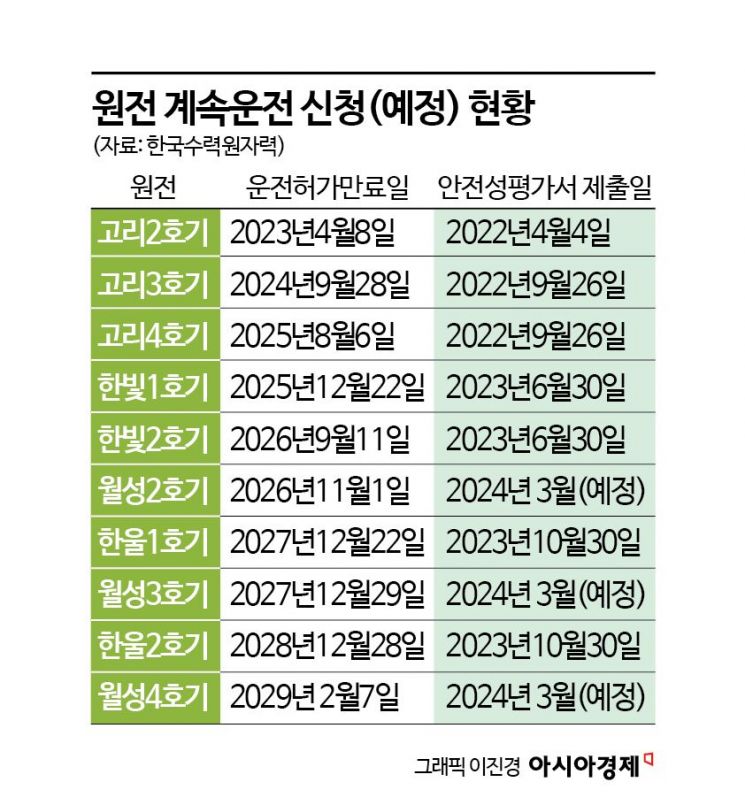
According to KHNP, the nuclear reactors whose operating licenses have expired or will expire by 2030 include Kori Units 2, 3, and 4; Hanbit Units 1 and 2; Hanul Units 1 and 2; and Wolsong Units 2, 3, and 4, totaling 10 reactors. The total installed capacity amounts to 8.45 gigawatts (GW).
Previously, Kori Unit 2 ceased operation after its license expired on April 8 last year. Kori Units 3 and 4 will have their licenses expire on September 26 this year and August 6 next year, respectively. Hanbit Units 1 and 2 will expire on December 22 next year and September 11, 2026, respectively, while Hanul Units 1 and 2 will have their licenses end on December 22, 2027, and December 8, 2028, respectively.
The Yoon Suk-yeol administration, which included the abolition of the Moon Jae-in government's "nuclear phase-out policy" as a national agenda, has been promoting the continued operation of all 10 reactors. Seven reactors have already applied for continued operation sequentially since April 2022, right after President Yoon's election. Including Wolsong Units 2, 3, and 4, which are scheduled to apply next month, all 10 reactors targeted by the Yoon administration have now begun the related procedures for continued operation.
The continued operation process involves submitting the PSR to the NSSC, public inspection and hearings on the Radiation Environmental Impact Assessment report, and applying for operational change approval for continued operation to the NSSC. Kori Unit 2, which stopped last April due to license expiration, is the most advanced in progress. KHNP applied for continued operation of Kori Unit 2 on April 4, 2022, and only the NSSC's review and decision remain. However, even if reactivation occurs as planned in June next year, a 2-year and 2-month operational gap is expected.
KHNP has applied for continued operation to the NSSC for Kori Units 3 and 4 in September 2022, Hanbit Units 1 and 2 in June last year, and Hanul Units 1 and 2 in October of the same year.
Although the continued operation procedures for Wolsong Units 2, 3, and 4, the final pieces of the puzzle, are being actively pursued, some units are expected to halt operation due to license expiration. Korea's first nuclear reactor, Kori Unit 1, permanently shut down in 2017, took 18 months from application to approval for reactivation, while the early-closed Wolsong Unit 1 took 62 months. The time required from application to approval varies greatly. However, the nuclear industry generally estimates it takes about 3 years and 5 months. Applying this period to Wolsong Units 2, 3, and 4 means reactivation would only be possible by August 2027. Wolsong Unit 2, which will end operation in November 2026, will inevitably face about 9 months of downtime.
Professor Jeong Dong-wook of the Department of Energy Systems Engineering at Chung-Ang University said, "In France, series reactors, meaning reactors of the same model, are reviewed collectively, but Korea does not do this, so the review period for continued operation takes a long time. Also, there is overlap between the periodic safety reviews conducted every 10 years and the evaluations for continued operation, so institutional improvements are needed to resolve this issue."
© The Asia Business Daily(www.asiae.co.kr). All rights reserved.
![Clutching a Stolen Dior Bag, Saying "I Hate Being Poor but Real"... The Grotesque Con of a "Human Knockoff" [Slate]](https://cwcontent.asiae.co.kr/asiaresize/183/2026021902243444107_1771435474.jpg)

















