82% of Seoul's Semi-Industrial Areas Concentrated in Southwest Region
Relaxation of Apartment Floor Area Ratio, Ordinance Revision Within the Year
Guro Machinery Market to Become Future-Oriented Business and Industrial Hub
Geumcheon Air Force Base to Be Designated as 'Spatial Innovation Zone'
Gimpo Airport Innovation District Targeted for Designation Within the Year
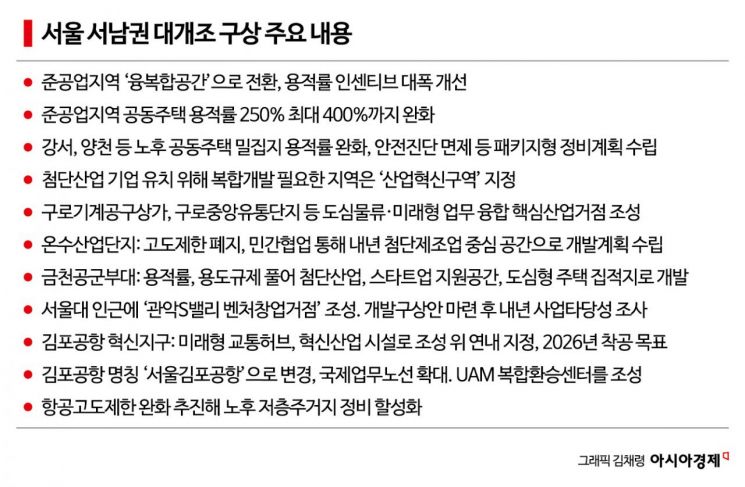
The skyline of the southwestern region of Seoul, including Yeongdeungpo and Guro, which houses 82% of Seoul's semi-industrial zones, is set to change dramatically. The current floor area ratio (FAR) of 250% in semi-industrial zones will be increased up to 400%, and former distribution industry hubs such as the Guro Machinery and Tool Market will be transformed into future-oriented industrial hubs. Large-scale sites adjacent to metropolitan cities, such as Onsu Industrial Complex and Geumcheon Air Force Base, will undergo customized development projects.
Seoul Mayor Oh Se-hoon announced the ‘Southwestern Region Grand Renovation Plan’ on the 27th, outlining these initiatives. According to the plan, the city will begin institutional improvements and basic planning for each district within the year and start construction next year. Significant changes are expected to appear as early as 2026 in Seoul’s southwestern districts, including Yeongdeungpo, Guro, Geumcheon, Gangseo, Yangcheon, Gwanak, and Dongjak.
The southwestern region was once the center of consumption and manufacturing industries, but despite changes in the industrial structure, opportunities for transformation were limited due to semi-industrial zone regulations focused on protecting manufacturing. Among Seoul’s five regions, it has the lowest apartment price per pyeong (38.96 million KRW). It is also the area with the largest youth population (ages 19-34), totaling 737,000.
Floor Area Ratio in Semi-Industrial Zones Raised to 400%
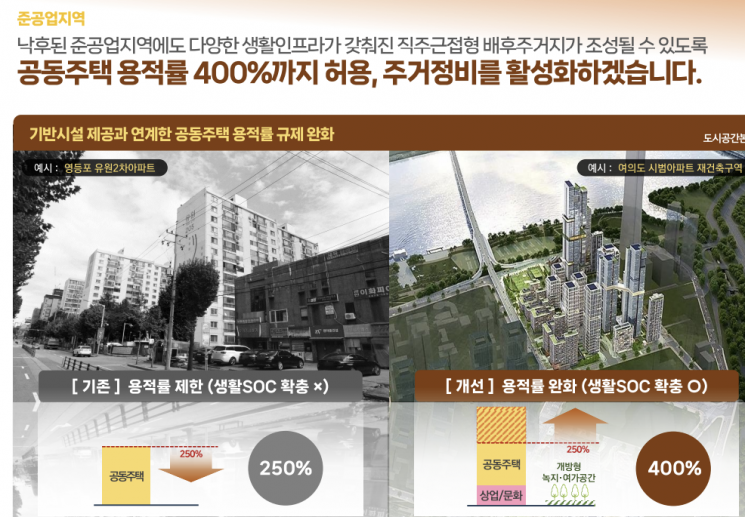
The city will ease the floor area ratio, a long-standing demand of apartment residents in semi-industrial zones, from the current 250% to a maximum of 400%. This is equivalent to the FAR of the Yeouido pilot apartment complex. Apartments in Yeongdeungpo and Guro are expected to benefit from this change.
To create residential areas close to workplaces, the city will also revise urban planning ordinances and other institutional improvements within the year. The criteria for zoning adjustments will be made more flexible. In areas where residential complexes have already been widely established within semi-industrial zones, the zoning will be changed to residential or semi-residential zones to prevent the construction of inappropriate facilities within residential areas. A representative example is the Yeomchang-dong area, which is a semi-industrial zone but densely populated with residential buildings.
For aging apartment complexes in Gangseo and Yangcheon districts where reconstruction is difficult under current regulations, the city will establish a package-type redevelopment plan including the ‘Special Act on Aging Planned Cities,’ which involves easing floor area ratios and exempting safety inspections. The relaxation of aviation height restrictions around Gimpo Airport will also proceed without delay. The city established a dedicated team for the International Civil Aviation Organization (ICAO) in January.
The semi-industrial zones, which have been managed mainly through total volume control and regulations, will be transformed into mixed-use spaces that meet diverse urban demands. The city plans to designate areas requiring advanced enterprise attraction and complex development as ‘Industrial Innovation Zones’ and is considering changing central urban areas like Yeongdeungpo to commercial zones if necessary. Until now, all factory sites in Seoul have been designated as semi-industrial zones, and the ‘total factory volume system’ under the Metropolitan Area Readjustment Planning Act has been used as a regulatory tool for Seoul’s semi-industrial zones.
Transforming Manufacturing-Centered Semi-Industrial Zones into Converged Industrial Spaces
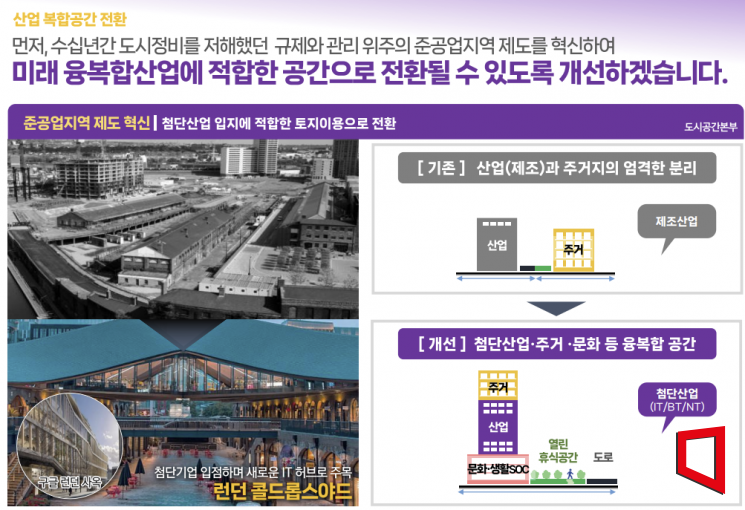
Former industrial distribution hubs in the metropolitan area, such as the Guro Machinery and Tool Market and Guro Central Distribution Complex, will be utilized as key industrial hubs combining urban logistics and future-oriented office functions.
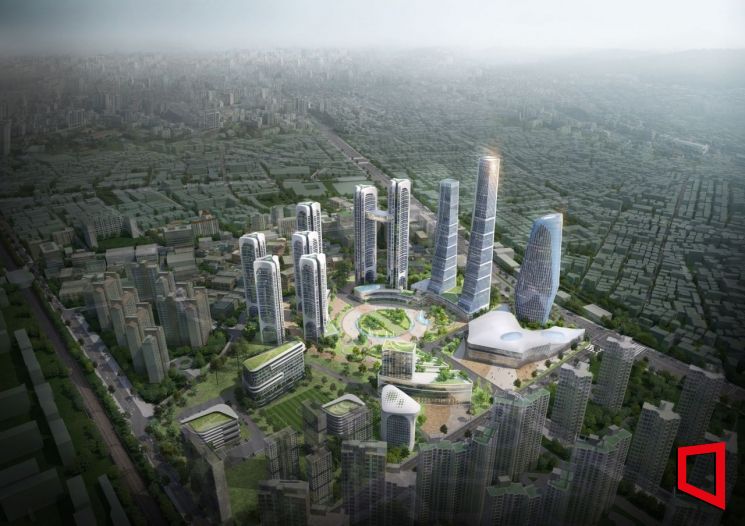
The Onsu Industrial Complex, developed in the 1970s and left without development plans, will have a redevelopment plan established next year to restructure it as a space centered on advanced manufacturing. The Geumcheon Air Force Base, whose development has been repeatedly stalled, will be developed into a cluster for advanced industries, startup support spaces, and urban housing. The city has submitted the Geumcheon Air Force Base as a candidate site for a pilot project to the Ministry of Land, Infrastructure and Transport. Near Seoul National University and Nakseong Venture Valley, the city will create the ‘Gwanak S-Valley Venture Startup Hub’ to build an artificial intelligence (AI) research cluster and startup support facilities. A development plan will be prepared, and a feasibility study will begin next year.
Additionally, the city plans to rename Gimpo Airport to ‘Seoul Gimpo Airport’ and expand international business routes to strengthen its international flight functions. With the Gimpo Airport-Yeouido section selected as the second phase demonstration route in May next year, the vertical takeoff and landing airport (vertiport) in Yeouido will be completed within the year. A UAM (Urban Air Mobility) integrated transfer center will also be established in the Gimpo Airport Innovation District.
Mayor Oh Se-hoon said, "Starting with the first phase of the urban grand renovation to restore the reputation and pride of the southwestern region that led national growth in the 1960s and 70s, we plan to proceed with a series of grand renovations by region."
© The Asia Business Daily(www.asiae.co.kr). All rights reserved.



















