Operation of Countermeasures Headquarters with District Mayor and Headquarters Chief
Extension of Health Center Consultation Hours, etc.
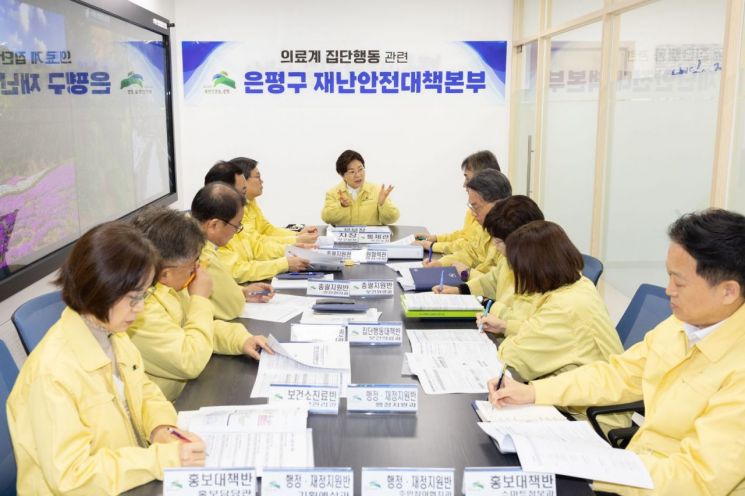 Eunpyeong-gu has been operating the Disaster and Safety Countermeasures Headquarters since the 23rd and is monitoring the local health care system situation. (Photo by Eunpyeong-gu Office)
As doctors collectively oppose the increase in medical school admissions, raising concerns about a healthcare vacuum, each district in Seoul has begun actively implementing disaster safety measures in response.
When the disaster crisis level was raised to 'severe' on the 23rd, the Eunpyeong-gu Disaster Safety Countermeasures Headquarters formed a command team led by the district mayor and six working groups to respond. The situation room (02-351-8640~1), which handles resident inquiries and provides guidance and consultation services, operates from 9 a.m. to 9 p.m. on weekdays and from 9 a.m. to 6 p.m. on weekends. Seoul City also operates a situation room (02-2133-9310).
Eunpyeong-gu plans to continuously monitor developments in the medical sector, provide residents with accurate medical information such as hospital and clinic treatment statuses, and devise measures according to the disaster crisis level to minimize confusion and inconvenience.
Seodaemun-gu decided to establish and operate a regional disaster safety countermeasures headquarters led by the district mayor starting from the 26th. The operation period will continue until the situation is resolved.
During this period, the district will form a command team consisting of the district mayor, deputy mayor, director of the Safety and Construction Bureau, and director of the Public Health Center, and operate five working groups: situation management, medical quarantine, resource support and emergency rescue, administrative support and volunteer services, and disaster publicity.
The situation management team operates 24 hours a day, including weekends, from the situation room located on the 6th floor of the district office. It oversees the management of disaster site recovery, including monitoring human casualties and deployment of rescue personnel, checking the status of emergency medical institutions, and verifying emergency contact networks. Additionally, Seodaemun-gu operates an emergency medical team centered at the Public Health Center from 9 a.m. to 8 p.m. on weekdays, with plans to extend this to weekends and holidays if additional situations arise.
Through text messages, residents are informed about hospitals operating 24-hour emergency rooms within the district and clinics available for nighttime and holiday treatment. Since the advanced general hospital, Sinchon Severance Hospital, is operating on a reduced scale, residents are urged to use nearby general hospitals or clinics for relatively mild symptoms.
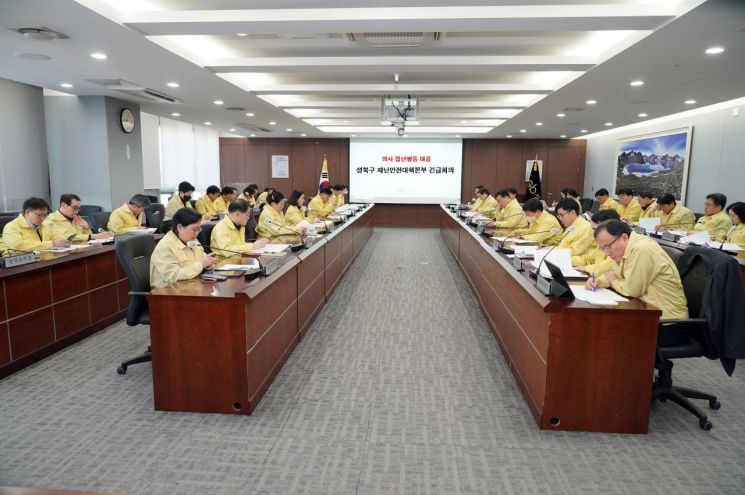 Seongbuk-gu held an "Emergency Disaster Safety Countermeasure Meeting" chaired by the district mayor on the 26th to review the emergency medical system maintenance and the emergency medical service system to minimize treatment gaps. (Photo by Seongbuk-gu Office)
Seongbuk-gu also held an 'Emergency Disaster Safety Countermeasure Meeting' on the 26th, chaired by the district mayor and attended by all district executives, to review the emergency medical system and minimize treatment gaps.
On the 23rd, Seongbuk-gu expanded its emergency health care countermeasures headquarters into a disaster safety countermeasures headquarters. It is composed of a total of 13 working groups, including disaster situation management, medical and quarantine services, and disaster recovery publicity.
Jungnang-gu elevated its emergency health care countermeasures headquarters, which had been operating since the 7th, to a disaster safety countermeasures headquarters on the 23rd, expanding its roles and organization. It continuously monitors the status of medical institution strikes within the region and responds to complaints such as patient inconvenience reports caused by the strikes. Furthermore, it is preparing emergency medical countermeasures for situations like private practitioners' strikes and maintains a cooperative system with related organizations such as the Jungnang Medical Association and Jungnang Fire Station.
Meanwhile, information on medical institutions that are open can be checked through the Emergency Medical Information Center E-GEN. Telephone guidance is available via the Dasan Call Center (120), Health and Welfare Call Center (129), 119 Emergency Situation Management Center (Fire Agency), National Health Insurance Service (1577-1000), and Health Insurance Review & Assessment Service (1644-2000) call centers.
© The Asia Business Daily(www.asiae.co.kr). All rights reserved.
![Clutching a Stolen Dior Bag, Saying "I Hate Being Poor but Real"... The Grotesque Con of a "Human Knockoff" [Slate]](https://cwcontent.asiae.co.kr/asiaresize/183/2026021902243444107_1771435474.jpg)












