The downward trend in housing prices in major advanced countries has hit bottom and is rebounding. As pivots (direction changes) by central banks around the world, including the U.S. Federal Reserve (Fed), are expected to fully take effect within the year, the real estate market, which had been suppressed by high interest rates, is also regarded as having reached a turning point.
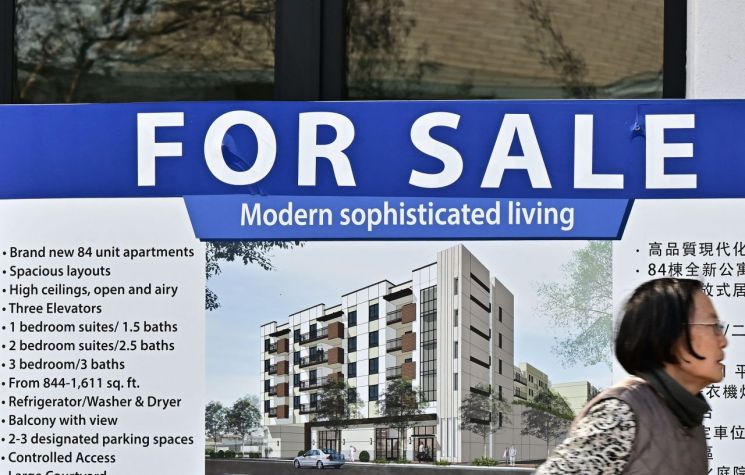
The Financial Times (FT) reported on the 25th (local time), analyzing data from the Organisation for Economic Co-operation and Development (OECD), that "the real estate markets in advanced countries are emerging from the largest downturn in a decade."
According to the report, nominal housing prices in the third quarter of last year rose by 2.1% compared to the previous quarter across 37 OECD member countries. Among these 37 countries, only about one-third experienced a decline in housing prices. This contrasts with the beginning of the year when more than half of the countries saw a downward trend. Considering inflation, the real housing prices of OECD member countries also shifted from negative to positive recently.
Andrew Wishart, Chief Real Estate Economist at Capital Economics, stated, "This suggests that the downward trend in housing prices has now bottomed out in most countries," adding, "a housing price adjustment has taken place."
Previously, the real estate markets in advanced countries were hit hard as mortgage rates soared due to rapid interest rate hikes by major central banks fighting inflation. At the end of 2022, when interest rate hikes were at their peak, the average housing price increase among OECD member countries was only 0.6% quarter-on-quarter, marking the lowest nominal increase since 2012. On a real basis, prices turned downward.
However, since the second half of last year, market sentiment changed as expectations for interest rate cuts spread. Although mortgage rates in the U.S. and the U.K. rose this month, they remain much lower than the peak levels recorded in 2023. With expectations that mortgage rates will decline in the future, the U.S. housing purchase sentiment index in January reached its highest level in about two years. Additionally, a reduction in the supply of existing homes in major advanced countries has also contributed to pushing up housing prices.
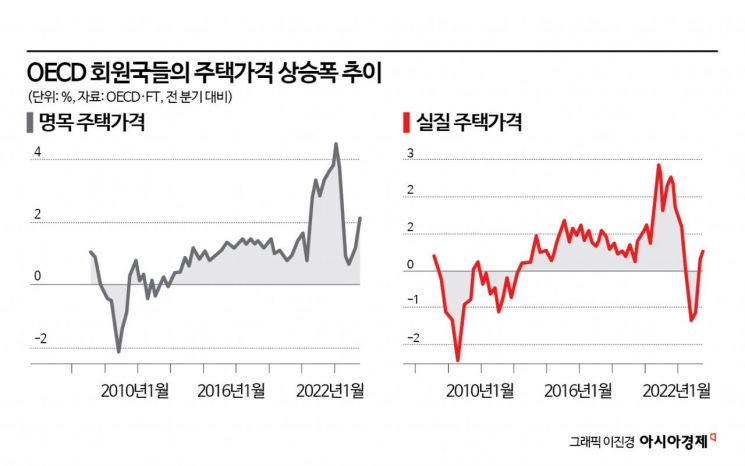
Currently, housing prices in most advanced countries are rising or stabilizing. FT reported that even countries showing some downward trends have reduced the magnitude of their declines. Thomas Bieleldek, an economist at T. Rowe Price, diagnosed that "in many countries, housing prices have bottomed out and are recovering or are close to the bottom." Wishart noted that additional declines may continue in countries with relatively large rental markets such as Germany, Denmark, and Sweden, but "even in these countries, the downward phase is almost over."
Looking at country-specific data, in the U.S., nominal housing prices rose 5.2% over the year through November last year, supported by a stronger-than-expected economy and labor market. Australia and New Zealand have also recently shown clear upward trends in housing prices. In the U.K., Canada, and others, upward pressure is confirmed due to immigration demand. FT added that South Korea also showed stabilization after housing prices bottomed out in mid-2023. In the European Union (EU), nominal housing prices rose 0.8% in the third quarter of last year, turning positive from the decline at the beginning of the year. However, on an annual basis, there was still a 1% decline.
Sylvain Broyer, Senior Economist at S&P Global Ratings, said, "Since mortgage rates remain high in some countries, the housing price adjustment in the EU is not yet over," but added, "the worst is behind us. The remaining period will see a gradual adjustment."
However, FT pointed out that a different atmosphere is observed in countries that are not OECD members. In China, the world's second-largest economy, despite successive stimulus measures announced by the authorities, a severe real estate downturn continues.
© The Asia Business Daily(www.asiae.co.kr). All rights reserved.
![Clutching a Stolen Dior Bag, Saying "I Hate Being Poor but Real"... The Grotesque Con of a "Human Knockoff" [Slate]](https://cwcontent.asiae.co.kr/asiaresize/183/2026021902243444107_1771435474.jpg)

















