Status of Parental Leave and Reduced Working Hours Users
Number of Parental Leave Users Decreased by 3.9%
Number of Users with Reduced Working Hours During Childcare Increased by 19.1%
Last year, the number of people taking parental leave decreased, but the number of users of reduced working hours during the childcare period increased significantly.
According to the Ministry of Employment and Labor on the 25th, the number of parental leave users last year was 126,008, down 5,076 (3.9%) from the previous year. This figure is based on those who received parental leave benefits through employment insurance, excluding public officials, teachers, and others who are not covered by employment insurance.
The slight decrease in parental leave users last year is explained by the Ministry of Labor as being due to an 8.1% decrease in the number of births from January to November last year compared to the previous year, as well as some postponing their leave usage to this year because of the expanded benefits for parental leave taken jointly by both parents starting January this year.
The Ministry of Employment and Labor stated, "Considering the scale of the decrease in births, the actual utilization rate of parental leave is on an increasing trend."
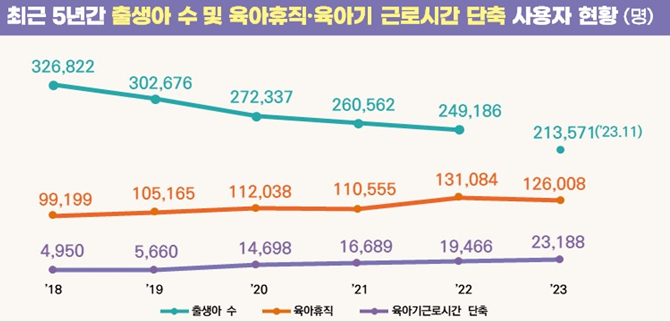
Among last year's leave users, 72.0% were women and 28.0% were men. The proportion of men rapidly increased from 8.7% in 2016 to 28.9% in 2022, then slightly decreased last year.
By the age of the child, 67.0% of leaves were taken during infancy under 1 year old, which is a 2.7 percentage point increase from the previous year.
For women, 77.9% took leave when their child was under 1 year old, often combined with maternity leave, while 39.0% of men took leave when their child was under 1 year old, and 19.2% used it when their child was 6 to 7 years old, the age of entering elementary school.
The average duration of leave was 8.9 months, with women averaging 9.5 months and men 7.5 months. Monthly, the number of parental leave users was somewhat higher in March and April, the school opening period, compared to other months.
By company size, 55.6% of all leave users belonged to small and medium-sized enterprises (SMEs), and 44.4% to large companies. The proportion of users from SMEs has steadily increased from 51.3% in 2019.
While the use of parental leave has stagnated, the number of users of reduced working hours during the childcare period has greatly increased. The childcare period reduced working hours system allows workers with children aged 8 or under, or in the 2nd grade of elementary school, to reduce their working hours to 15?35 hours per week for one year (up to two years if including periods not using parental leave). Last year, 23,188 people used this system, a 19.1% increase from the previous year.
Among users of this system, 64.4% were workers at SMEs. The proportion using it when their child was 0?1 years old was 28.6%, and 26.2% used it when their child was 6?7 years old. The average reduced working hours were 12.4 hours per week.
The government is currently pursuing legal amendments to extend the parental leave period (from 1 year to 1 year and 6 months), raise the eligible child age for reduced working hours during the childcare period (from 8 to 12 years old), and extend the maximum period (from 2 to 3 years) to promote a culture of shared parenting between parents.
Additionally, to revitalize work and childcare support systems in SMEs, the Ministry of Employment and Labor announced plans to create work-life balance happiness complexes, strengthen support for hiring replacement workers, and introduce subsidies for workload sharing related to reduced working hours during the childcare period.
© The Asia Business Daily(www.asiae.co.kr). All rights reserved.

















