Fuel prices, including gasoline, which surpassed 1,600 won per liter (ℓ) earlier this month, have been rising daily, prompting the government to take what is effectively a 'fuel price crackdown' to clearly establish a price stabilization policy. The government will operate an all-government petroleum market inspection team intensively for one month and conduct special inspections on some gas stations.
According to the Korea National Oil Corporation's oil price information system OPINET, as of the morning of the 24th, the nationwide average gasoline price was 1,632.84 won per liter, up 0.43 won from the previous day. Diesel was 1,534.58 won, up 0.15 won, and liquefied petroleum gas (LPG) was 970.48 won, down 0.1 won from the previous day.
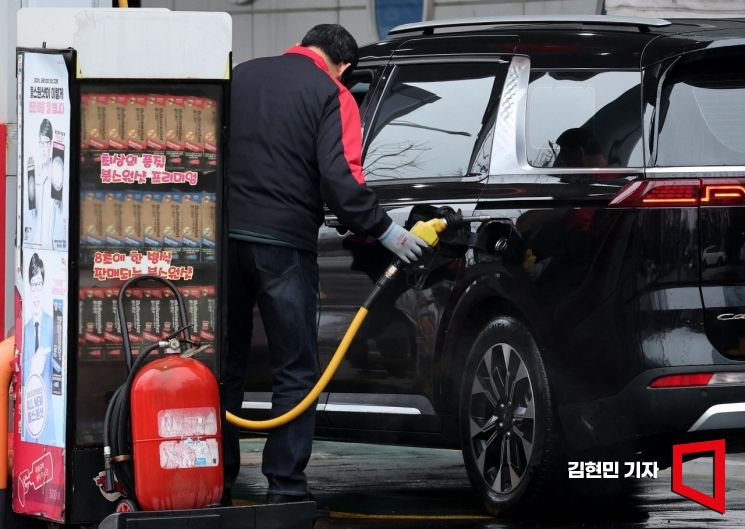 A gas station in downtown Seoul on the 19th. In response to signs of rising fuel prices, the government decided to extend the temporary fuel tax reduction, originally scheduled to end on the 29th of this month, by two months (until April 30). Photo by Hyunmin Kim kimhyun81@
Gasoline prices surpassed 1,600 won per liter earlier this month. According to OPINET's 'Domestic Petroleum Products Weekly Price Trends,' gas station gasoline prices recorded 1,609.5 won in the second week of February, exceeding the 1,600 won range for the first time in about two months. In the third week, prices rose 17.6 won from the previous week to 1,627.1 won. Diesel prices had already exceeded 1,500 won per liter in the first week of February, recording 1,501.0 won.
The government began inspecting gasoline prices considering public complaints that gasoline prices rise quickly when international oil prices increase but fall slowly when they decrease. On the 22nd, Choi Sang-mok, Deputy Prime Minister for Economy and Minister of Strategy and Finance, held a meeting on price stabilization issues with ministers and vice ministers of related ministries and decided to intensively operate the all-government petroleum market inspection team for one month starting that day until petroleum prices stabilize. The purpose is for related ministries to directly visit gas stations together to check whether there are excessive price increases beyond the rise in international oil prices.
The Ministry of Trade, Industry and Energy also held a 'Petroleum Market Inspection Meeting' the day before and decided to conduct special inspections on about 1,600 gas stations with a history of illegal petroleum distribution until June. The locations of gas stations involved in illegal activities will be publicly disclosed and expanded so that they can be displayed on navigation systems used by the public.
The rise in domestic fuel prices is due to the recent increase in international oil prices amid concerns over the expansion of conflicts in the Middle East. As the conflict prolongs and geopolitical uncertainties grow, the pressure for international oil prices to rise is expected to continue. However, recently, international oil prices have shown a downward trend due to weak demand. On the 23rd (local time), as the Federal Reserve's (Fed) rate cut prospects retreated, the price of West Texas Intermediate (WTI) crude oil for April delivery on the New York Mercantile Exchange fell by 2.7% in one day.
© The Asia Business Daily(www.asiae.co.kr). All rights reserved.
![Clutching a Stolen Dior Bag, Saying "I Hate Being Poor but Real"... The Grotesque Con of a "Human Knockoff" [Slate]](https://cwcontent.asiae.co.kr/asiaresize/183/2026021902243444107_1771435474.jpg)
















