Is Increasing Medical School Admissions the Solution?
"Healthcare System Facing Limits" vs. "Avoidance of Essential Departments Is the Core Issue"
Is the Scale of 2,000 Admissions Negotiable?
"Let's Meet and Discuss" vs. "We Must Be Flexible"
Concerns Over Declining Education Quality
"Expanding National Medical School Professors by 1,000" vs. "Difficulty in Recruiting Professors"
Avoidance of Essential Departments
"Gradual Increase in Fees" vs. "Even Matching Costs Will Revive Them"
On the 23rd, the government and the medical community, which are in extreme conflict over the increase in medical school admissions, held a live public debate. Park Min-su, the 2nd Vice Minister of the Ministry of Health and Welfare, and Kim Taek-woo, the Emergency Response Committee Chairman of the Korean Medical Association, clashed over key issues such as the necessity of increasing medical school admissions, the appropriateness of the scale of 2,000 students, and concerns about the decline in education quality after implementation during the 90-minute discussion on KBS 1TV's current affairs program 'Sasageongeon'. However, regarding the increase in medical school admissions, Vice Minister Park said, "Let's meet and discuss it as part of the overall package," and Chairman Kim responded, "If the government shows flexibility, we will negotiate," showing room for discussion.
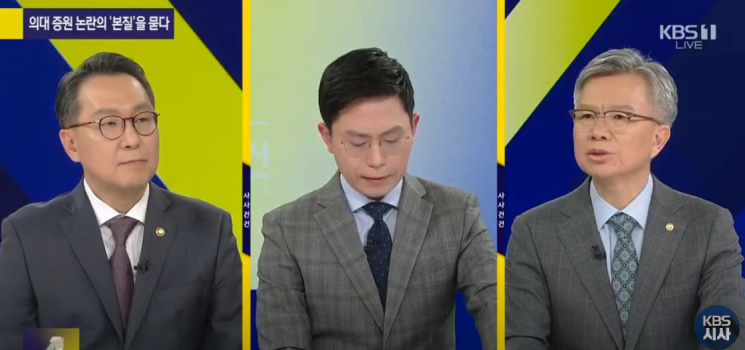
Is Increasing Medical School Admissions Necessary? "Healthcare System Facing Limits" vs. "Avoidance of Essential Departments is the Core Issue"
On that day, Vice Minister Park explained that the domestic healthcare system has reached its limits and that increasing medical school admissions is necessary. He said, "Due to aging, medical demand has greatly increased, but supply is limited, causing severe imbalance," adding, "This is reflected in long waiting times at large hospitals, patients traveling to Seoul for treatment, emergency room overcrowding, recruitment difficulties at regional hospitals, and resulting wage increases." Vice Minister Park stated, "Overall, these are phenomena caused by a shortage of doctors," and added, "Considering the trend of work-life balance in the medical community, working hours must also be reduced. It is difficult to solve this without increasing medical school quotas."
Chairman Kim countered, "Each country has different healthcare coverage systems and medical systems, but they say 'there are not enough doctors per population.' Is that really true?" He argued, "In other countries, waiting times for appointments often exceed a week, but our waiting times are not that long. While there is an oversupply of private practitioners and a slight shortage of employed doctors, this is not due to a shortage of doctors but rather a problem with the medical system and avoidance of essential departments."
Is There Room to Adjust the Scale of 2,000? "Let's Meet and Discuss" vs. "We Must Be Flexible"
The debate continued regarding the core issue of increasing medical school admissions by 2,000 students.
Chairman Kim pointed out, "The government can discuss the essential medical package, but the fact that it cannot concede even one step on the scale of 2,000 medical school admissions is an obstacle to medical negotiations." In response, Vice Minister Park said, "There are claims that the scale of 2,000 is too large, but the later the increase is delayed, the more we will have to increase the shortage of doctors later."
When asked by the moderator, "Does the number 2,000 mean you have no intention to concede?" Vice Minister Park replied, "(The scale of increase) is not a matter to be pushed and pulled through negotiation. It must be decided objectively and scientifically." He added, "The expansion of medical school admissions by 2,000 is also part of the 'Essential Medical Policy Package,'" and said, "We need to discuss whether to adjust the speed of increase or if there are other alternatives, but before discussing, the Korean Medical Association walked out of the negotiation table. Let's meet and discuss to solve this structured problem." Currently, the government holds the position that 2,000 is the minimum necessary scale of increase that cannot be reduced, but Vice Minister Park did not make such a statement at the debate.
Regarding Vice Minister Park's mention of meeting and discussing, Chairman Kim said, "If the government shows policy flexibility regarding the number of doctors, we can negotiate." He added, "I heard the government initially conveyed an increase of 350 students to the medical community. If the government shows policy flexibility on the scale of medical school admissions, we will sit at the negotiation table."
Regarding Chairman Kim's criticism that "none of the three government research reports supporting the increase mention the number 2,000," Vice Minister Park said, "The research reports are composed of 'scientific analysis' at the front and 'policy proposals' at the back, and the government decided the scale of increase based on scientific analysis." He explained that while the government refers to the analysis of research data when making policy decisions, it is not obligated to necessarily reflect individual researchers' proposals on the scale of increase.
Decline in Education Quality: "Expanding National Medical School Professors by 1,000" vs. "Difficulty in Recruiting Professors"
The debate also continued over claims that normal education would be difficult in medical schools, where one-on-one practice is important, if admissions increase by 2,000 students. Chairman Kim expressed concerns about the decline in education quality, saying, "It is really difficult to find basic medical science professors now."
In response, Vice Minister Park said, "It is fully possible to increase by 2,000 without a decline in education quality. Experts have also verified this." He added, "We are also discussing a plan to increase national medical school professors by 1,000."
Vice Minister Park said, "We are discussing ways to manage the quality of medical education by increasing the number of professors at national medical schools and having private universities invest through their foundations," and added, "From concerns raised in the field, one-on-one education between professors and students must be conducted, but if suddenly dozens of students enter due to the increase, it becomes impossible. Some universities already have a ratio of one student per three professors. We will sufficiently recruit professors to solve these problems."
Regarding Chairman Kim's point about the difficulty in recruiting basic medical science professors, Vice Minister Park acknowledged, "We know that medical students do not often choose basic medical science majors, which makes it difficult to secure professors," and stated, "We will pursue various measures to recruit basic medical science professors, including appointing majors from other related departments such as physiology, pathology, and pharmacology, which are not medical school graduates."
Avoidance of Essential Departments: "Gradual Increase in Fees" vs. "Even Matching Costs Will Revive Them"
The debate also addressed the causes of avoidance of essential departments.
Chairman Kim said, "Avoidance of essential departments is due to low fees," and added, "Surgical fees for essential departments are only about 80% of the treatment cost, but if fees are adjusted to match costs, essential medical care will revive." In response, Vice Minister Park said, "It is true that surgical and procedural fees are below cost," but added, "Fees for specimen tests and imaging diagnostics are set higher than 100% of costs, so it is important to balance overall fees."
Vice Minister Park said, "Rapidly increasing fees for childbirth, etc., has caused problems such as university hospital professors resigning and opening private clinics, so it is difficult to increase fees rapidly unconditionally," and added, "We will raise fees gradually." He said, "While resolving existing imbalances, we will separately focus investment on undervalued essential medical fees," and added, "We have planned '10 trillion won + α (alpha)' in new investments by 2028. The 10 trillion won is the basic amount, and the plus alpha part will be additional budget support."
© The Asia Business Daily(www.asiae.co.kr). All rights reserved.
![Clutching a Stolen Dior Bag, Saying "I Hate Being Poor but Real"... The Grotesque Con of a "Human Knockoff" [Slate]](https://cwcontent.asiae.co.kr/asiaresize/183/2026021902243444107_1771435474.jpg)
















